





























The digital payments industry is evolving faster than ever, and in 2026, one innovation is beginning to reshape the entire ecosystem: Agentic AI. Unlike traditional AI systems that simply analyze data or offer recommendations, Agentic AI goes a step further. It can make decisions, perform multi-step actions, automate transactions, and interact across systems with minimal human intervention.
This is a major leap for the payments industry. The opportunity is massive. Global payments revenue is projected to grow to $2.4 trillion by 2029, according to new research from Boston Consulting Group (BCG). As transaction volumes rise and customer expectations continue to shift toward faster, safer, and more intelligent payment experiences, businesses can no longer rely solely on traditional payment systems.
Key Highlights
- Agentic AI can understand context, make decisions, and take action, making payment processes more dynamic and efficient.
- Businesses that reduce friction at checkout through AI-powered payment experiences will be better positioned to improve conversions and strengthen customer satisfaction.
- Agentic AI can identify suspicious behavior in real time and intervene before fraudulent transactions are completed, offering stronger protection than traditional rule-based systems.
- By analyzing real-time payment conditions, Agentic AI can choose the most effective transaction path and reduce failed payments, false declines, and revenue leakage.
- Consumers increasingly expect payment journeys that adapt to their behavior, financial preferences, and goals. Agentic AI makes this level of personalization possible at scale.
- The success of Agentic AI in payments will rely on strong security, regulatory compliance, clear user consent, transparent decision-making, and responsible implementation.
What Is Agentic AI in Digital Payments?
Agentic AI refers to advanced AI systems that are designed not only to analyze and recommend but also to take action. These systems can understand user intent, evaluate real-time data, make contextual decisions, and trigger the next best step across multiple platforms.
In the digital payments space, this means AI is no longer limited to flagging suspicious transactions or suggesting offers. Instead, it can automatically choose the most suitable payment method, optimize transaction routing, prevent fraud before a payment is authorized, manage recurring billing intelligently, and even execute transactions on behalf of users within defined rules and approvals.
This shift is extremely important because digital payments have become more complex than ever before. Payment ecosystems today must handle real-time approvals, fraud prevention, tokenization, cross-border transactions, dispute resolution, user authentication, merchant risk evaluation, and seamless customer experiences, all at scale. Traditional rule-based systems struggle to keep up with this level of complexity, but Agentic AI can respond dynamically.
How Is Agentic AI Transforming Digital Payments?
Agentic AI is revolutionizing digital payments by enabling smarter fraud detection, autonomous transactions, intelligent payment routing, and personalized user experiences, helping businesses create faster, safer, and more efficient financial ecosystems.
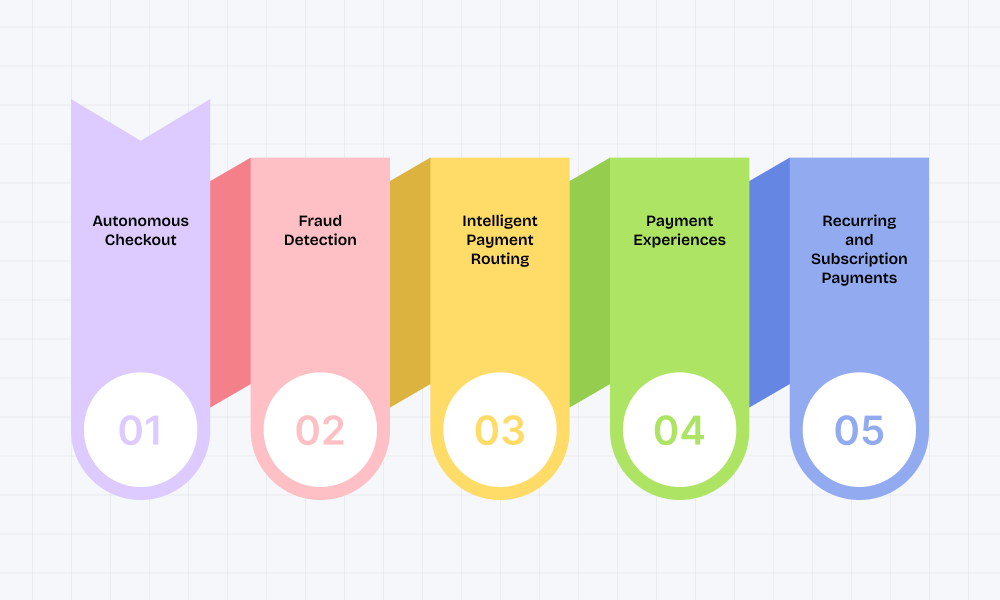
1. Autonomous Checkout
Autonomous checkout is transforming how customers complete transactions by reducing manual effort and making the buying process faster and more seamless. With Agentic AI, users can rely on intelligent systems to handle everything from product selection to final payment within defined preferences.
- Automates product search, comparison, and purchase decisions based on user-defined criteria.
- Reduces checkout friction, leading to lower cart abandonment rates and higher conversions.
- Enhances user experience by minimizing manual input and streamlining transactions.
- Enables secure, fast, and personalized purchasing within user-approved limits.
2. Fraud Detection
Fraud detection in digital payments is evolving as cyber threats become more advanced and sophisticated. Agentic AI introduces a proactive approach by identifying risks before transactions are completed, ensuring stronger security and trust.
- Continuously monitors user behavior, device signals, and transaction patterns in real time.
- Detects advanced fraud tactics like phishing, deepfakes, and synthetic identities.
- Prevents fraudulent transactions before authorization instead of reacting afterward.
- Strengthens payment security while reducing false positives and customer friction.
3. Intelligent Payment Routing
Payment failures can negatively impact customer trust and business revenue. Agentic artificial intelligence improves this by intelligently selecting the best payment route, ensuring higher success rates and smoother transactions.
- Analyzes real-time data such as issuer behavior, location, and transaction type.
- Selects optimal payment gateways to increase authorization success rates.
- Reduces failed transactions and false declines during checkout.
- Improves operational efficiency and boosts overall revenue for businesses.
4. Payment Orchestration
Payment orchestration is the centralized coordination of all payment-related processes through a single intelligent layer. Instead of managing gateways, processors, fraud tools, and retry logic separately, an orchestration layer brings them together so the system can make smarter, taster decisions at every step of a transaction.
Agentic Al takes orchestration further by dynamically selecting the right combination of providers, rules, and flows based on real-time signals such as transaction type, geography, risk score, and cost efficiency.
- Connects and manages personalizes payment methods and processors through a single layer.
- Dynamically selects the best provider combination for each transaction.
- Applies real-time rules for routing, retries, fallback logic, and compliance.
- Reduces dependency on a single payment provider and improves system resilience.
5. Recurring and Subscription Payments
Recurring payments play a crucial role in modern digital services, but they often face issues like failures and churn. Agentic AI helps optimize subscription management by predicting and resolving potential issues in advance.
- Predicts potential payment failures and takes preventive actions proactively.
- Suggests alternative payment methods or retry strategies for failed transactions.
- Sends timely reminders and notifications before subscription renewals.
- Reduces customer churn by identifying risks and recommending retention strategies.
Benefits of Agentic AI in Digital Payments
Agentic AI is redefining how digital payments operate by introducing intelligent automation, real-time decision-making, and personalized financial experiences. It enables businesses to move beyond traditional systems and deliver faster, safer, and more efficient payment solutions that align with modern user expectations.
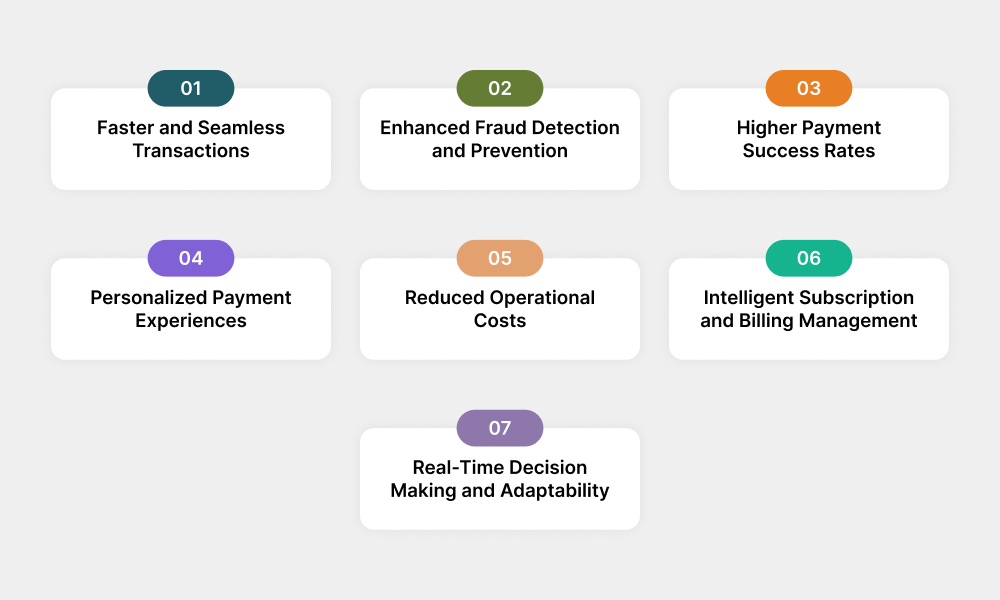
1. Faster and Seamless Transactions
Agentic AI significantly improves transaction speed by automating multiple steps involved in the payment process. From selecting the best payment method to completing authorization, everything happens in real time with minimal delays. This reduces checkout time, eliminates friction, and ensures a smooth and seamless experience for users across all digital platforms.
2. Enhanced Fraud Detection and Prevention
Security is one of the biggest advantages of Agentic AI. It continuously monitors user behavior, transaction history, device signals, and risk patterns to detect suspicious activity. Instead of reacting after fraud occurs, it proactively prevents unauthorized transactions, helping businesses build trust and protect sensitive financial data.
3. Higher Payment Success Rates
Agentic AI improves payment success by intelligently routing transactions through the most reliable channels. It analyzes factors like issuer performance, location, and transaction type to reduce failures and false declines. This ensures more transactions are completed successfully, leading to increased revenue and improved customer satisfaction.
4. Personalized Payment Experiences
Modern users expect tailored experiences, and Agentic AI in payment makes this possible by understanding individual preferences and financial behavior. It can recommend the best payment methods, offer relevant discounts, suggest installment plans, and optimize loyalty rewards, creating a more engaging and user-centric payment journey.
5. Reduced Operational Costs
By automating repetitive and complex payment processes, Agentic AI reduces the need for manual intervention and support. This helps businesses lower operational costs, minimize errors, and improve overall efficiency. It also allows teams to focus on strategic tasks instead of routine payment management.
6. Intelligent Subscription and Billing Management
Agentic AI enhances recurring payment systems by predicting potential failures, suggesting alternative payment methods, and optimizing retry attempts. It can also identify customers at risk of churn and recommend retention strategies, helping businesses maintain steady revenue and improve long-term customer relationships.
7. Real-Time Decision Making and Adaptability
One of the most powerful benefits of Agentic AI is its ability to make real-time decisions based on dynamic conditions. Whether it is adjusting payment flows, managing risk, or selecting the best transaction route, it adapts instantly to changing scenarios. This flexibility ensures more reliable, efficient, and future-ready payment systems.
Challenges Associated with AI in Digital Payments
As Agentic AI continues to reshape digital payments, businesses must carefully navigate security, compliance, data privacy, user trust, legacy infrastructure, and automation risks to ensure smooth and responsible adoption.
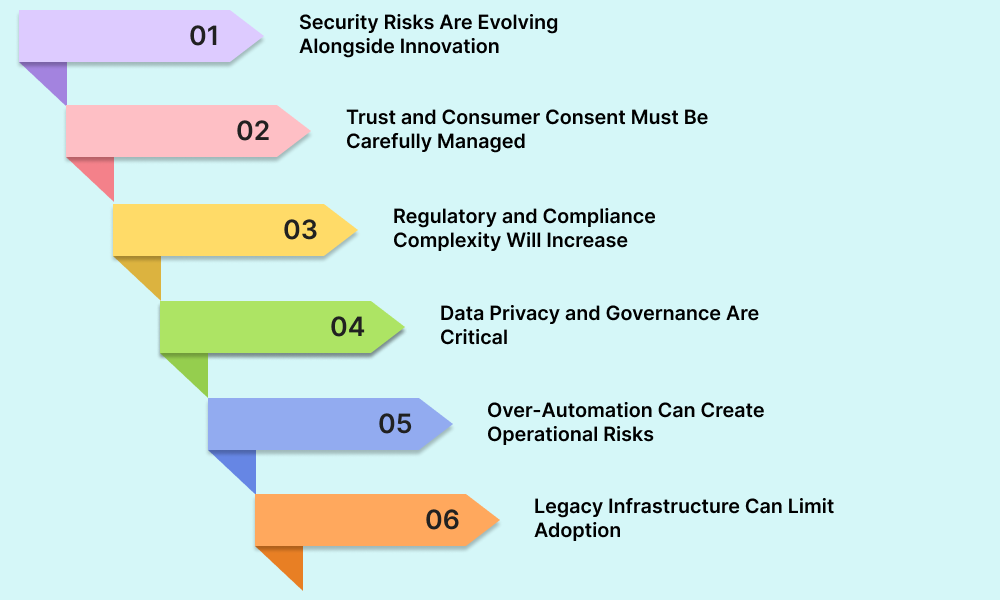
1. Security Risks Are Evolving Alongside Innovation
While Agentic AI in payment can significantly improve fraud prevention, it also creates new attack surfaces. Fraudsters can use AI tools for phishing, deepfake verification attempts, identity spoofing, and social engineering. This means businesses must understand that AI is both a defensive tool and a potential threat vector. The challenge is not simply adopting AI, but building layered security models that combine behavioral analysis, authentication, device intelligence, tokenization, and continuous monitoring.
2. Trust and Consumer Consent Must Be Carefully Managed
If AI is going to initiate or influence transactions, users must know exactly what the system is allowed to do. They need confidence that the AI will only act within approved boundaries and that they can easily change permissions or revoke access.
Without clear consent models and transparent controls, customers may hesitate to trust AI-powered payment systems. This makes user education and interface design just as important as the technology itself.
3. Regulatory and Compliance Complexity Will Increase
The payments industry is already heavily regulated, and Agentic AI introduces a new layer of complexity. Questions around liability, explainability, delegated authority, data usage, and auditability will become more important as AI systems take on greater responsibility. Businesses will need to ensure that their AI-driven payment systems comply with financial regulations, privacy laws, security standards, and regional requirements. They must also be prepared to explain how an AI system made a decision when disputes or compliance reviews occur.
Also Read: A Complete Guide to Payment App Development?
4. Data Privacy and Governance Are Critical
Payment data is among the most sensitive types of digital information. Any AI system working with payment data must be built on strong governance principles. This includes secure access controls, tokenization, encryption, data minimization, monitoring, and compliance with privacy regulations. Poor governance can lead to reputational damage, legal exposure, and loss of customer trust. As a result, organizations cannot treat Agentic AI as just another feature. It must be supported by enterprise-grade governance frameworks.
5. Over-Automation Can Create Operational Risks
Not every payment decision should be fully automated. High-value transactions, complex disputes, compliance escalations, and unusual risk events may still require human review. Over-automation can create mistakes that are difficult to reverse, especially when financial transactions are involved. The best AI payment systems will combine automation with human oversight. This human-in-the-loop approach ensures that efficiency does not come at the cost of accountability or customer protection.
6. Legacy Infrastructure Can Limit Adoption
Many financial institutions and businesses still operate on outdated payment infrastructures that were not designed for intelligent orchestration. Legacy systems often rely on rigid workflows, siloed data, limited APIs, and poor interoperability. Agentic AI performs best in modern, API-first, event-driven environments. For many organizations, the biggest challenge may not be the AI itself, but the need to modernize the underlying payment architecture so that intelligent automation can function effectively.
The Future of Digital Payments
The future of digital payments will be shaped by three powerful themes: intelligence, autonomy, and trust. Over the next few years, payment systems will become far more AI-native. Users will interact less with traditional checkout forms and more with intelligent assistants that can understand intent and act on their behalf. This does not mean users will lose control. In fact, the most successful payment experiences will be those that combine automation with clear permissions, limits, and transparency.
We are likely to see a growing adoption of trusted agent frameworks, where AI systems are verified, tokenized, and authorized to perform specific payment tasks within defined boundaries. This will create a new layer of payment infrastructure built around delegated trust and secure automation. Another important shift will be the rise of invisible payments. In many cases, transactions will happen in the background as part of a broader digital experience. Whether it is a subscription renewal, a smart device reorder, a logistics platform settlement, or a voice-assisted purchase, the payment itself will become less visible - but more intelligently managed. Machine-to-machine payments may also become more common in the long term. Software agents could autonomously pay for APIs, cloud resources, digital assets, or service usage without human intervention, opening new possibilities for digital ecosystems.
Conclusion
At ToXSL Technologies, we believe Agentic AI is not just a futuristic concept, it is the next major evolution of digital payments. We help startups, enterprises, and fintech brands build secure, scalable, and future-ready digital payment solutions powered by advanced technologies. Whether you are looking to develop a fintech app, modernize your payment infrastructure, or integrate AI into your financial workflows, our team can help you create intelligent payment systems built for tomorrow.
The future of digital payments is autonomous, personalized, and data-driven - and the time to build for that future is now. Contact us for more information.
Frequently Asked Questions
1. What is Agentic AI in digital payments?
Agentic AI in digital payments refers to advanced AI systems that can make decisions and perform payment-related tasks automatically. Unlike traditional AI, which mainly supports analytics or alerts, Agentic AI can actively optimize payment flows, prevent fraud, manage subscriptions, and even execute transactions within approved limits.
2. How is Agentic AI different from traditional AI in the payments industry?
Traditional AI is usually focused on identifying patterns, generating recommendations, or automating repetitive tasks. Agentic AI goes beyond that by taking action based on context and real-time conditions. It can evaluate payment scenarios, decide what should happen next, and carry out those actions across connected systems.
3. How does Agentic AI improve fraud detection in digital payments?
Agentic AI improves fraud detection by analyzing real-time behavior, transaction context, device data, and customer patterns before a payment is approved. Instead of only reacting after a suspicious event occurs, it can proactively identify risk and intervene early, which makes fraud prevention faster and more effective.
4. Can Agentic AI improve payment success rates for businesses?
Yes, Agentic AI can significantly improve payment success rates by intelligently routing transactions based on issuer behavior, processor performance, customer location, and other real-time factors. This reduces false declines, lowers transaction failures, and helps businesses recover more revenue from completed payments.
5. What are the biggest challenges of using AI in digital payments?
The biggest challenges include data privacy, regulatory compliance, evolving fraud threats, legacy payment infrastructure, consumer trust, and the risks of over-automation. Businesses must ensure that AI systems are secure, transparent, and supported by proper governance and human oversight.
6. Why should businesses invest in Agentic AI for the future of digital payments?
Businesses should invest in Agentic AI because it improves efficiency, strengthens security, enhances customer experiences, and prepares payment systems for the future of autonomous commerce. As digital payments continue to grow globally, companies that adopt intelligent payment infrastructure early will gain a stronger competitive advantage.