




























According to the latest market analysis, the global cross-platform app development framework market is projected to reach US$ 369.2 million by 2032, reflecting the increasing demand for efficient, scalable, and cost-effective mobile app development solutions. The market is expected to expand significantly over the forecast period, with leading frameworks such as Flutter and React Native driving widespread adoption.
As businesses strive to accelerate digital transformation while optimizing development costs, Flutter has emerged as one of the most preferred frameworks for building high-performance cross-platform applications. Its single codebase approach, native-like performance, rich widget ecosystem, and faster development cycle enable organizations to create feature-rich applications for Android, iOS, web, and desktop platforms without compromising quality or user experience.
In this comprehensive guide, we'll explore everything you need to know about Flutter app development, including its key features, advantages, development process, industry use cases, best practices, and why it has become a leading choice for businesses looking to build modern, scalable, and future-ready cross-platform applications.
Key Takeaways
- Flutter enables businesses to build Android, iOS, web, and desktop applications using a single codebase.
- Hot Reload significantly speeds up development, testing, and deployment.
- Flutter delivers near-native performance with visually stunning and highly customizable interfaces.
- Businesses can reduce development costs while reaching multiple platforms simultaneously.
- Flutter is ideal for startups, SMEs, and enterprises looking for scalable and future-ready applications.
Why Flutter Has Become the Top Choice for Modern Business App Development
Businesses today need mobile applications that are fast, cost-effective, scalable, and capable of delivering a seamless user experience across multiple platforms. Flutter has emerged as one of the most preferred cross-platform development frameworks because it allows companies to build high-performance applications from a single codebase.
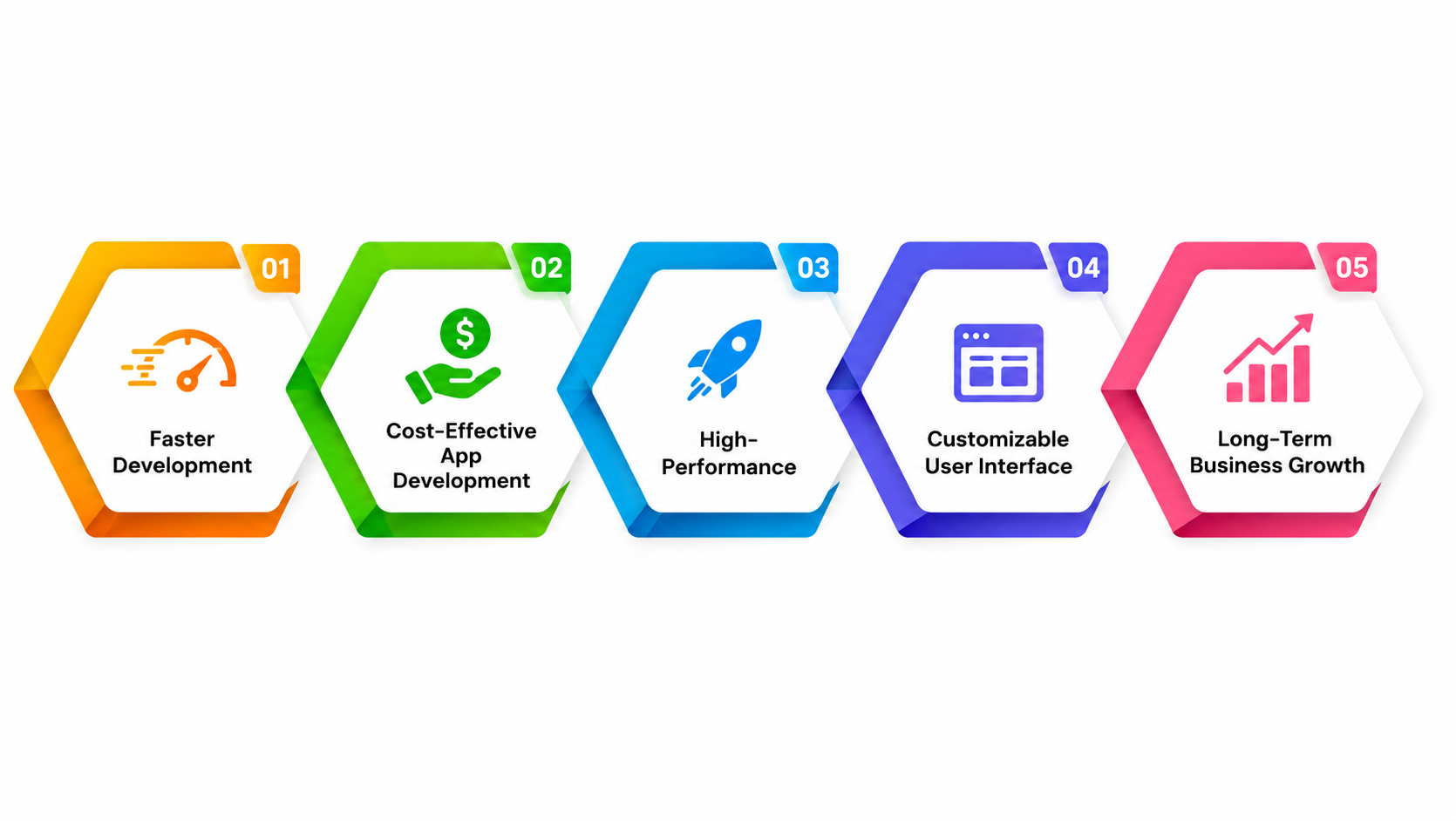
1. Faster Development
Flutter enables developers to write one codebase that works seamlessly on both Android and iOS platforms. This eliminates the need to build and maintain separate applications, significantly reducing development time while ensuring consistent functionality and design across devices.
2. Cost-Effective App Development
Developing separate native applications can be expensive for businesses. Flutter minimizes development costs by allowing a single development team to create applications for multiple platforms, reducing resource requirements while maintaining exceptional app quality and performance.
3. High-Performance
Flutter uses its own rendering engine and compiles directly into native machine code, allowing applications to deliver smooth animations, quick loading times, and responsive user interactions. This ensures an experience that closely matches fully native applications.
4. Customizable User Interface
Flutter offers a rich collection of customizable widgets that help developers build visually appealing and highly interactive interfaces. Businesses can create unique brand experiences while maintaining consistent design across different operating systems and screen sizes.
5. Long-Term Business Growth
Flutter is designed to support applications of all sizes, from startup MVPs to enterprise-grade solutions. Its flexible architecture and strong ecosystem make it easier to add new features, integrate APIs, and scale applications as business requirements evolve.
Essential Features That Make Flutter App Development Stand Out
Flutter has transformed cross-platform mobile app development by offering a powerful framework that combines speed, performance, flexibility, and scalability. Backed by Google's robust ecosystem, Flutter enables developers to create visually stunning, feature-rich, and high-performing applications using a single codebase.
1. Single Codebase for Multiple Platforms
One of Flutter's biggest strengths is its ability to build applications for Android, iOS, web, desktop, and even embedded devices using a single codebase. This significantly reduces development complexity while ensuring consistent functionality and user experience across all supported platforms.
- Develop apps for Android and iOS simultaneously.
- Reduce duplicate coding and development efforts.
- Maintain consistent features across platforms.
- Simplify future updates and maintenance.
2. Hot Reload for Faster Development
Flutter's Hot Reload feature allows developers to instantly view code changes without restarting the application. This accelerates development, simplifies debugging, and enables faster UI experimentation, resulting in shorter development cycles and improved productivity.
- Instantly preview code modifications.
- Speed up testing and debugging.
- Improve developer productivity.
- Accelerate overall project delivery.
3. Rich Collection of Customizable Widgets
Flutter comes with an extensive library of pre-built widgets that help developers create highly responsive and visually appealing user interfaces. These widgets can be easily customized to match business branding and provide a seamless experience across different devices.
- Access hundreds of ready-to-use widgets.
- Customize interfaces to reflect brand identity.
- Create responsive layouts for multiple screen sizes.
- Deliver engaging and interactive user experiences.
4. Native-Like Performance
Unlike many hybrid frameworks, Flutter compiles directly into native machine code and uses its own rendering engine. This allows applications to deliver smooth animations, fast loading times, and exceptional responsiveness comparable to native mobile applications.
- Achieve smooth animations and transitions.
- Deliver faster application performance.
- Reduce latency during user interactions.
- Enhance overall user satisfaction.
5. Expressive and Flexible UI Design
Flutter empowers developers to build unique and modern interfaces with complete design flexibility. Whether creating Material Design for Android or Cupertino-style interfaces for iOS, Flutter ensures a consistent and visually appealing user experience.
- Support Material and Cupertino design systems.
- Build highly customized application interfaces.
- Create visually consistent cross-platform designs.
- Improve brand recognition through personalized UI.
6. Strong API and Third-Party Integration Support
Flutter seamlessly integrates with REST APIs, cloud platforms, payment gateways, authentication systems, and third-party SDKs. This flexibility allows businesses to develop feature-rich applications that easily connect with existing software ecosystems.
- Integrate payment gateways effortlessly.
- Connect with cloud platforms and databases.
- Support authentication and social logins.
- Extend functionality using third-party plugins.
Top Advantages of Flutter App Development for Modern Businesses
Flutter has become one of the leading cross-platform development frameworks because it enables businesses to build fast, scalable, and visually engaging applications with reduced development time and cost.
1. Reduced Development Time
Flutter enables developers to create applications for multiple platforms using a single codebase, significantly reducing development time. Features like Hot Reload further speed up coding, testing, and debugging, allowing businesses to launch products faster and respond quickly to changing market demands.
2. Lower Development Costs
Using one codebase for Android and iOS eliminates the need for separate development teams. Businesses can save significantly on development, testing, maintenance, and future upgrades while maintaining consistent quality across all supported platforms.
3. Native-Like Performance
Flutter compiles directly into native machine code and uses its own high-performance rendering engine. This enables applications to deliver smooth animations, faster loading times, responsive interactions, and an experience that closely matches native mobile applications.
4. Consistent User Experience
Flutter ensures that applications look and behave consistently across Android, iOS, web, and desktop platforms. Its extensive widget library helps maintain uniform design standards while adapting seamlessly to different screen sizes and operating systems.
5. Highly Customizable User Interface
Flutter provides a rich collection of customizable widgets that enable developers to create attractive, interactive, and brand-focused interfaces. Businesses can build unique application designs without relying heavily on platform-specific components.
6. Faster Time-to-Market
Businesses can quickly transform ideas into fully functional applications using Flutter's efficient development process. Shorter development cycles allow companies to gain a competitive advantage by launching products ahead of competitors.
Step-by-Step Flutter App Development Process for Building Cross-Platform Applications
A well-structured Flutter app development process ensures the creation of high-quality, scalable, and user-friendly applications that meet business objectives. From planning and UI/UX design to development, testing, deployment, and ongoing maintenance, every stage plays a crucial role in delivering a high-performance cross-platform application that provides an exceptional user experience across multiple devices.
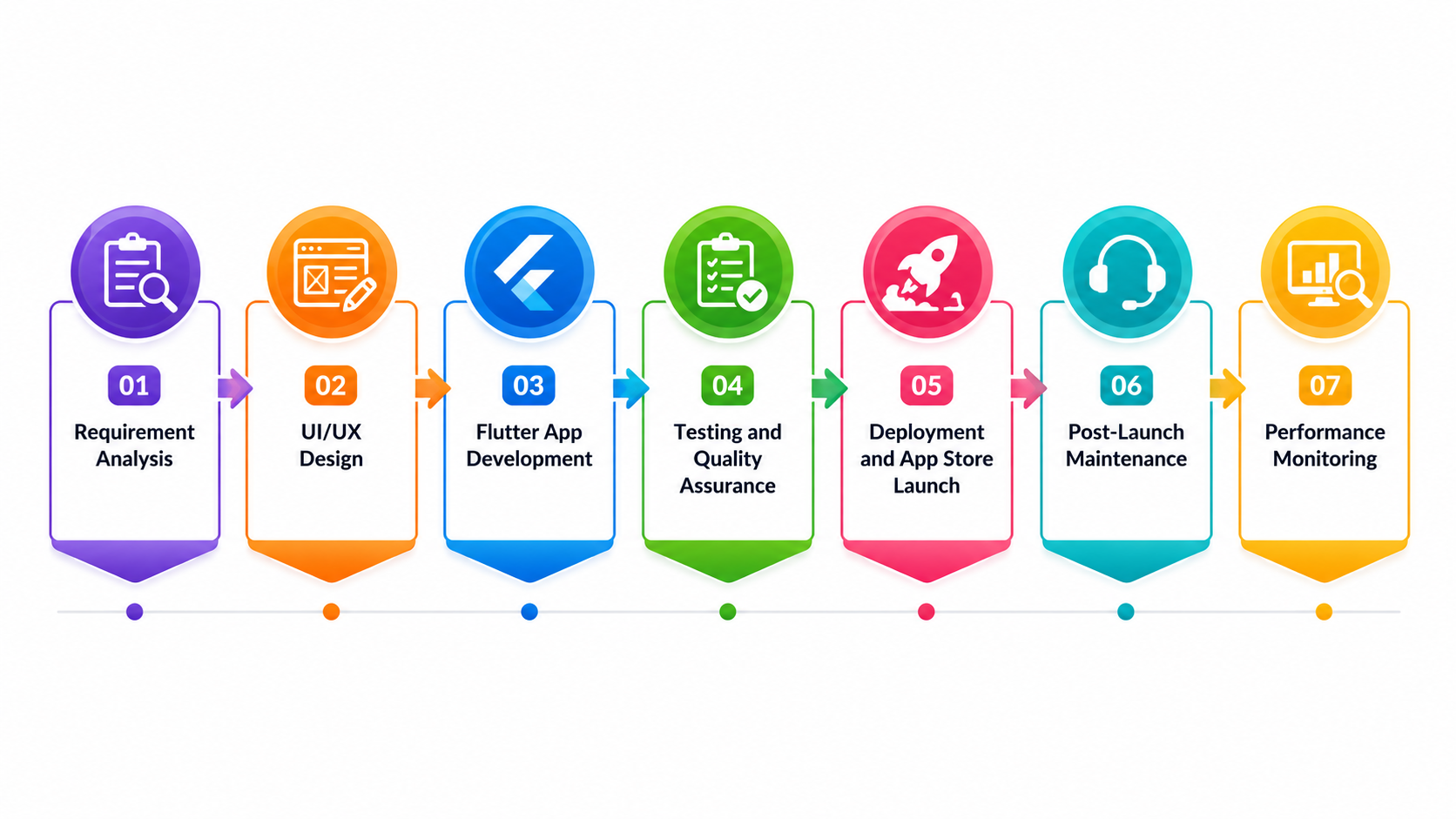
1. Requirement Analysis
Every successful Flutter application begins with a detailed analysis of business objectives, target audience, technical requirements, and project scope. Proper planning helps define the application's features, technology stack, development timeline, and budget while minimizing risks during the development lifecycle.
2. UI/UX Design
The design phase focuses on creating intuitive wireframes, interactive prototypes, and visually engaging user interfaces. Flutter's rich widget library allows designers and developers to build responsive, user-friendly interfaces that deliver a consistent experience across Android and iOS platforms.
3. Flutter App Development
Once the designs are finalized, developers begin coding using Flutter's single codebase architecture. Core functionalities, APIs, databases, authentication systems, and third-party integrations are implemented while maintaining clean, scalable, and reusable code for future enhancements.
4. Testing and Quality Assurance
Comprehensive testing ensures the application performs flawlessly across multiple devices and operating systems. Functional, usability, performance, security, and compatibility testing help identify bugs early and ensure a reliable, stable, and secure application before launch.
5. Deployment and App Store Launch
After successful testing, the application is prepared for deployment on Google Play Store and Apple App Store. Developers optimize the application, configure store listings, complete compliance requirements, and publish the app for users worldwide.
6. Post-Launch Maintenance
The development journey continues after deployment with regular monitoring, bug fixes, feature enhancements, and performance optimization. Continuous updates help improve security, user satisfaction, and compatibility with evolving operating systems and business requirements.
7. Performance Monitoring
Tracking user behavior and application performance helps businesses make informed decisions for future improvements. Analytics tools provide valuable insights into user engagement, feature usage, crash reports, and overall application performance.
Top Real-World Use Cases of Flutter App Development Across Industries
Flutter's versatility, speed, and cross-platform capabilities make it an ideal framework for developing a wide variety of mobile, web, and desktop applications. From startups launching innovative products to enterprises modernizing their digital services, Flutter supports scalable, feature-rich, and high-performance solutions across multiple industries. Its ability to deliver native-like performance with a single codebase makes it a preferred choice for businesses worldwide.
1. E-Commerce and Online Shopping Apps
Flutter enables businesses to build feature-rich e-commerce applications with intuitive navigation, secure payment gateways, real-time inventory management, personalized recommendations, and seamless checkout experiences. Its responsive UI ensures consistent shopping experiences across Android and iOS devices.
2. Healthcare and Telemedicine Applications
Healthcare providers use Flutter to create telemedicine platforms, appointment booking systems, electronic health record (EHR) applications, fitness app, and remote patient monitoring solutions. Flutter ensures secure data handling and delivers responsive experiences for both patients and healthcare professionals.
3. FinTech and Digital Banking Applications
Flutter is widely adopted for developing secure financial applications such as digital wallets, online banking platforms, investment apps, and payment solutions. It supports robust encryption, biometric authentication, and seamless integration with financial APIs.
4. Food Delivery and Restaurant Apps
Restaurants and food delivery businesses leverage Flutter to build applications with real-time order tracking, menu management, GPS navigation, online payments, and customer loyalty programs. The framework delivers smooth performance even during high user traffic.
5. Taxi Booking and Ride-Sharing Apps
Flutter is an excellent choice for developing ride-hailing applications with GPS tracking, route optimization, fare estimation, driver-passenger communication, and secure payment integration. It ensures fast performance and real-time location updates.
6. Education and E-Learning Platforms
Educational institutions and EdTech companies use Flutter to create interactive elearning applications with live classes, video streaming, quizzes, assignments, and progress tracking. The framework supports engaging user experiences across multiple devices.
Flutter vs Native App Development
Choosing between Flutter and native app development depends on your business goals, budget, timeline, and performance requirements. Flutter is an excellent choice for businesses looking to build high-quality cross-platform applications using a single codebase, reducing development time and costs.
Feature | Flutter App Development | Native App Development |
|---|---|---|
Codebase | Single codebase for Android, iOS, web, and desktop | Separate codebases for Android and iOS |
Development Speed | Faster development with reusable code | Slower due to platform-specific development |
Development Cost | Lower overall development and maintenance costs | Higher cost because separate teams are required |
Performance | Near-native performance with smooth UI | Best possible platform-specific performance |
User Interface | Consistent UI across all platforms with customizable widgets | UI follows each platform's native design guidelines |
Time-to-Market | Faster product launch | Longer development and release cycles |
Maintenance | Easier to maintain a single codebase | Updates must be implemented separately for each platform |
Hot Reload | Supports Hot Reload for rapid testing and debugging | Does not offer a similar built-in feature |
Platform Compatibility | Android, iOS, Web, Windows, macOS, and Linux | Limited to the platform it is developed for |
Access to Device Features | Supports most native features through plugins and platform channels | Direct access to all platform-specific APIs and hardware features |
Scalability | Highly scalable for startups and enterprise applications | Highly scalable but requires separate scaling efforts for each platform |
Third-Party Integration | Extensive plugin ecosystem with easy API integration | Full access to native SDKs and third-party libraries |
Best For | Cross-platform apps, startups, MVPs, enterprise solutions, and cost-efficient development | High-performance gaming, graphics-intensive apps, and platform-specific applications |
Overall Business Value | Faster delivery, lower costs, and wider platform reach | Maximum performance and complete control over platform capabilities |
Best Practices for Flutter App Development
Building a successful Flutter application requires more than choosing the right framework. Following industry best practices helps developers create applications that are scalable, secure, maintainable, and high-performing.
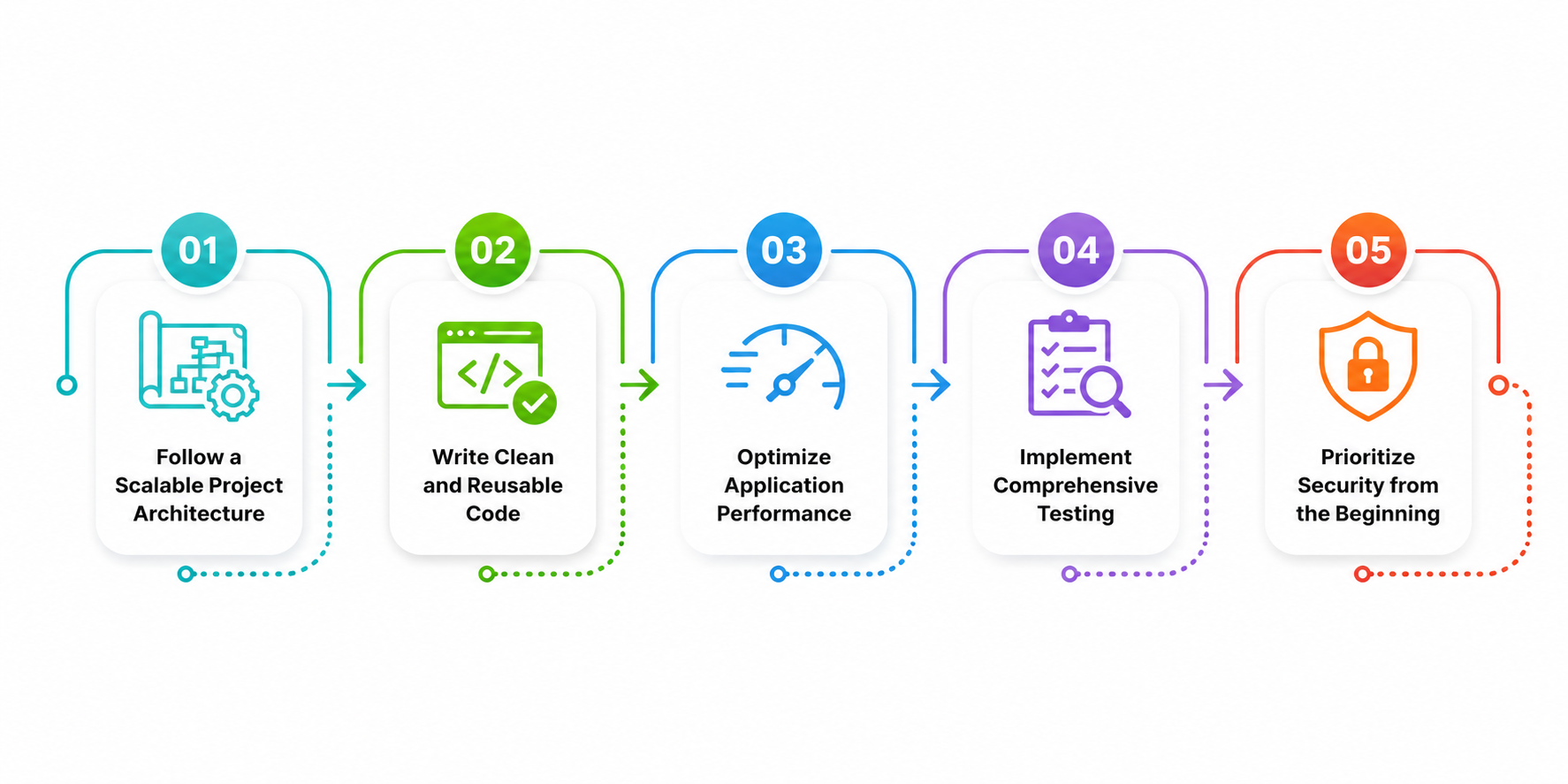
1. Follow a Scalable Project Architecture
Adopt a well-structured architecture such as MVVM, Clean Architecture, or BLoC to organize your code effectively. A scalable architecture improves maintainability, simplifies debugging, supports team collaboration, and makes it easier to add new features as the application grows.
2. Write Clean and Reusable Code
Use modular components, reusable widgets, and consistent coding standards to keep your codebase organized. Clean code enhances readability, minimizes duplication, reduces technical debt, and allows developers to maintain and update the application more efficiently.
3. Optimize Application Performance
Reduce unnecessary widget rebuilds, optimize image assets, use lazy loading, and efficiently manage memory usage. Performance optimization ensures faster loading times, smoother animations, and a responsive user experience across various devices and operating systems.
4. Implement Comprehensive Testing
Perform unit testing, widget testing, integration testing, and user acceptance testing throughout the development lifecycle. Thorough testing helps identify bugs early, improves application stability, and ensures consistent functionality before deployment.
5. Prioritize Security from the Beginning
Protect sensitive user information through secure authentication, encrypted data storage, API security, and proper permission management. Incorporating security best practices minimizes vulnerabilities and builds trust among users and business stakeholders.
Why Choose Flutter for Your Next Mobile App?
Choosing the right development framework directly impacts your project's success. Flutter stands out because it combines speed, flexibility, cost-effectiveness, and outstanding user experience in a single solution.
Whether you're building a startup MVP, an enterprise application, an eCommerce platform, a healthcare solution, or a FinTech product, Flutter enables faster development without compromising quality or performance.
Its single codebase, extensive widget library, near-native speed, and seamless scalability make it an ideal choice for organizations looking to accelerate digital innovation while reducing development costs. As businesses continue prioritizing agility and faster time-to-market, Flutter remains one of the smartest investments for cross-platform application development.
Conclusion
Flutter has transformed the way businesses build mobile applications by making cross-platform development faster, more efficient, and cost-effective. With its single codebase, near-native performance, customizable UI, and extensive ecosystem, Flutter empowers organizations to launch high-quality applications across Android, iOS, web, and desktop platforms without maintaining multiple codebases. As the framework continues to evolve with regular updates and strong community support, it is well-positioned to meet the demands of modern digital businesses.
ToXSL Technologies specializes in delivering robust, scalable, and feature-rich Flutter applications tailored to your unique business needs. Our experienced Flutter developers leverage industry best practices, cutting-edge technologies, and user-centric design to build high-performance cross-platform apps that drive engagement and business growth. Whether you are planning a startup MVP or a large-scale enterprise solution, ToXSL Technologies is your trusted technology partner for transforming innovative ideas into successful digital products.
Frequently Asked Questions
1. Why should businesses choose Flutter for app development?
Flutter enables businesses to build high-performance applications for Android and iOS using a single codebase. This reduces development costs, shortens time-to-market, simplifies maintenance, and ensures a consistent user experience across multiple platforms.
2. Is Flutter suitable for enterprise-level application development?
Yes. Flutter is widely used for enterprise applications because it supports scalable architecture, robust security, seamless API integrations, and high-performance user interfaces. It is suitable for industries such as healthcare, fintech, eCommerce, logistics, education, and real estate.
3. How much does Flutter app development cost?
The cost depends on several factors, including the app's complexity, features, UI/UX design, third-party integrations, backend infrastructure, and development timeline. Flutter generally offers a lower total development cost than building separate native applications for Android and iOS.
4. How long does it take to build a Flutter application?
Development timelines vary based on project requirements. A basic Flutter application may take 2–4 months, while feature-rich or enterprise-grade solutions can require 6–12 months or more. Flutter's single codebase significantly reduces overall development time compared to native development.
5. Why partner with a professional Flutter app development company?
An experienced Flutter app development company provides end-to-end services, including business analysis, UI/UX design, development, testing, deployment, and post-launch support. This ensures your application is secure, scalable, optimized for performance, and aligned with your long-term business objectives.