




























Key Takeaways
- EdTech app development costs depend on app complexity, features, technology stack, and development requirements.
- A structured development process covering research, planning, design, development, and maintenance ensures better outcomes.
- Course management, live classes, gamification, notifications, payments, and analytics are key features of modern EdTech apps.
- Artificial intelligence can enable personalized recommendations, automated assessments, predictive analytics, and smarter learner support.
- EdTech applications help businesses expand market reach, automate operations, personalize education, and develop scalable revenue models.
Imagine a classroom that never closes its doors, a teacher who can reach thousands of learners simultaneously, and a learning experience that adapts to every student's pace. This is no longer a futuristic concept. EdTech app development is transforming traditional education by combining mobile technology, artificial intelligence, cloud computing, analytics, and interactive learning into a single digital ecosystem.
From online learning platforms and virtual classrooms to language-learning applications, exam preparation apps, skill-development platforms, and corporate training solutions, EdTech applications are helping organizations deliver education more efficiently and conveniently.
For businesses, educational institutions, startups, and training providers, investing in a well-designed EdTech application can create new revenue opportunities while improving learner engagement and accessibility. However, the cost of developing an EdTech app depends on several factors, including app complexity, features, technology stack, UI/UX design, integrations, security requirements, and development team expertise.
Whether you are planning to build an e-learning app, tutoring platform, LMS, or AI-powered education application, understanding the development process, costs, features, and influencing factors can help you make better technology decisions.
The global education technology market size is projected to grow from USD 213.2 billion in 2026 to USD 437.5 billion by 2033, at a CAGR of 10.8% from 2026 to 2033. This growth highlights the increasing demand for digital learning solutions across schools, universities, professional training organizations, coaching businesses, and enterprises. As learners become more comfortable with mobile and online education, businesses have an opportunity to develop scalable platforms that deliver personalized, interactive, and accessible learning experiences.
Modern EdTech applications are also moving beyond basic video lessons. AI-powered recommendations, automated assessments, gamification, virtual classrooms, learning analytics, chatbots, and personalized learning paths are becoming important components of competitive education platforms.
Build Smarter Learning Experiences with a Strategic EdTech Development Process
Developing a successful EdTech application requires more than simply creating a mobile interface and adding educational content. A structured development strategy helps ensure that the application meets learner expectations, supports educators, protects sensitive information, and remains scalable as the user base grows. A professional EdTech app development process generally includes the following stages:
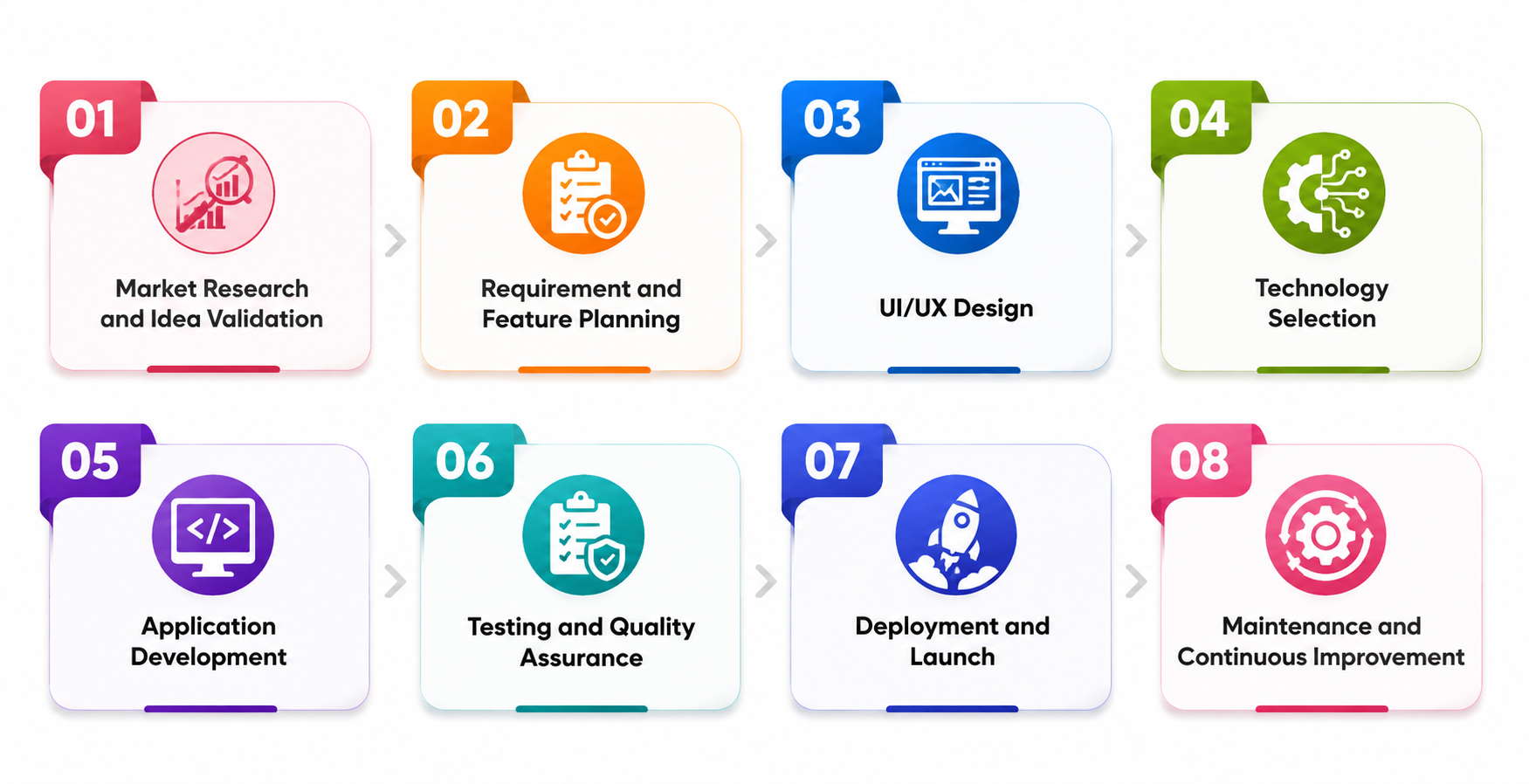
1. Market Research and Idea Validation
The process begins by understanding the target audience, competitors, educational requirements, business objectives, and market opportunities. Developers and stakeholders identify the application's purpose, target learners, monetization strategy, and unique value proposition before moving toward technical implementation.
2. Requirement and Feature Planning
Once the concept is validated, the development team defines functional and technical requirements. This includes user roles, learning modules, assessments, payment systems, communication tools, dashboards, integrations, administrative controls, and other capabilities required for the platform.
3. UI/UX Design
An intuitive interface is essential for keeping learners engaged. Designers create user journeys, wireframes, prototypes, navigation structures, and visual elements that make lessons, assignments, assessments, and progress tracking simple across smartphones, tablets, and web platforms.
4. Technology Selection
The appropriate technology stack is selected according to the application's requirements, scalability, performance, security, and budget. Technologies may include native or cross-platform frameworks, cloud services, databases, APIs, AI models, analytics tools, and third-party integrations.
5. Application Development
Developers then transform the approved designs and technical specifications into a functional application. Front-end and back-end development are performed alongside database implementation, API integration, authentication, payment integration, content management, and other required functionality.
6. Testing and Quality Assurance
The application undergoes extensive testing to identify functional, performance, security, usability, and compatibility issues. Testing across different devices, operating systems, screen sizes, and network conditions helps create a more reliable learning experience.
7. Deployment and Launch
After successful testing, the application is prepared for deployment. Mobile apps can be submitted to relevant app stores, while web-based platforms are deployed to appropriate cloud or hosting environments. Configuration, monitoring, analytics, and security controls are also established.
8. Maintenance and Continuous Improvement
EdTech development does not end after launch. Regular updates, security patches, performance improvements, new features, bug fixes, analytics reviews, and technology upgrades help the platform remain competitive and aligned with changing learner expectations.
How Much Does EdTech App Development Cost?
The cost of EdTech app development can vary significantly because every education platform has different requirements. A simple learning application with basic content delivery will generally require less investment than a sophisticated platform featuring AI personalization, live classes, gamification, payment systems, analytics, and multiple user dashboards. The development budget is influenced by application complexity, number of platforms, development location, UI/UX requirements, integrations, security, backend infrastructure, and post-launch maintenance.
EdTech App Type | Estimated Development Cost | Typical Development Time |
Basic Learning App | $20,000–$40,000 | 3–5 Months |
E-Learning Platform | $40,000–$70,000 | 5–7 Months |
Advanced EdTech App | $70,000–$120,000 | 7–10 Months |
AI-Powered EdTech Platform | $100,000–$180,000+ | 9–14+ Months |
Enterprise EdTech Ecosystem | $150,000–$300,000+ | 12–18+ Months |
What Determines the Investment Behind EdTech App Development?
Understanding the major development factors before starting a project helps businesses create realistic budgets and avoid unexpected expenses. From application complexity and platform selection to security, integrations, and maintenance, each technical and business decision can influence the overall development investment.
1. App Complexity
A basic application with course listings and video content is considerably simpler than an advanced EdTech ecosystem with AI recommendations, virtual classrooms, analytics, assessments, gamification, and multiple user roles. Greater complexity requires additional development, testing, infrastructure, and maintenance resources.
2. Number of Platforms
Developing for Android, iOS, web, tablets, and other devices can increase development requirements. Businesses must decide whether they need native applications for each platform or prefer cross-platform development to reduce development time while maintaining broad device coverage.
3. UI/UX Design
Education applications require interfaces that make complex learning activities easy to understand. Customized dashboards, interactive lessons, animations, accessibility features, and personalized navigation can increase design and development efforts but may significantly improve learner engagement and usability.
4. Technology Stack
The selected programming languages, frameworks, databases, cloud infrastructure, AI technologies, and APIs influence development costs. A technology stack should be selected according to performance, scalability, security, integration requirements, development speed, and long-term maintenance rather than short-term cost alone.
5. Third-Party Integrations
Payment gateways, video conferencing platforms, cloud storage, email services, analytics tools, CRM systems, authentication services, and communication APIs can extend application capabilities. However, every integration introduces additional development, testing, configuration, and maintenance requirements.
6. Artificial Intelligence
AI can introduce personalized recommendations, intelligent tutoring, automated content generation, conversational assistants, predictive analytics, and automated assessments. However, implementing AI requires additional model development or integration, data processing, infrastructure, testing, and monitoring.
7. Security Requirements
EdTech platforms can handle user profiles, educational records, payment information, assessments, and other sensitive information. Strong authentication, authorization, encryption, secure APIs, data protection mechanisms, and regular security testing are therefore important development considerations.
8. Maintenance and Scalability
A successful EdTech platform needs continuous improvements after launch. Cloud infrastructure, server scaling, bug fixes, feature updates, security patches, performance optimization, and technical support should be included in the long-term development budget.
Essential Features for a Modern EdTech Application
The right features determine how effectively an EdTech platform serves learners, educators, administrators, and businesses. A modern solution should combine usability, engagement, communication, personalization, security, and analytics to create a complete digital learning environment.
1. User Registration and Profiles
Secure registration enables learners, teachers, administrators, and other users to create personalized profiles. Social login, email authentication, role-based access, profile management, and account settings can simplify onboarding while maintaining appropriate access controls.
2. Course and Content Management
Administrators and educators should be able to create, organize, update, and manage courses. The platform can support videos, PDFs, presentations, quizzes, assignments, audio lessons, and other educational resources within structured learning modules.
3. Live Classes and Virtual Learning
Video conferencing and live classroom functionality enable real-time interaction between instructors and learners. Features such as screen sharing, chat, attendance tracking, recordings, and interactive sessions can recreate many aspects of traditional classroom experiences digitally.
4. Online Assessments
Quizzes, examinations, assignments, automated scoring, question banks, and performance reports allow educators to evaluate learner progress. Automated assessment features can reduce administrative workload while providing students with faster feedback.
5. Progress Tracking
Learner dashboards can display completed lessons, assessment results, course progress, achievements, and upcoming activities. Progress tracking helps students understand their learning journey and gives educators valuable insights into performance.
6. Gamification
Points, badges, leaderboards, challenges, achievement levels, and rewards can introduce engaging elements into the learning process. Gamification can encourage learners to complete activities, maintain consistency, and participate more actively.
7. AI-Powered Recommendations
AI can analyze learning behavior and performance to recommend relevant courses, lessons, resources, or practice activities. Intelligent recommendations can make content discovery more relevant and support personalized learning experiences.
8. Push Notifications
Notifications can remind learners about upcoming classes, assignments, examinations, new courses, achievements, payment deadlines, and other activities. Carefully designed notifications can improve engagement without overwhelming users.
9. Payment and Subscription Management
For commercial EdTech platforms, secure payment functionality is essential. Businesses can support subscriptions, one-time purchases, course packages, memberships, promotional offers, invoices, and transaction history through integrated payment systems.
10. Analytics and Reporting
Advanced dashboards can provide information about learner engagement, course completion, assessment results, revenue, active users, and content performance. These insights help businesses make informed decisions and optimize their educational offerings.
Future Scope of EdTech App Development
The future of EdTech is moving toward more intelligent, immersive, and personalized learning experiences. Artificial intelligence will continue to influence tutoring, content recommendations, assessment, and learner support, while technologies such as augmented reality, virtual reality, cloud computing, and advanced analytics can introduce new methods of digital education.
AI-powered tutors can provide instant assistance, while predictive analytics can help identify learning difficulties earlier. Voice-based learning, multilingual education, immersive simulations, and adaptive learning systems can also make educational platforms more accessible.
For businesses, this means EdTech applications are evolving from simple content platforms into intelligent ecosystems capable of connecting learners, educators, administrators, and organizations through a single digital environment.
Conclusion
The demand for flexible, personalized, and technology-driven education is creating significant opportunities for businesses to invest in EdTech app development. From online classrooms and course marketplaces to AI-powered learning platforms, digital education applications can help organizations expand their reach, improve learner engagement, automate operations, and develop scalable revenue models.
At ToXSL Technologies, we help businesses transform innovative education concepts into scalable digital solutions. Our expertise in mobile app development, web development, AI, cloud technologies, UI/UX, and enterprise software enables us to build EdTech applications tailored to specific business and learning requirements. Whether you are planning an e-learning platform, virtual classroom, LMS, tutoring application, or AI-powered education solution, the right technology partner can help turn your idea into a reliable and engaging digital learning experience.
Ready to build the next generation of digital learning? Partner with ToXSL Technologies to develop a feature-rich, scalable, and future-ready EdTech application.
Frequently Asked Questions
1. How much does it cost to develop an EdTech app?
The cost can range from approximately $20,000 for a basic learning application to $300,000 or more for an enterprise-level EdTech ecosystem. Features, platforms, integrations, AI capabilities, design, security, and development complexity determine the final investment.
2. How long does it take to develop an EdTech application?
An EdTech application can take around three to eighteen months or more, depending on its complexity. A basic application may require a few months, while an AI-powered or enterprise platform with extensive integrations can require significantly more development time.
3. What features should an EdTech app have?
Important features include user registration, course management, video lessons, live classes, assessments, progress tracking, notifications, payments, analytics, gamification, communication tools, and administrative dashboards. Advanced applications can additionally include AI-powered recommendations and intelligent tutoring.
4. Can AI be integrated into an EdTech application?
Yes. AI can support personalized learning, intelligent tutoring, automated assessments, content recommendations, conversational assistants, predictive analytics, and learner support. The appropriate AI capabilities depend on the application's objectives, available data, target audience, and technical requirements.
5. Which technologies are used for EdTech app development?
Depending on project requirements, developers may use technologies such as Flutter, React Native, native Android and iOS technologies, Node.js, Python, cloud platforms, relational or NoSQL databases, AI frameworks, APIs, and analytics tools.
6. How can an EdTech app generate revenue?
EdTech applications can use subscription plans, one-time course purchases, premium content, institutional licensing, certification fees, advertisements, memberships, tutoring services, and enterprise packages. The ideal monetization strategy depends on the target market and business model.