


































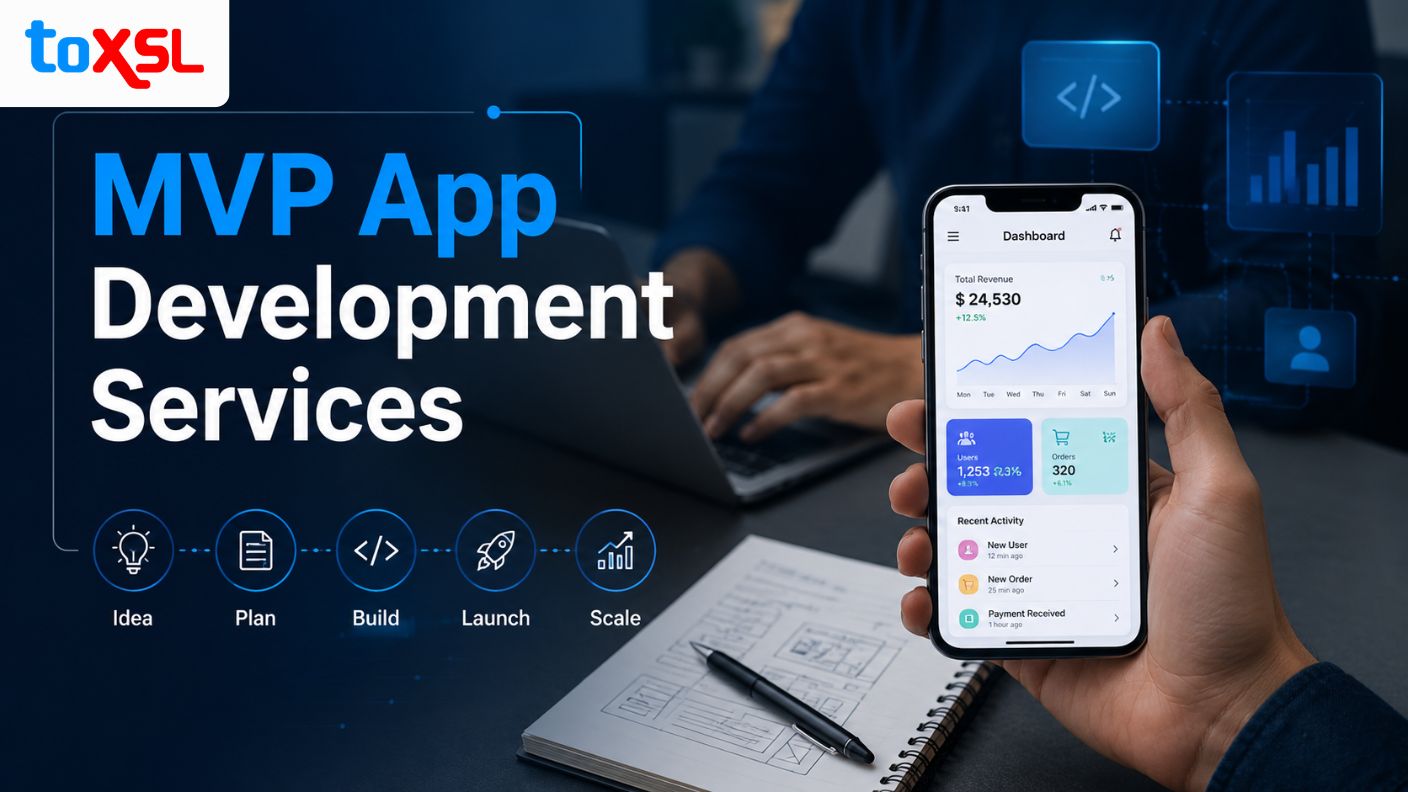
According to SDH Global, approximately 72% of startups use a Minimum Viable Product (MVP) approach to gather user feedback, validate their ideas, and refine their products before full-scale development. This highlights how MVP development helps businesses reduce risks, optimize costs, and launch products with greater confidence.
MVP app development services enable businesses to build a product with only its core features, allowing them to test market demand, collect real user insights, and improve the application based on customer feedback. Whether you're a startup or an established enterprise, an MVP provides a faster, smarter, and more cost-effective path to launching successful digital products.
Key Takeaways
- Launch faster with essential features and test your concept before making larger investments.
- Build only the most valuable functionalities, minimizing unnecessary expenses and development risks.
- Release your application quickly and gain a competitive advantage with early customer feedback.
- Improve your application based on real user insights instead of assumptions.
- Use validated data to expand features, improve performance, and attract investors effectively.
Role of MVP App Development Services In Building Successful Digital Products
MVP app development helps businesses validate innovative ideas while minimizing financial risks and accelerating product launches. Instead of investing heavily in a complete application, organizations can focus on developing essential features, gathering customer feedback, and continuously improving their product based on real-world usage and evolving market demands.
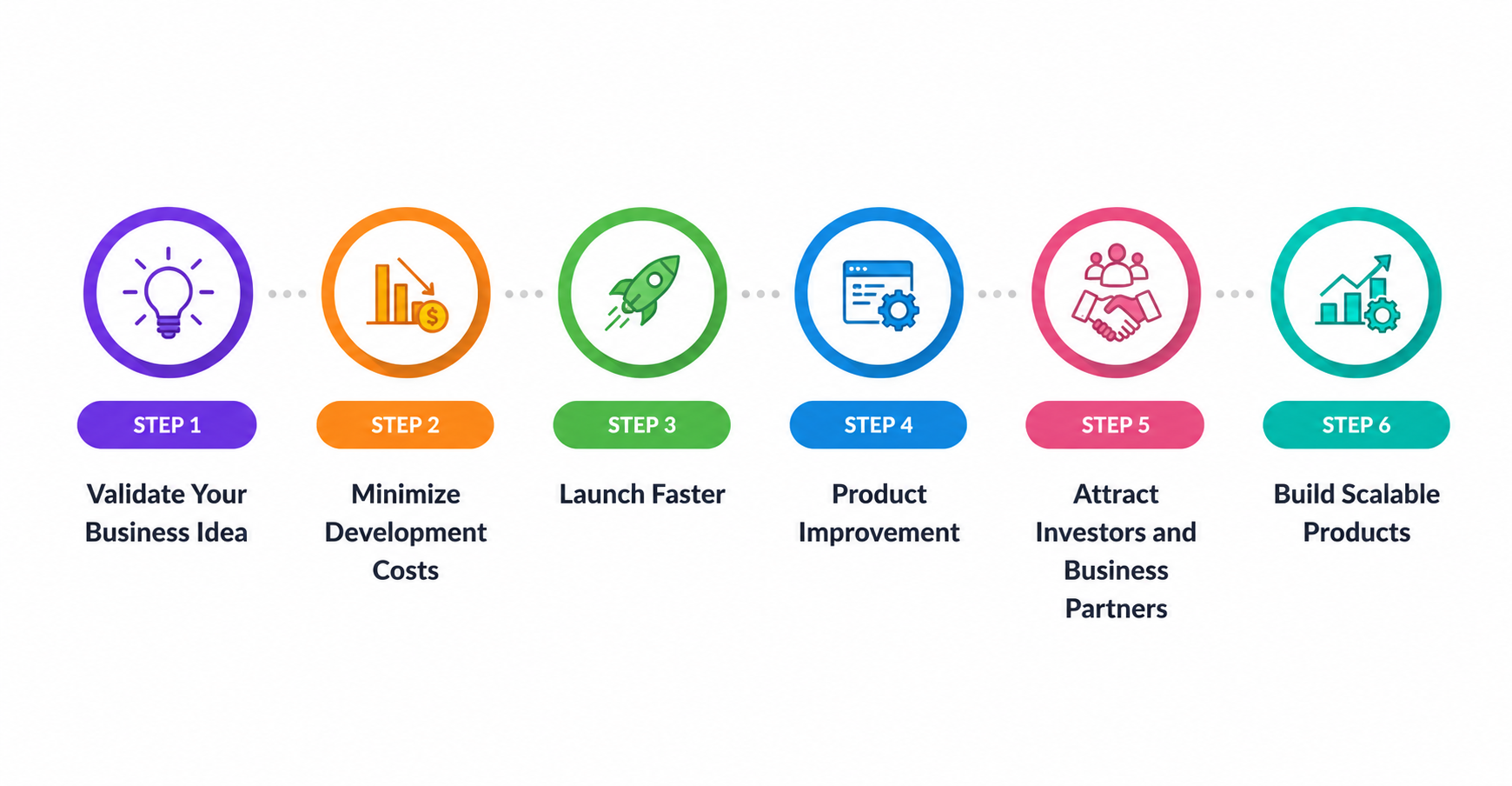
1. Validate Your Business Idea
Launching an application without market validation often leads to wasted investments and product failure. MVP development enables businesses to test core concepts with actual users before committing to extensive development.
- Confirms real market demand before expanding the application.
- Reduces uncertainty by validating assumptions with actual users.
- Prevents unnecessary investments in unwanted features.
- Provides measurable customer insights for future development.
2. Minimize Development Costs
Building every planned feature at the initial stage can significantly increase development costs and project risks. MVP development focuses only on the essential functionality required to solve users' problems.
- Eliminates spending on unnecessary functionalities.
- Enables better allocation of development resources.
- Reduces financial risks associated with product launches.
- Supports gradual investment based on proven success.
3. Launch Faster
Speed plays a crucial role in today's competitive digital landscape. MVP development allows businesses to introduce products quickly, capture market opportunities, and collect valuable customer insights before competitors establish dominance.
- Reduces product development timelines significantly.
- Helps capture market opportunities earlier.
- Builds customer awareness before competitors.
- Generates valuable feedback immediately after launch.
4. Product Improvement
Customer opinions are among the most valuable assets during product development. Instead of relying on internal assumptions, MVP applications collect authentic user feedback that helps businesses identify usability issues, prioritize features, and enhance overall customer satisfaction.
- Understands customer expectations more accurately.
- Improves user experience through continuous updates.
- Prioritizes features based on actual customer demand.
- Builds stronger customer engagement and loyalty.
5. Attract Investors and Business Partners
Investors prefer businesses with validated ideas and measurable market traction. An MVP demonstrates customer interest, product viability, and growth potential through real performance data. This evidence increases investor confidence and improves opportunities for strategic partnerships.
- Demonstrates product-market validation effectively.
- Provides measurable growth metrics for investors.
- Increases credibility during funding discussions.
- Strengthens long-term business expansion opportunities.
6. Build Scalable Products
An MVP establishes a strong technological foundation for future growth. Instead of rebuilding applications from scratch, businesses can gradually introduce advanced features based on customer feedback, market trends, and evolving business requirements while maintaining stability and scalability.
- Supports seamless feature expansion over time.
- Maintains application stability during scaling.
- Adapts quickly to changing market requirements.
- Creates sustainable long-term business growth.
Our Proven 8-Step MVP App Development Process for Faster Product Success
A structured MVP development process transforms innovative ideas into successful digital products efficiently. Our step-by-step methodology emphasizes market research, strategic planning, agile development, and iterative improvements to deliver scalable applications that meet business objectives while ensuring exceptional user experiences and long-term product growth.
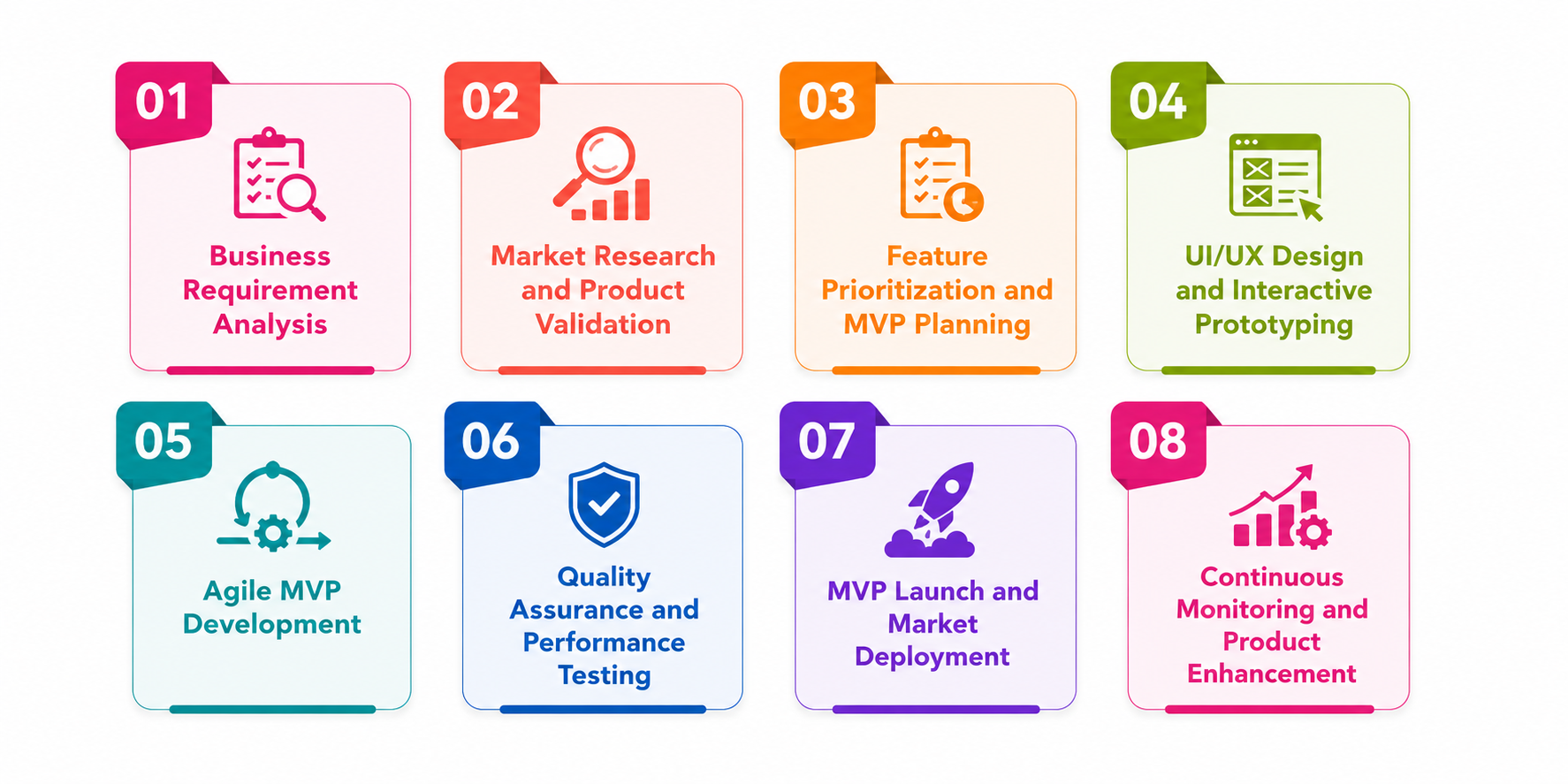
Step 1. Business Requirement Analysis
Every successful MVP begins with understanding business objectives, customer expectations, and market challenges. During this stage, our experts collaborate closely with stakeholders to identify product goals, define success metrics, and create a development roadmap that aligns technology with business strategy.
- Identify business goals and project objectives.
- Analyze competitors and market opportunities.
- Define target audience requirements.
- Establish measurable success indicators.
Step 2. Market Research and Product Validation
Before writing code, we validate the product concept through comprehensive market analysis. This ensures that the proposed solution addresses genuine customer pain points and possesses the potential for sustainable business growth while minimizing future development risks.
- Research industry trends and customer behavior.
- Evaluate competing digital products.
- Validate business assumptions using market data.
- Identify product differentiation opportunities.
Step 3. Feature Prioritization and MVP Planning
Rather than developing every planned feature, we prioritize functionalities that deliver the highest customer value. This strategic planning enables businesses to launch quickly while maintaining flexibility for future enhancements based on user feedback and evolving business goals.
- Prioritize essential product functionalities.
- Eliminate unnecessary development complexity.
- Define product release milestones.
- Prepare scalable technology architecture.
Step 4. UI/UX Design and Interactive Prototyping
User experience determines product success. Our design team creates intuitive interfaces and interactive prototypes that visualize user journeys before development begins, ensuring an engaging, accessible, and customer-friendly application experience across multiple devices.
- Design intuitive user interfaces.
- Develop interactive product wireframes.
- Optimize user navigation experiences.
- Validate design through stakeholder feedback.
Step 5. Agile MVP Development
Using agile methodologies, our developers build the MVP in iterative development cycles. Continuous collaboration, rapid feature delivery, and flexible development practices ensure faster releases while maintaining exceptional code quality and system reliability.
- Develop features using agile methodology.
- Maintain high coding standards.
- Deliver iterative product updates.
- Ensure scalable application architecture.
Step 6. Quality Assurance and Performance Testing
Before launch, every feature undergoes extensive testing to ensure functionality, security, compatibility, and performance. Our quality assurance specialists identify potential issues early, guaranteeing a reliable product that delivers exceptional customer experiences.
- Perform comprehensive functional testing.
- Validate security and data protection.
- Test application performance extensively.
- Ensure cross-platform compatibility.
Step 7. MVP Launch and Market Deployment
Once testing is complete, we deploy the application using industry best practices. Our deployment strategy minimizes disruptions while ensuring smooth product availability across selected platforms and target markets.
- Deploy applications securely.
- Configure production environments.
- Monitor launch performance continuously.
- Ensure successful platform availability.
Step 8. Continuous Monitoring and Product Enhancement
Launching an MVP marks the beginning, not the end of product development. We continuously analyze user behavior, collect customer feedback, and implement improvements that enhance performance, expand functionality, and support sustainable business growth.
- Analyze customer usage patterns.
- Collect actionable product feedback.
- Introduce new features gradually.
- Optimize performance through continuous updates.
Core Principles That Drive Our Successful MVP App Development Process
Every successful MVP begins with a strong foundation built on proven development principles. At ToXSL Technologies, we follow a strategic, customer-focused, and agile approach that ensures your MVP delivers maximum business value.
1. Customer-Centric Product Development
A successful MVP is built around the needs of real users rather than assumptions. We prioritize understanding your target audience, identifying their pain points, and developing features that solve meaningful problems.
2. Build Only What Matters Most
Instead of developing every possible feature, we focus on creating the essential functionalities that provide immediate value. This lean development strategy minimizes costs, accelerates product launches, and enables businesses to validate their ideas efficiently before expanding the application with advanced capabilities based on market demand.
3. Agile and Iterative Development
We follow agile methodologies that divide development into manageable iterations, allowing continuous collaboration, faster improvements, and flexible adaptation to changing business requirements. This iterative approach ensures every development cycle delivers measurable value while enabling rapid adjustments based on customer feedback and evolving market conditions.
4. Validate Every Decision with Data
Successful MVP development relies on measurable insights rather than assumptions. We continuously collect user feedback, monitor application performance, and analyze customer behavior to make informed product decisions. This data-driven methodology helps businesses prioritize improvements that maximize user satisfaction and long-term product success.
5. Design for Future Scalability
An MVP should serve as the foundation for future business growth. We build scalable architectures that support feature expansion, increasing user traffic, and evolving business requirements without requiring significant redevelopment. This forward-thinking approach ensures long-term flexibility and cost-effective application growth.
MVP App Development Cost Analysis: Budgeting for a Successful Product Launch
The cost of MVP app development depends on several factors, including application complexity, platform selection, feature requirements, UI/UX design, third-party integrations, and development timeline. Building an MVP allows businesses to minimize initial investment by focusing on core functionalities while creating a scalable foundation for future enhancements based on user feedback and market demand.
Development Stage | Estimated Cost (USD) | Estimated Timeline |
|---|---|---|
Product Discovery & Requirement Analysis | $2,000 – $5,000 | 1–2 Weeks |
Market Research & MVP Planning | $2,000 – $4,000 | 1 Week |
UI/UX Design & Wireframing | $3,000 – $8,000 | 2–3 Weeks |
Frontend App Development | $8,000 – $20,000 | 4–8 Weeks |
Backend Development & APIs | $8,000 – $18,000 | 4–8 Weeks |
Third-Party Integrations | $2,000 – $8,000 | 1–3 Weeks |
Quality Assurance & Testing | $3,000 – $7,000 | 2–3 Weeks |
Deployment & Launch Support | $1,000 – $3,000 | 1 Week |
Estimated Total MVP Development Cost | $25,000 – $75,000+ | 10–20 Weeks |
Factors That Influence MVP App Development Cost
The cost of MVP app development is determined by several technical and business factors, including project complexity, feature requirements, platform selection, design quality, technology stack, and third-party integrations.
1. App Complexity
Simple applications with limited functionality cost significantly less than enterprise-grade platforms requiring advanced workflows, automation, AI capabilities, real-time communication, or complex business logic. As product complexity increases, development time, testing efforts, and infrastructure requirements also rise, directly impacting the overall project budget.
2. Platform Selection
Developing for a single platform such as Android, iOS, or the web is generally more cost-effective than creating a cross-platform or multi-platform application. Choosing the right technology stack based on business objectives helps optimize development costs while ensuring scalability and performance.
3. UI/UX Design Requirements
A well-designed user interface improves engagement and customer satisfaction but also contributes to development costs. Custom branding, animations, interactive prototypes, and accessibility features require additional design effort, resulting in higher overall investment while delivering a superior user experience.
4. Third-Party Integrations
Many MVP applications rely on external services such as payment gateways, cloud storage, authentication systems, maps, analytics, or communication APIs. The number and complexity of these integrations influence both development time and project cost.
5. Development Team and Technology Stack
The expertise of the development team and the technologies used significantly affect project pricing. Experienced developers deliver scalable, secure, and high-performing MVPs more efficiently, reducing long-term maintenance costs and accelerating product success.
Why ToXSL Technologies Is the Ideal Partner for Your MVP App Development Journey
Choosing the right MVP development company is essential for transforming innovative ideas into successful digital products. At ToXSL Technologies, we combine technical expertise, agile methodologies, and customer-focused strategies to deliver scalable, high-quality MVP applications.
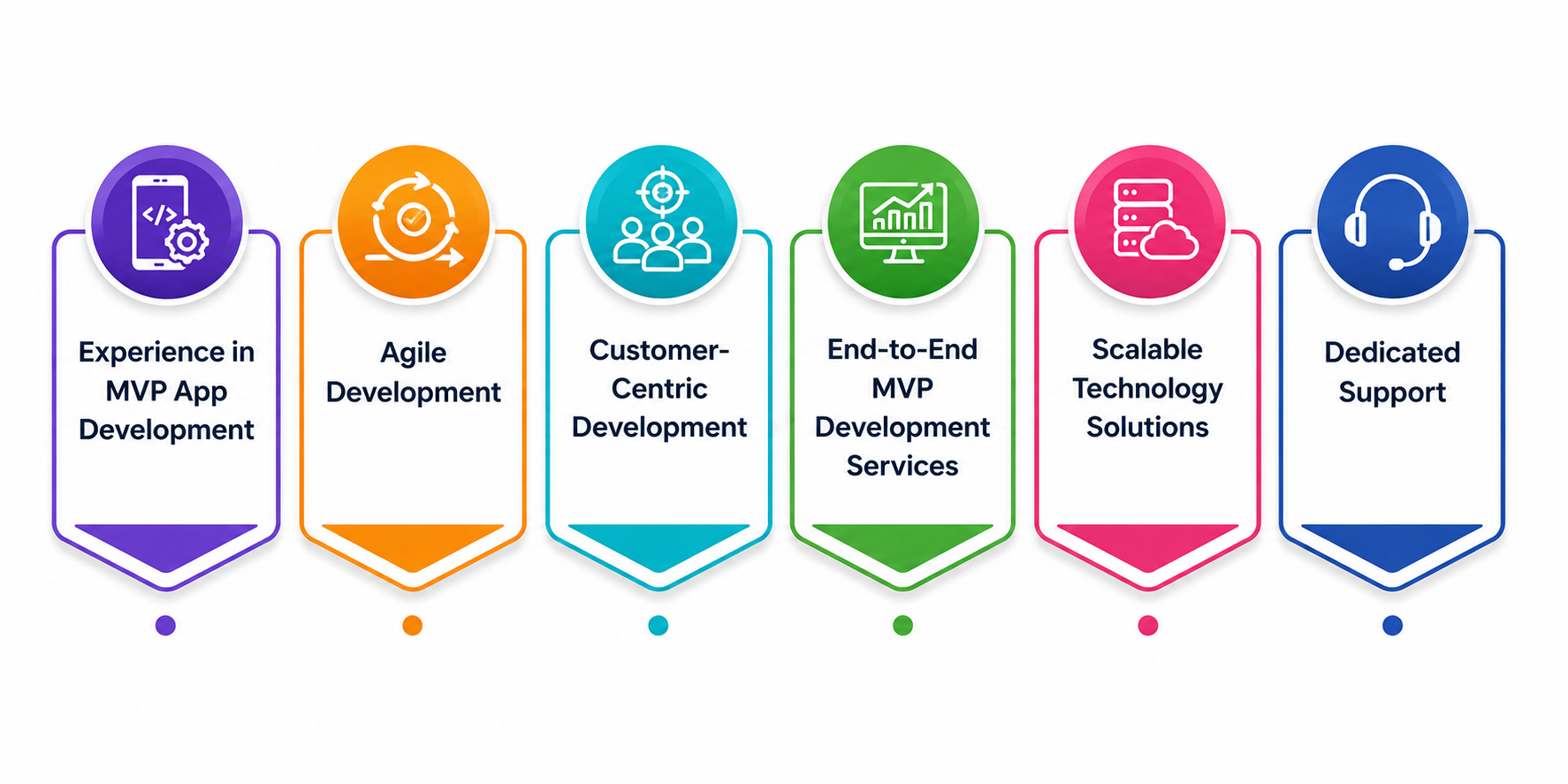
1. Experience in MVP App Development
With years of experience delivering innovative digital solutions across various industries, our team understands how to transform ideas into market-ready MVPs. We build scalable applications that validate business concepts, reduce development risks, and create a strong foundation for future growth while ensuring exceptional performance and user satisfaction.
2. Agile Development
We follow agile development practices that enable rapid product releases without compromising quality. Our iterative approach allows businesses to launch quickly, gather valuable customer feedback, and continuously improve their applications while adapting efficiently to changing market demands and business objectives.
3. Customer-Centric Development
Every MVP we develop is designed around your business goals and user expectations. We work closely with clients throughout the development journey, ensuring every feature addresses real customer needs while delivering intuitive user experiences that increase engagement and customer retention.
4. End-to-End MVP Development Services
From idea validation and market research to UI/UX design, development, testing, deployment, and post-launch support, we provide comprehensive MVP development services under one roof. Our integrated approach ensures consistency, faster execution, and seamless project delivery from start to finish.
5. Scalable Technology Solutions
Our MVP applications are built using modern technologies and scalable architectures that support future growth. As your business evolves, your application can easily accommodate new features, increasing users, and changing business requirements without major redevelopment efforts.
6. Dedicated Support
We believe successful partnerships are built on trust and transparency. Our team keeps clients informed through regular progress updates, milestone reviews, and collaborative discussions. Even after launch, we provide dedicated technical support to ensure your MVP continues to perform efficiently.
Conclusion
Building a successful digital product starts with validating your idea before making a significant investment. An MVP enables businesses to reduce development risks, accelerate time-to-market, gather valuable customer feedback, and create products that truly meet market demands. By focusing on essential features first, organizations can make informed decisions, optimize development costs, and establish a scalable foundation for future growth.
At ToXSL Technologies, we specialize in delivering robust, scalable, and user-centric MVP app development services tailored to your unique business goals. From idea validation and strategic planning to development, deployment, and continuous enhancement, our experienced team is committed to helping startups and enterprises transform innovative concepts into successful digital products. Partner with ToXSL Technologies to launch your MVP confidently and accelerate your journey toward long-term business success.
Frequently Asked Questions
1. What is an MVP in app development?
An MVP (Minimum Viable Product) is the first version of an application that includes only the essential features needed to solve users' primary problems. It helps businesses validate ideas, gather customer feedback, and improve the product before investing in full-scale development.
- Includes only core functionalities.
- Reduces initial development costs.
- Validates product-market fit.
- Supports faster product launches.
2. How long does it take to develop an MVP app?
The development timeline depends on project complexity, features, platform selection, and integrations. A typical MVP can usually be developed within 10 to 20 weeks using an agile development approach, allowing businesses to launch quickly and start collecting valuable user feedback.
- Depends on project requirements.
- Simpler MVPs launch faster.
- Agile development speeds delivery.
- Timelines vary by feature complexity.
3. How much does MVP app development cost?
The cost of MVP app development varies based on application complexity, technology stack, UI/UX design, integrations, and development resources. Most MVP projects generally range between $25,000 and $75,000+, depending on business requirements and future scalability.
- Cost varies by project scope.
- Features directly impact pricing.
- Platform choice affects budget.
- Scalable architecture adds long-term value.
4. Why should startups choose MVP development?
MVP development helps startups minimize financial risks, validate business ideas, and launch products quickly. By collecting real customer feedback early, startups can improve their applications, attract investors, and make informed product decisions without overspending on unnecessary features.
- Validates innovative business ideas.
- Minimizes investment risks.
- Attracts potential investors.
- Supports data-driven product improvements.
5. Can an MVP be scaled into a full-featured application?
Yes. A well-developed MVP is designed with scalability in mind, allowing businesses to add advanced features, support more users, and enhance functionality over time without rebuilding the entire application from scratch.
- Built for future scalability.
- Supports feature expansion.
- Handles growing user demand.
- Reduces redevelopment efforts.
6. Why choose ToXSL Technologies for MVP app development?
ToXSL Technologies offers end-to-end MVP development services backed by experienced developers, agile methodologies, modern technologies, and continuous support. We help businesses validate ideas, accelerate product launches, and build scalable digital solutions that drive long-term growth and business success.
- Experienced MVP development team.
- Agile and transparent development process.
- End-to-end development services.
- Long-term technical support and maintenance.