























Key Takeaways
- Remote Patient Monitoring (RPM) enables continuous healthcare outside traditional clinical settings.
- AI-powered RPM applications help detect health risks early through real-time monitoring.
- Connected wearable devices improve patient engagement and treatment adherence.
- Healthcare providers can significantly reduce hospital readmissions and operational costs.
- HIPAA, GDPR, and other healthcare compliance standards are essential for secure RPM applications.
- Development costs vary based on features, integrations, compliance, and technology stack.
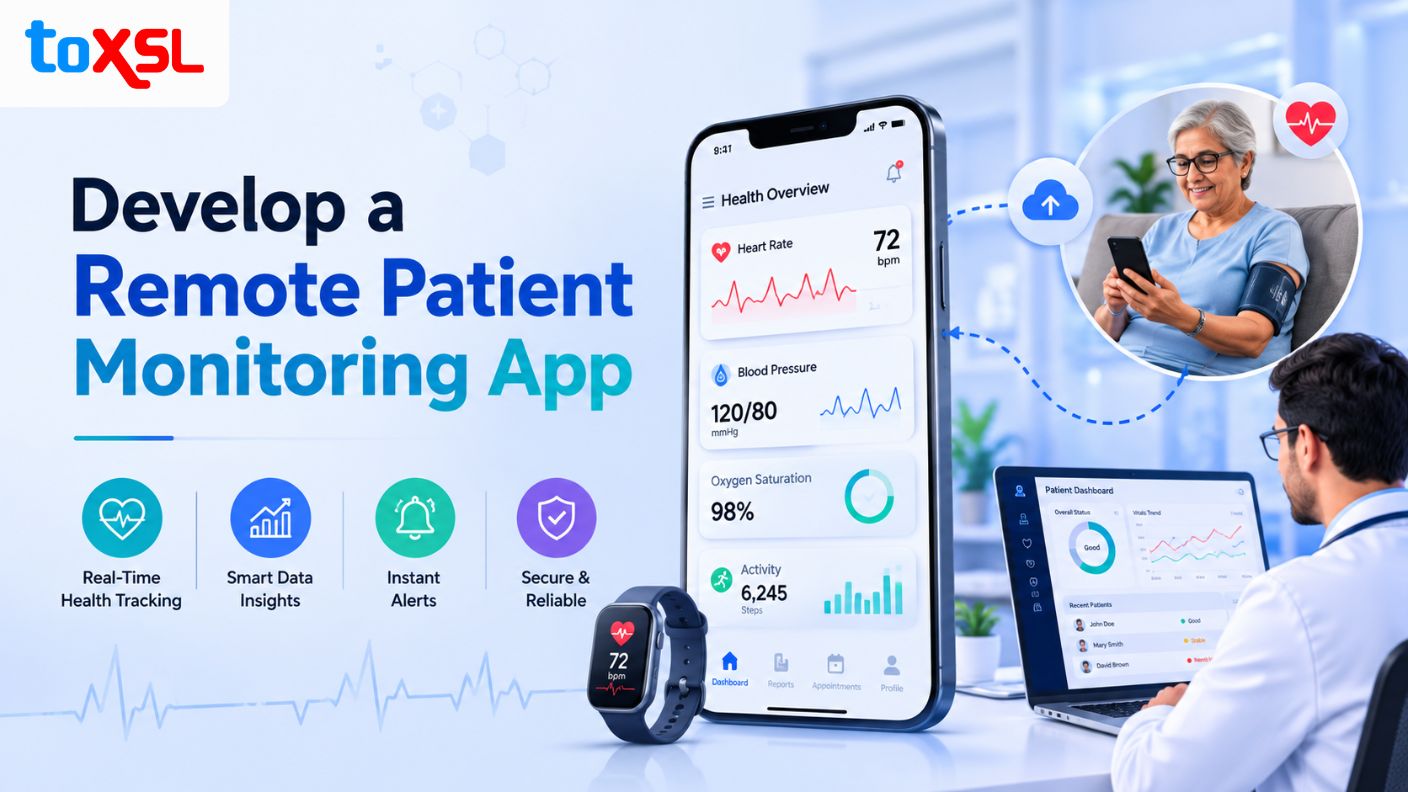
Healthcare is rapidly shifting from hospital-centered care to patient-centered digital care. One of the biggest drivers behind this transformation is Remote Patient Monitoring (RPM). By enabling healthcare providers to monitor patients' health data in real time through connected devices and mobile applications, RPM improves clinical outcomes, reduces hospital readmissions, and enhances patient engagement.
From managing chronic illnesses like diabetes and hypertension to monitoring post-operative recovery and elderly care, Remote Patient Monitoring applications are becoming an essential part of modern healthcare ecosystems. Wearable devices, IoT sensors, cloud computing, Artificial Intelligence (AI), and secure healthcare integrations have made it easier than ever for healthcare organizations to deliver continuous care without requiring patients to visit hospitals frequently.
As healthcare organizations continue to embrace digital transformation, investing in a Remote Patient Monitoring application is no longer a luxury, it is a strategic necessity. Whether you're a hospital, healthcare startup, clinic, insurance provider, or telemedicine company, a custom RPM solution can improve operational efficiency while delivering better patient experiences.
The rapid adoption of digital healthcare solutions continues to fuel the growth of the Remote Patient Monitoring market worldwide. According to Grand View Research, the global Remote Patient Monitoring market is projected to grow at a CAGR exceeding 18% through 2030, driven by increasing chronic diseases, aging populations, and digital healthcare adoption.
Why Remote Patient Monitoring App Development Is Transforming Modern Healthcare
Remote Patient Monitoring applications are reshaping healthcare by enabling proactive care instead of reactive treatment. They empower providers with continuous patient insights while improving convenience, accessibility, and operational efficiency. Businesses investing in RPM applications can enhance patient satisfaction, optimize clinical workflows, and create scalable digital healthcare ecosystems.
1. Real-Time Patient Monitoring
Healthcare professionals can continuously monitor vital signs such as heart rate, blood pressure, oxygen saturation, glucose levels, ECG readings, and body temperature. Immediate access to patient data enables faster clinical decisions, minimizes emergencies, and improves treatment effectiveness without requiring patients to visit healthcare facilities regularly.
- Continuous health tracking
- Faster clinical intervention
- Improved treatment accuracy
- Better patient safety
2. Better Chronic Disease Management
Patients suffering from diabetes, hypertension, COPD, asthma, cardiovascular diseases, and other chronic conditions require regular monitoring. RPM applications help healthcare providers track patient health remotely, adjust medications promptly, and detect health deterioration before complications become severe.
- Better chronic care
- Early disease detection
- Reduced emergency admissions
- Improved medication adherence
3. Reduced Hospital Readmissions
Remote monitoring allows physicians to closely observe patients after discharge. Early identification of warning signs enables timely intervention, reducing unnecessary hospital readmissions while lowering healthcare costs for providers, insurers, and patients alike.
- Lower readmission rates
- Reduced healthcare costs
- Improved recovery outcomes
- Enhanced post-discharge care
4. Increased Patient Engagement
RPM applications encourage patients to actively participate in their healthcare journey. Through reminders, personalized health insights, educational resources, and progress tracking, patients become more engaged with treatment plans, leading to higher adherence and improved long-term health outcomes.
- Higher patient satisfaction
- Better medication compliance
- Improved health awareness
- Increased patient retention
5. Improved Healthcare Accessibility
Remote Patient Monitoring bridges the healthcare gap for rural communities, elderly individuals, and patients with limited mobility. It provides continuous medical support regardless of geographical location, making quality healthcare accessible to a wider population.
- Better rural healthcare
- Greater accessibility
- Convenient virtual care
- Reduced travel requirements
6. Faster Clinical Decision Making
Healthcare providers receive real-time patient insights, historical trends, and automated alerts through integrated dashboards. This data-driven approach enables physicians to diagnose conditions more accurately, prioritize critical patients, and make informed clinical decisions faster.
- Data-driven diagnosis
- Faster response times
- Improved clinical efficiency
- Better patient outcomes
7. Lower Healthcare Operational Costs
Hospitals and healthcare organizations can reduce administrative workload, optimize staff allocation, decrease unnecessary appointments, and minimize emergency admissions through automation and remote monitoring capabilities.
- Reduced operational expenses
- Improved resource utilization
- Automated workflows
- Higher ROI
8. Enhanced Data Accuracy
Connected IoT devices automatically capture and transmit patient health data, eliminating manual data entry errors while providing healthcare professionals with accurate and reliable clinical information.
- Automated data collection
- Improved accuracy
- Reduced human errors
- Better clinical records
Powerful Features Every Remote Patient Monitoring App Should Include
Remote Patient Monitoring (RPM) applications combine IoT, AI, cloud computing, and secure healthcare integrations to deliver continuous patient care beyond hospitals. The right set of features ensures accurate health tracking, seamless communication between patients and providers, and compliance with healthcare regulations while improving operational efficiency and patient outcomes.
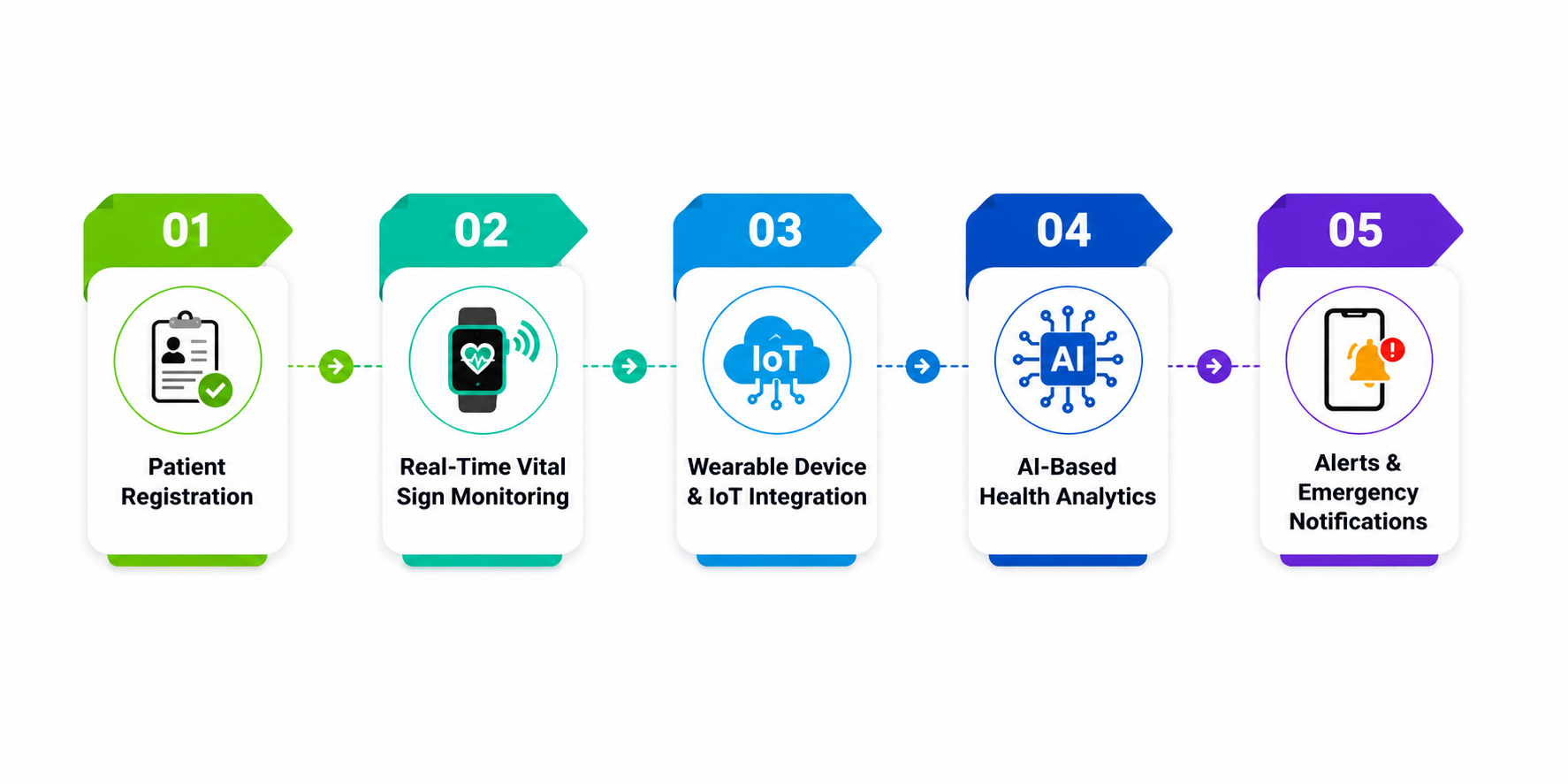
1. Patient Registration
A secure onboarding system enables patients to create personalized profiles containing medical history, allergies, medications, chronic conditions, emergency contacts, and insurance details. Healthcare providers can access comprehensive patient information to deliver personalized treatment plans and improve care coordination.
2. Real-Time Vital Sign Monitoring
The application continuously collects health metrics such as heart rate, blood pressure, oxygen saturation (SpO₂), blood glucose levels, ECG, body temperature, respiratory rate, and weight through connected wearable devices.
3. Wearable Device & IoT Integration
Modern RPM apps integrate with smartwatches, fitness bands, glucose monitors, ECG devices, blood pressure monitors, pulse oximeters, and other IoT-enabled medical devices to automate health data collection.
4. AI-Based Health Analytics
Artificial Intelligence analyzes patient health trends, identifies abnormalities, predicts potential complications, and provides actionable insights for healthcare professionals. Predictive analytics helps prevent medical emergencies before they occur.
5. Alerts & Emergency Notifications
The application automatically sends alerts to patients, caregivers, and physicians whenever vital signs exceed predefined thresholds, ensuring immediate medical intervention during emergencies.
Remote Patient Monitoring App Development Cost
Developing a Remote Patient Monitoring (RPM) app depends on factors such as app complexity, number of platforms, UI/UX design, IoT integrations, AI capabilities, cloud infrastructure, third-party APIs, and healthcare compliance requirements. While a basic solution is suitable for startups, enterprise-grade applications require advanced analytics, interoperability, and robust security, increasing the overall development investment.
Development Type | Estimated Cost (USD) | Development Timeline |
Basic RPM App | $20,000 – $40,000 | 3–5 Months |
Standard RPM App | $40,000 – $75,000 | 5–7 Months |
Advanced RPM App | $75,000 – $120,000 | 7–10 Months |
AI-Powered RPM Platform | $120,000 – $200,000+ | 10–14 Months |
Enterprise Healthcare Ecosystem | $200,000 – $400,000+ | 12–18 Months |
Factors Influencing Remote Patient Monitoring App Development Cost
Several technical, regulatory, and business factors determine the overall cost of building a Remote Patient Monitoring app. Understanding these variables helps healthcare organizations estimate budgets accurately, prioritize essential features, and choose the right development approach for long-term scalability.
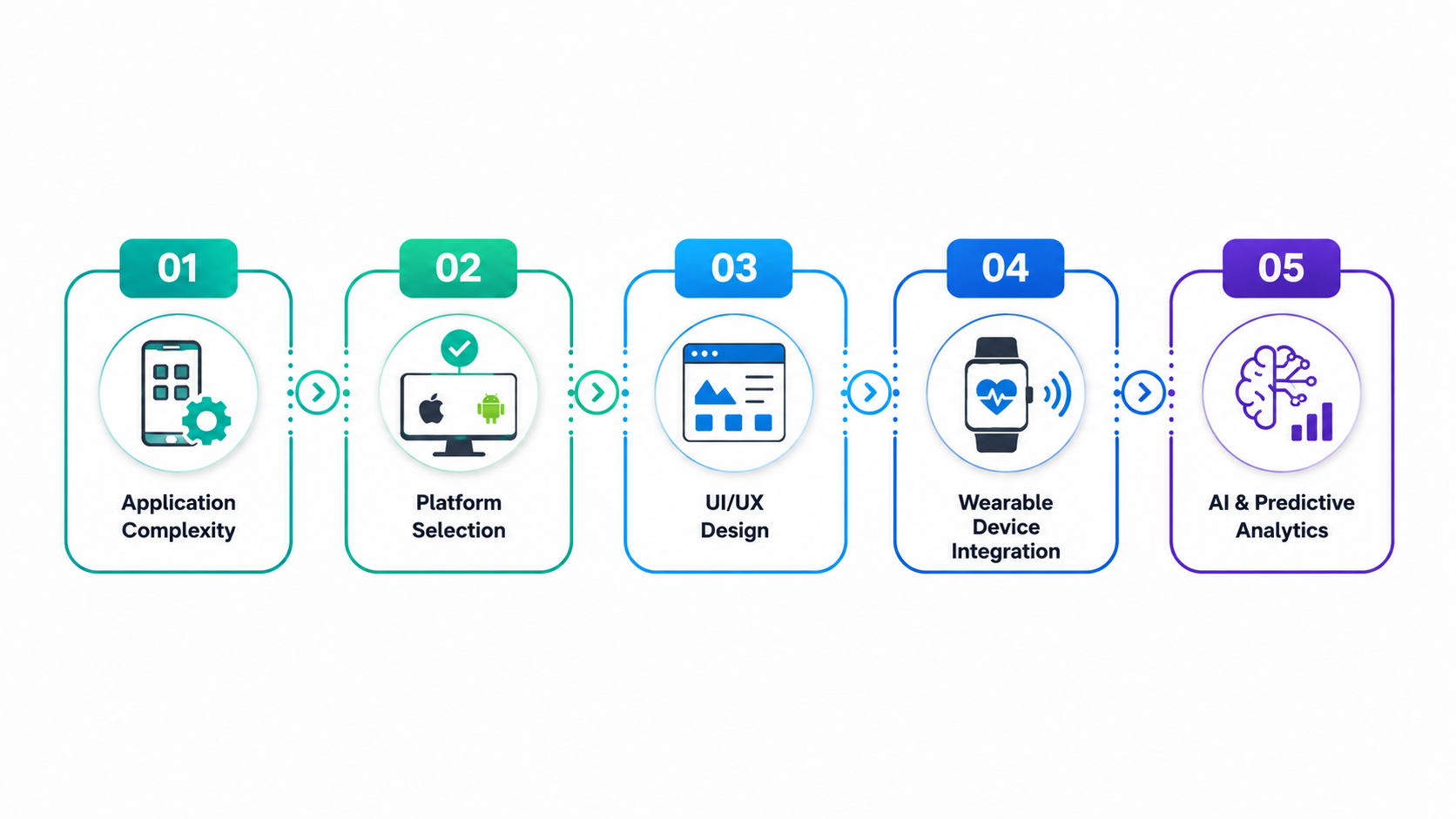
1. Application Complexity
A basic RPM application with health tracking and notifications costs significantly less than an enterprise solution offering AI analytics, telemedicine, predictive healthcare, and multi-hospital management. More features require additional development hours, testing, and infrastructure, increasing the total project budget.
2. Platform Selection
Developing native applications for Android and iOS separately generally costs more than using cross-platform technologies like Flutter or React Native. Businesses must choose the platform strategy based on target users, performance requirements, and long-term maintenance goals.
3. UI/UX Design
Healthcare applications require intuitive, accessible, and user-friendly interfaces for patients, doctors, and caregivers. Custom dashboards, accessibility features, responsive layouts, and personalized experiences increase design complexity and development costs while improving usability.
4. Wearable Device Integration
Connecting the application with smartwatches, ECG monitors, glucose meters, pulse oximeters, blood pressure monitors, and other IoT devices requires custom APIs, SDK integration, device compatibility testing, and data synchronization, which significantly impacts development costs.
5. AI & Predictive Analytics
Adding Artificial Intelligence capabilities such as health trend analysis, anomaly detection, predictive alerts, personalized recommendations, and clinical decision support requires advanced machine learning models, large datasets, and additional backend infrastructure, making AI one of the major cost drivers.
Conclusion
Remote Patient Monitoring (RPM) is revolutionizing healthcare by enabling continuous, data-driven patient care beyond traditional clinical settings. With advancements in Artificial Intelligence, IoT-enabled medical devices, cloud computing, and telemedicine, RPM applications empower healthcare providers to deliver proactive care, improve patient outcomes, and reduce operational costs.
From real-time health monitoring and chronic disease management to predictive analytics and secure Electronic Health Record (EHR) integration, a well-designed Remote Patient Monitoring application enhances patient engagement while streamlining healthcare workflows. As the demand for digital healthcare continues to grow, investing in a scalable, secure, and feature-rich RPM solution has become a strategic priority for hospitals, clinics, healthcare startups, and insurance providers.
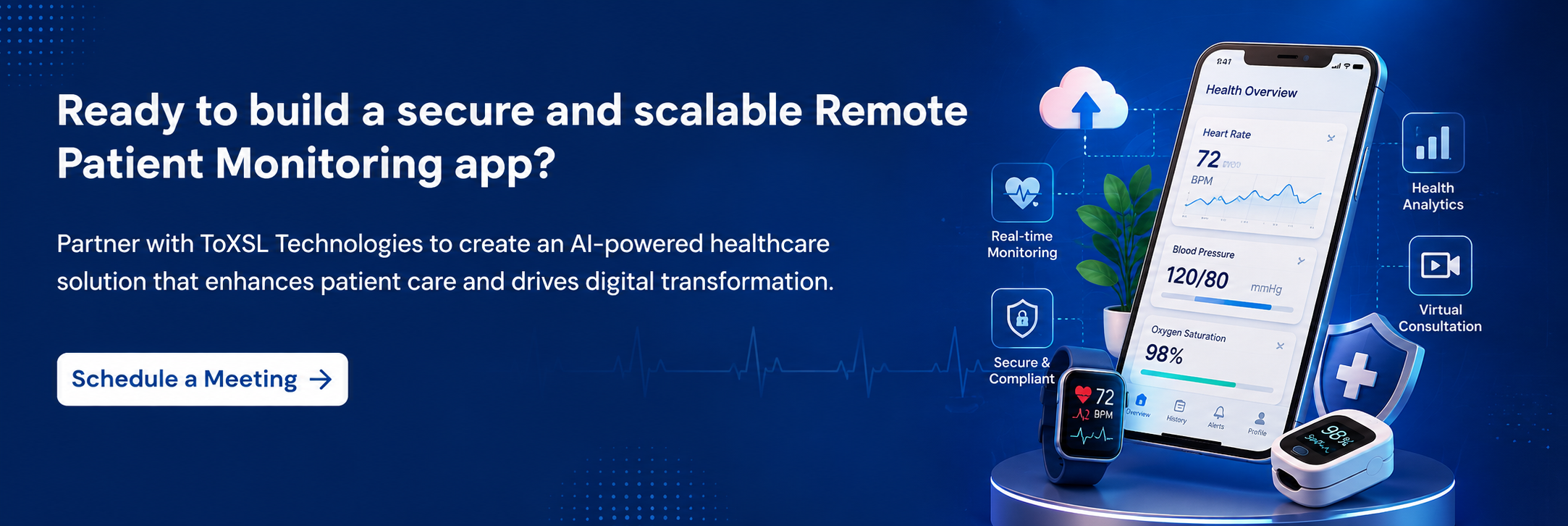
At ToXSL Technologies, we specialize in developing custom healthcare software solutions tailored to your business objectives. Our experienced team builds secure, HIPAA-compliant, AI-powered Remote Patient Monitoring app with seamless IoT integrations, intuitive user experiences, and scalable cloud architecture. Whether you are launching a new digital health platform or modernizing an existing healthcare system, we help you transform innovative ideas into reliable, future-ready healthcare solutions. Contact us to learn more.
Frequently Asked Questions
1. Why should healthcare organizations invest in a Remote Patient Monitoring (RPM) app?
Remote Patient Monitoring apps enable healthcare providers to deliver continuous patient care beyond hospital settings. By offering real-time health monitoring, proactive interventions, and improved patient engagement, RPM solutions help organizations enhance care quality while reducing operational costs and supporting long-term business growth.
Key Benefits:
- Enables continuous remote patient monitoring.
- Reduces hospital readmissions and emergency visits.
- Improves patient engagement and treatment adherence.
- Increases operational efficiency and healthcare ROI.
2. How long does it take to develop a Remote Patient Monitoring application?
The development timeline depends on the application's complexity, features, integrations, and compliance requirements. A basic RPM app may take a few months, while an enterprise-grade solution with AI, IoT, and EHR integrations requires a longer development cycle to ensure quality, scalability, and security.
Typical Timelines:
- Basic RPM app: 3–5 months.
- Standard application: 5–7 months.
- Advanced AI-powered platform: 8–12 months.
- Enterprise healthcare ecosystem: 12–18 months.
3. What technologies are commonly used for Remote Patient Monitoring app development?
Modern RPM applications leverage advanced technologies to ensure secure data collection, seamless connectivity, and intelligent healthcare insights. The technology stack is selected based on scalability, interoperability, performance, and healthcare compliance requirements.
Common Technologies:
- Flutter, React Native, Swift, and Kotlin.
- Node.js, Python, Java, and .NET.
- AWS, Microsoft Azure, and Google Cloud.
- HL7, FHIR, AI/ML, IoT, and wearable integrations.
4. Why is healthcare compliance important in a Remote Patient Monitoring app?
Healthcare applications process highly sensitive patient information, making regulatory compliance essential. Adhering to standards such as HIPAA, GDPR, HL7, and FHIR ensures data privacy, secure communication, and legal compliance while building trust among patients and healthcare providers.
Compliance Benefits:
- Protects sensitive patient health information.
- Ensures secure data storage and transmission.
- Meets global healthcare regulatory requirements.
- Reduces legal and cybersecurity risks.
5. Why choose ToXSL Technologies for Remote Patient Monitoring app development?
ToXSL Technologies provides end-to-end healthcare software development services, helping organizations build secure, scalable, and innovative RPM solutions. Our team combines expertise in AI, IoT, cloud computing, and healthcare compliance to deliver future-ready applications tailored to your business needs.
Why Partner with ToXSL Technologies?
- Custom AI-powered healthcare app development.
- Expertise in IoT and wearable device integration.
- HIPAA, GDPR, HL7, and FHIR-compliant solutions.
- End-to-end development, deployment, and ongoing support.