








































Key Takeaways
- Mobile banking apps provide customers with convenient, anytime access to essential financial services through smartphones.
- Security, authentication, encryption, fraud detection, and regulatory compliance should be incorporated from the beginning of development.
- Core features can include account management, money transfers, bill payments, card controls, notifications, deposits, and financial insights.
- Development costs depend on app complexity, features, platforms, integrations, security requirements, and development team location.
- APIs and reliable backend architecture are essential for connecting banking applications with payment gateways, core banking systems, KYC providers, and third-party services.
- AI, biometric authentication, personalized recommendations, and automation are shaping the next generation of mobile banking experiences.
Banking has moved far beyond physical branches, long queues, and paperwork. Today, customers expect to check balances, transfer money, pay bills, manage cards, apply for financial products, and receive transaction alerts directly from their smartphones. This shift has made mobile banking apps an essential digital channel for banks, fintech companies, credit unions, and financial institutions.
A modern mobile banking application is more than a convenient interface. It acts as a secure digital banking ecosystem connecting customers with accounts, payments, financial services, support, and personalized experiences. Behind every successful banking app is a combination of intuitive UI/UX design, secure APIs, robust backend architecture, real-time processing, identity verification, fraud prevention, and regulatory compliance.
For businesses planning to enter digital banking or modernize an existing banking platform, understanding the development process, features, costs, benefits, and technical considerations is essential. This guide explains everything you need to know about mobile banking app development and how businesses can build a secure, scalable, customer-focused solution.
Why Mobile Banking App Development Matters for Modern Financial Businesses
The growing adoption of smartphones and digital financial services has transformed customer expectations. According to the World Bank's Global Findex, 86% of adults globally owned a mobile phone, while 68% owned a smartphone.
These numbers highlight an important business opportunity. Customers increasingly expect financial services to be accessible through mobile devices. For banks and fintech businesses, a well-designed mobile banking app can improve customer engagement, reduce operational friction, expand digital service availability, and create opportunities for new financial products.
However, banking applications require a higher level of security and reliability than many standard consumer applications. Every transaction, login, API connection, and customer interaction must be carefully designed around security, privacy, compliance, and performance.
From Banking App Idea to Launch: A Smarter Mobile Banking Development Process
Developing a mobile banking app requires a structured approach because financial applications combine complex technology, sensitive information, regulatory requirements, and high customer expectations. A successful development lifecycle typically moves from business planning and UX research to architecture, development, security testing, deployment, and continuous improvement.
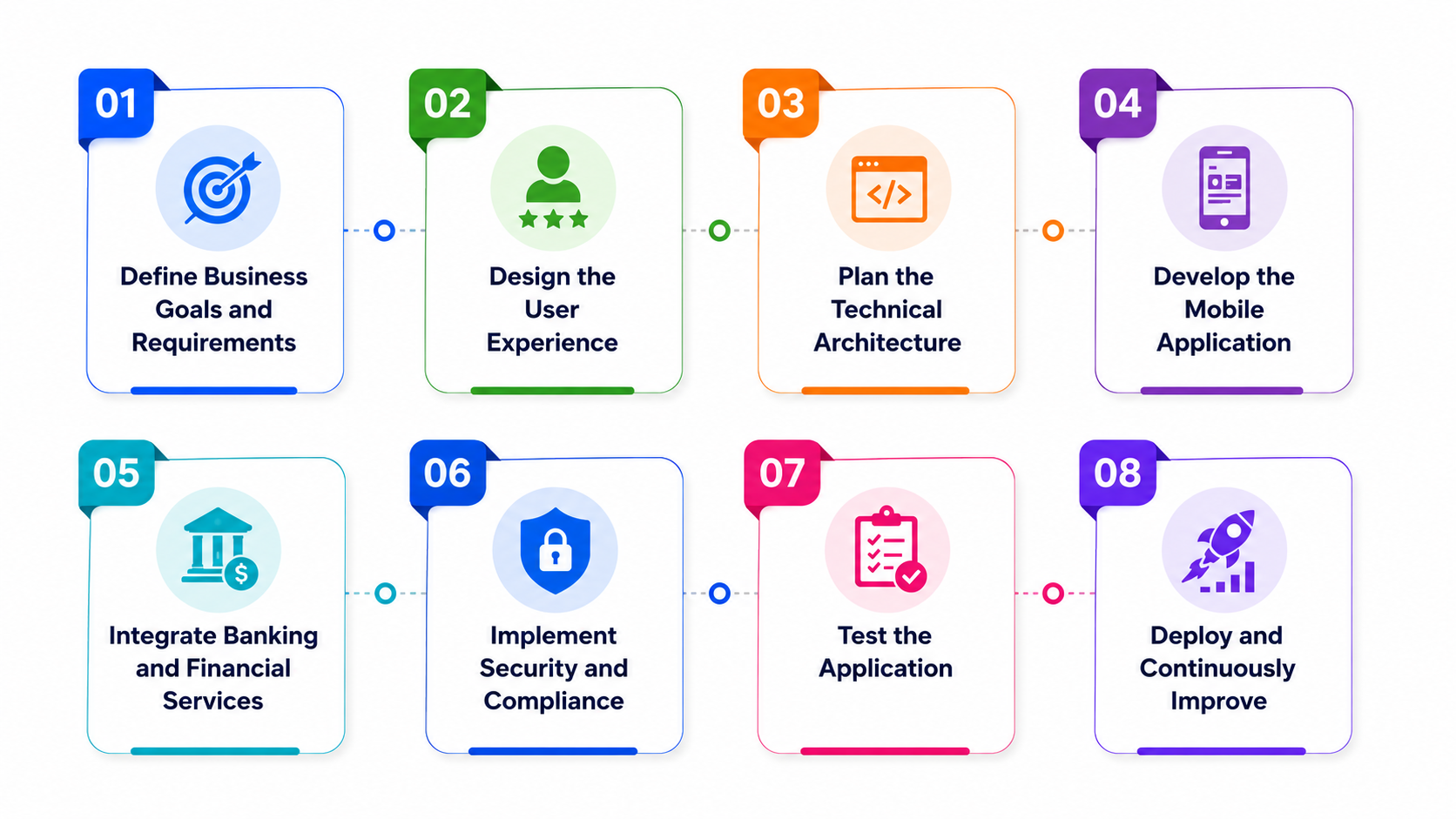
1. Define Business Goals and Requirements
The first stage is understanding the institution's business model, target customers, banking services, geographic market, regulatory environment, and competitive landscape. The team identifies whether the application will support retail banking, corporate banking, digital wallets, lending, payments, or multiple financial services.
- Identify target customers
- Define business objectives
- Analyze competitors
- Establish regulatory requirements
2. Design the User Experience
Banking users need interfaces that feel simple, trustworthy, and predictable. Designers create user journeys for registration, authentication, account management, transfers, payments, cards, notifications, and customer support. Prototypes are tested before development to identify usability issues and reduce expensive changes later.
- Create user journeys
- Develop wireframes
- Build interactive prototypes
- Test usability
3. Plan the Technical Architecture
The architecture determines how the application communicates with backend systems, databases, payment services, authentication providers, and external APIs. Developers select appropriate technologies and establish requirements for scalability, availability, data protection, performance, monitoring, and disaster recovery.
- Select technology stack
- Design API architecture
- Plan database structure
- Define security architecture
4. Develop the Mobile Application
Developers build the customer-facing mobile application and connect it with backend services. Depending on the business strategy, organizations can develop native iOS and Android applications or use cross-platform technologies. Development normally follows an iterative approach, allowing teams to test and improve individual modules.
- Build application modules
- Integrate APIs
- Implement authentication
- Develop transaction workflows
5. Integrate Banking and Financial Services
A banking application needs connections with core banking platforms and external financial systems. Integrations can include payment gateways, card processors, KYC services, credit bureaus, notification systems, analytics platforms, and third-party financial APIs.
- Connect core banking systems
- Integrate payment services
- Add KYC verification
- Connect third-party APIs
6. Implement Security and Compliance
Security should not be treated as a final development step. The application should use encryption, secure authentication, authorization controls, session management, fraud monitoring, secure API practices, and appropriate compliance controls throughout the development lifecycle.
- Encrypt sensitive information
- Implement MFA
- Monitor suspicious activity
- Conduct security testing
7. Test the Application
Testing covers functional performance as well as security, usability, compatibility, scalability, and transaction accuracy. Banking applications should be tested across devices and operating systems while simulated transaction scenarios help identify failures before customers encounter them.
- Perform functional testing
- Conduct security testing
- Test application performance
- Validate transaction accuracy
8. Deploy and Continuously Improve
After successful testing and compliance reviews, the application can be deployed through appropriate app distribution channels and production infrastructure. Development does not end at launch. Monitoring, analytics, security updates, customer feedback, and new financial services are necessary for long-term growth.
- Monitor application performance
- Analyze customer behavior
- Release security updates
- Add new capabilities
Turn Digital Banking into a Competitive Advantage: Key Benefits of Mobile Banking Apps
Mobile banking applications create value for both financial institutions and their customers. Beyond convenience, they can strengthen customer engagement, streamline operations, increase digital transaction volumes, and provide financial businesses with new opportunities to deliver personalized services at scale.
1. 24/7 Customer Accessibility
Mobile banking allows customers to access essential custom financial services without depending on branch operating hours. Users can check balances, transfer money, pay bills, manage cards, and review transactions whenever required, creating a more convenient and flexible banking experience.
2. Improved Customer Engagement
A mobile app provides a direct digital communication channel between financial institutions and customers. Personalized notifications, financial insights, product recommendations, and timely alerts can keep users engaged while helping businesses understand customer behavior and preferences.
3. Reduced Operational Costs
Digital banking can reduce dependence on manual processes and branch-based services. Automated transactions, digital statements, self-service features, and AI-powered support can handle routine activities efficiently, allowing financial institutions to optimize resources and focus employees on higher-value operations.
4. Faster Transactions
Mobile applications can make payments and account transfers considerably more convenient. Customers can initiate transactions directly from their devices while receiving immediate status updates and notifications, reducing unnecessary waiting and improving transparency.
5. Stronger Customer Retention
A smooth digital experience can influence whether customers continue using a financial service. Features such as easy navigation, personalized insights, card controls, alerts, and responsive support can make the application more useful in customers' everyday financial activities.
6. Scalable Financial Services
A well-designed application creates a foundation for expanding digital products. Financial institutions can introduce lending, investment services, insurance, savings tools, digital cards, and other capabilities without requiring customers to move to entirely different platforms.
Must-Have Mobile Banking App Features for a Modern Financial Platform
The feature set of a mobile banking application depends on its target audience, business model, market, and regulatory requirements. However, successful applications typically combine essential banking functions with strong security, personalization, communication, and customer-support capabilities.
1. Secure User Registration and Login
Registration should provide a smooth onboarding experience while maintaining strong identity verification. Users may authenticate through passwords, PINs, one-time passwords, biometrics, or multi-factor authentication depending on risk levels and regulatory requirements.
- Digital account registration
- OTP verification
- Biometric authentication
- Multi-factor authentication
2. Account Management
Customers should be able to view balances, account details, transaction histories, statements, and linked accounts from a centralized dashboard. Clear financial information helps users understand their current position without navigating complicated menus.
- Balance monitoring
- Transaction history
- Digital statements
- Multiple account management
3. Money Transfers and Payments
Transfers are among the most important banking app capabilities. Depending on the market, applications can support internal transfers, bank-to-bank transfers, peer-to-peer payments, scheduled payments, bill payments, and other supported payment methods.
- Fund transfers
- Bill payments
- Scheduled payments
- Beneficiary management
4. Card Management
Customers increasingly expect control over their cards directly through mobile applications. Card-management functionality can allow users to view card details, temporarily block cards, manage transaction settings, and receive instant transaction alerts.
- Card controls
- Card activation
- Temporary blocking
- Transaction alerts
5. Real-Time Notifications
Notifications keep customers informed about account activity. Push notifications can alert users about transactions, payments, login attempts, balance changes, card activity, and other important events, improving both transparency and security.
- Transaction alerts
- Security notifications
- Payment reminders
- Account updates
6. Financial Insights and Budgeting
Modern banking applications can move beyond transaction management by helping customers understand their financial behavior. Categorization, spending summaries, budgeting tools, savings goals, and personalized insights can make the application more valuable.
- Expense categorization
- Budget tracking
- Savings goals
- Spending insights
7. Customer Support
Integrated support can help customers resolve common issues without visiting a branch. Applications can provide FAQs, secure messaging, chatbot assistance, support tickets, and escalation to human representatives when required.
- In-app assistance
- AI chatbot support
- Secure messaging
- Support ticket management
8. Fraud Detection and Security Monitoring
Security features should continuously monitor suspicious behavior and transactions. Risk-based authentication, transaction monitoring, device intelligence, behavioral analysis, and automated alerts can help financial institutions identify potentially fraudulent activity.
- Suspicious transaction monitoring
- Risk-based authentication
- Device monitoring
- Fraud alerts
How Much Does It Cost to Build a Mobile Banking App?
Mobile banking app development costs vary significantly because banking applications involve specialized security, integrations, compliance, backend infrastructure, and testing requirements. A basic application with limited banking functionality can cost considerably less than a comprehensive banking ecosystem with advanced analytics, AI, biometric security, multiple integrations, and enterprise infrastructure.
Mobile Banking App Type | Estimated Development Cost | Approx. Timeline |
Basic Banking App | $30,000–$60,000 | 3–5 months |
Medium-Complexity Banking App | $60,000–$120,000 | 5–8 months |
Advanced Banking Platform | $120,000–$250,000+ | 8–12+ months |
Enterprise Banking Ecosystem | $250,000+ | 12+ months |
These figures are broad estimates rather than fixed quotations. The actual budget depends on the number of platforms, features, integrations, security architecture, development location, technology choices, testing requirements, compliance needs, and post-launch maintenance. For a business planning a mobile banking product, defining the MVP first can help control initial investment while creating a foundation for future features.
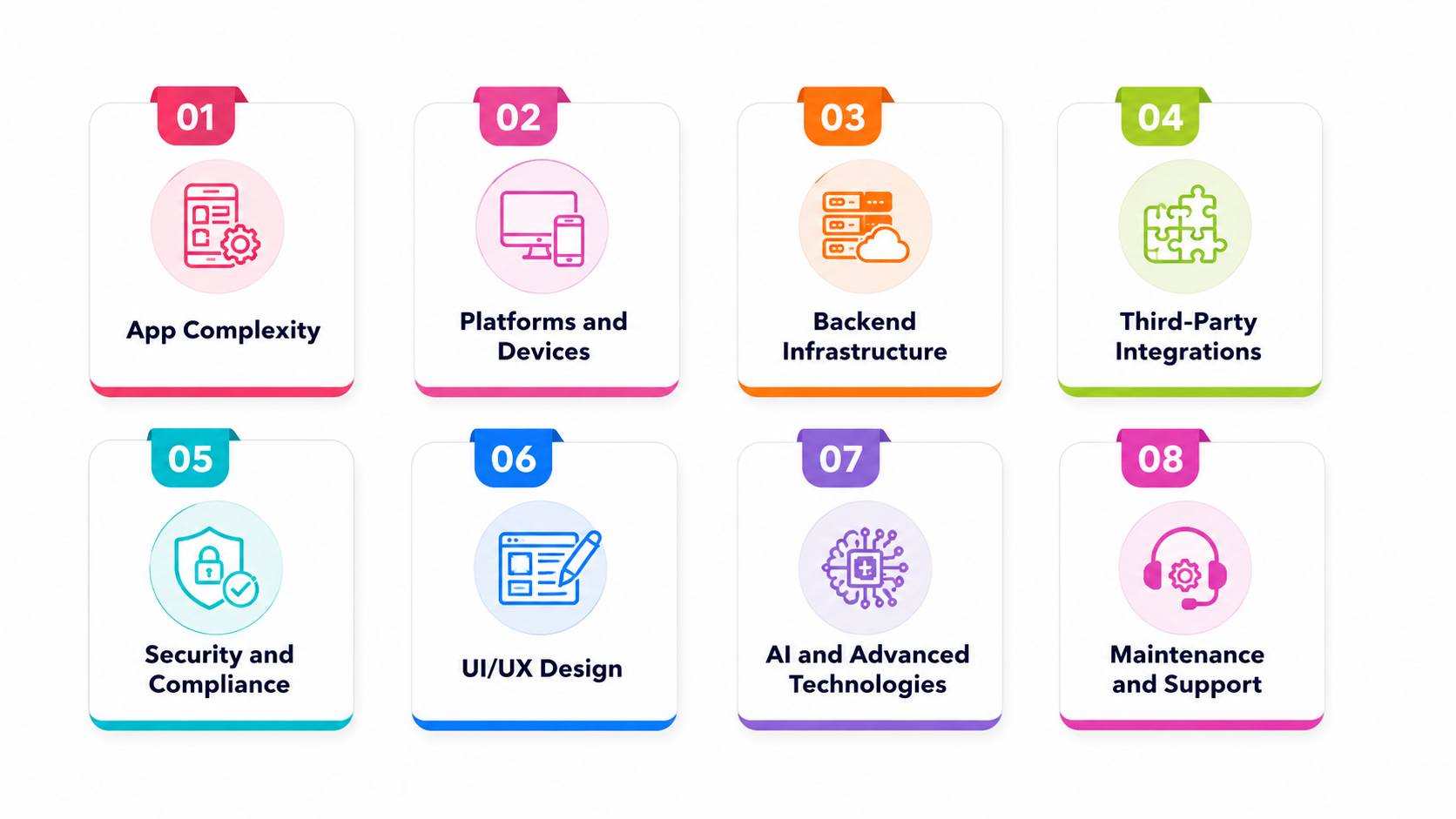
What Determines the Cost of Mobile Banking App Development?
The final development budget is influenced by much more than the number of screens. Financial applications require specialized infrastructure and integrations, meaning seemingly small requirements can affect architecture, testing, compliance, and development effort. Understanding the major cost drivers helps businesses create realistic budgets before development begins.
1. App Complexity
The number and sophistication of banking features directly influence development effort. A simple account-management application requires fewer resources than a platform supporting payments, lending, investments, cards, budgeting, AI, and advanced financial analytics.
2. Platforms and Devices
Building for iOS and Android can require additional development and testing resources. Businesses must also consider device compatibility, screen sizes, operating-system versions, accessibility, and performance requirements.
3. Backend Infrastructure
The backend manages accounts, transactions, authentication, APIs, notifications, databases, and business logic. A scalable banking backend requires careful architecture, monitoring, redundancy, security controls, and reliable data management.
4. Third-Party Integrations
Banking applications frequently depend on external services. Payment gateways, KYC providers, credit bureaus, fraud detection platforms, SMS providers, analytics systems, and core banking platforms can all introduce additional development and integration costs.
5. Security and Compliance
Security is one of the most important cost considerations. Encryption, secure authentication, access controls, vulnerability testing, fraud detection, audit logging, compliance reviews, and ongoing security monitoring require specialized expertise.
6. UI/UX Design
Banking interfaces need to balance simplicity with functionality. A professional UX process includes research, information architecture, wireframing, prototyping, usability testing, visual design, and accessibility considerations.
7. AI and Advanced Technologies
AI can add capabilities such as intelligent customer support, fraud detection, financial insights, personalized recommendations, and automated document processing. These capabilities require additional data infrastructure, model integration, testing, monitoring, and governance.
8. Maintenance and Support
A banking app requires continuous maintenance after launch. Operating-system updates, security patches, API changes, performance optimization, bug fixes, compliance updates, and feature enhancements contribute to ongoing costs.
Conclusion
Mobile banking app development has become a strategic investment for banks, fintech companies, financial institutions, and businesses looking to deliver modern digital financial services. From account management and payments to AI-powered insights and fraud monitoring, a thoughtfully designed application can transform how customers interact with financial products.
However, successful banking app development requires more than attractive screens. Security, scalability, compliance, backend architecture, integrations, performance, and user experience must work together from the beginning.
ToXSL Technologies, a leading FinTech app development company, helps businesses transform banking ideas into scalable digital solutions with modern technologies, secure architectures, intuitive interfaces, powerful integrations, and business-focused development strategies. Whether you are planning an MVP or an enterprise-grade banking ecosystem, the right development approach can help you build a reliable foundation for long-term digital growth. Ready to build a secure and scalable mobile banking application? Partner with ToXSL Technologies to turn your banking vision into a powerful digital experience.
Frequently Asked Questions
1. How can a mobile banking app benefit our financial business?
A mobile banking app can improve customer accessibility, automate routine services, increase digital engagement, and create opportunities for personalized financial products.
- 24/7 customer access
- Lower operational workload
- Better engagement
- Scalable services
2. How long does it take to develop a mobile banking app?
Development commonly takes three to twelve months or longer, depending on functionality, integrations, security requirements, platforms, testing, and regulatory complexity.
- Basic MVP: 3–5 months
- Medium app: 5–8 months
- Advanced platform: 8–12+ months
- Enterprise solution: 12+ months
3. What security features should businesses prioritize?
Financial businesses should prioritize layered security covering authentication, encryption, authorization, fraud monitoring, secure APIs, device security, audit trails, and continuous vulnerability testing.
- Multi-factor authentication
- Biometric verification
- Data encryption
- Fraud monitoring
4. Can a banking app integrate with our existing banking system?
Yes. Mobile banking applications can integrate with existing core banking platforms and external services through secure APIs, middleware, and appropriate integration architectures.
- Core banking APIs
- Payment gateways
- KYC providers
- Third-party financial services
5. Should we build an MVP before developing the complete banking platform?
An MVP can help businesses validate workflows, understand customer behavior, prioritize features, and reduce initial development risk before investing in a larger digital banking ecosystem.
- Validate the concept
- Test core workflows
- Gather customer feedback
- Plan future features
6. How can AI improve a mobile banking application?
AI can enhance customer support, fraud detection, personalization, financial insights, document processing, and automation while helping financial businesses deliver more responsive digital experiences.
- AI-powered assistance
- Fraud detection
- Personalized recommendations
- Automated workflows