








































According to Fortune Business Insights, the global insurtech market is projected to grow from USD 23.54 billion in 2026 to USD 132.71 billion by 2034, at a CAGR of 24.1%. Another 2026 market projection from Precedence Research estimates the global insurtech market will reach USD 50.03 billion in 2026 and expand significantly through 2035. These numbers clearly show where the industry is headed.
In 2026 and beyond, insurers that still rely on rigid legacy systems will find it increasingly difficult to keep up with rising customer expectations, stricter compliance requirements, and the demand for faster, more personalized service. That is exactly why custom insurance software development services have become a strategic necessity rather than a technical upgrade.
Key Highlights
- Custom platforms align with your underwriting rules, claims processes, policy administration workflows, and compliance requirements.
- From fraud detection and claims automation to customer support and underwriting assistance, AI is reshaping how insurers deliver speed and accuracy.
- Global market forecasts show strong long-term growth, proving that insurers are prioritizing digital-first platforms and intelligent automation.
- It helps reduce manual tasks, minimize claim delays, improve agent productivity, and deliver seamless omnichannel service.
- A basic MVP can be budget-friendly, while enterprise-grade insurance ecosystems require higher investment due to security, AI, and third-party integrations.
- The best insurance software development company brings domain knowledge, compliance expertise, and scalable architecture.
Why Should Businesses Invest in Custom Insurance Software Development Services?
Insurance businesses operate in a highly process-driven and regulation-heavy environment, where every stage of the customer journey demands speed, accuracy, security, and consistency. From onboarding policyholders and assessing risks to policy renewals, claims adjudication, and compliance reporting, insurers handle complex workflows that leave little room for error.
In such a demanding ecosystem, relying on outdated systems or generic software can slow down operations, increase inefficiencies, and make it difficult to meet rising customer expectations. This is why investing in custom insurance software development services has become a strategic move for modern insurance companies looking to improve performance, strengthen compliance, and stay competitive in an increasingly digital market.
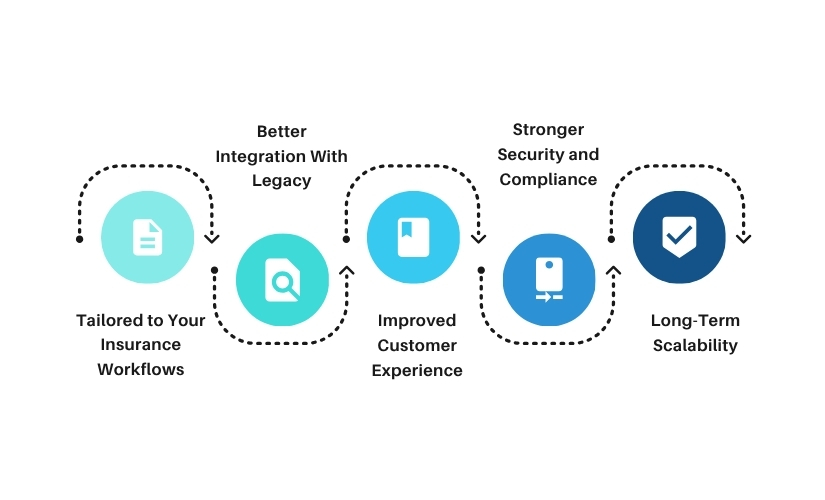
1. Tailored to Your Insurance Workflows
One of the strongest reasons businesses should invest in custom insurance software development services is the ability to build a platform that matches their exact operational model. No two insurance businesses work the same way. A life insurance provider manages different processes and compliance requirements than a health insurer, a property and casualty carrier, a broker network, an MGA, or a TPA. Each organization has its own underwriting rules, premium structures, policy management methods, customer communication preferences, and claims workflows. Off-the-shelf software often forces businesses to adapt their processes to fit the software, which can create inefficiencies and limit flexibility.
2. Better Integration With Legacy
Another major reason to invest in custom insurance software development services is the ability to integrate seamlessly with the tools and systems already in use across the business. Most insurance companies do not operate on a single platform. Over time, they often accumulate a mix of CRMs, payment gateways, KYC solutions, document storage systems, fraud detection tools, analytics platforms, customer support software, and regulatory reporting tools. In many cases, they may also still rely on legacy policy administration systems that are deeply embedded in their operations.
3. Improved Customer Experience
Customer expectations in the insurance industry have changed dramatically. Today’s policyholders expect the same digital convenience they receive from banking apps, eCommerce platforms, and telehealth services. They no longer want to wait days for updates, rely on paper-heavy processes, or struggle through complicated claims procedures. Instead, they want fast access, transparency, self-service options, and seamless digital interactions across every touchpoint.
4. Stronger Security and Compliance
Insurance companies handle large volumes of highly sensitive information, including personal details, financial records, policy documents, identity verification data, and in some cases health-related information. Because of this, security and compliance are not optional, they are essential. A single breach, compliance failure, or unauthorized access incident can result in financial loss, reputational damage, legal complications, and loss of customer trust. This makes security one of the most critical reasons to invest in custom insurance software development services.
5. Long-Term Scalability
As insurance businesses grow, their technology needs become more complex. A company that starts with a limited product portfolio may later expand into new insurance categories, enter new geographic markets, increase policy volumes, onboard more agents or brokers, or launch digital channels such as mobile apps and self-service portals. When growth happens, software that once seemed sufficient can quickly become a bottleneck - especially if it was never designed to scale.
Revolutionize Your Insurance Platform With AI-Driven Solutions
Artificial intelligence is no longer optional in modern insurance. It is quickly becoming a competitive differentiator. In fact, the global AI in insurance market is forecast to grow rapidly from 2026 onward, with strong adoption across underwriting, claims, customer service, and fraud prevention.
1. AI-Powered Claims Processing
AI can automate:
- First notice of loss (FNOL) intake
- Document extraction
- Damage image analysis
- Claim triage and routing
- Fraud flagging
- Settlement recommendations
This reduces claim turnaround times and operational overhead.
2. Intelligent Underwriting
AI-driven underwriting tools can analyze structured and unstructured data faster than manual teams. They help with:
- Risk scoring
- Policy eligibility checks
- Premium prediction
- Alternative data analysis
- Automated rule-based approvals
3. Fraud Detection and Prevention
Fraud remains a major challenge in insurance. AI models can detect unusual patterns in:
- Claims history
- Repeated claimant behavior
- Device and location anomalies
- Suspicious documentation
- Cross-policy fraud patterns
4. Virtual Assistants and Chatbots
AI chatbots can handle:
- Quote inquiries
- Policy FAQs
- Claim status updates
- Renewal reminders
- Agent support requests
This improves customer engagement while reducing service costs.
5. Predictive Analytics
Custom insurance software with predictive analytics helps businesses:
- Forecast claim volumes
- Identify high-risk customer segments
- Predict policy lapse probability
- Optimize pricing strategies
- Improve cross-sell and upsell decisions
A Roadmap to Insurance Software Development
Developing insurance software requires a clear and strategic approach, as insurance platforms are often complex, highly regulated, and deeply connected to business operations. From policy management and underwriting to claims processing and reporting, every feature must be built with accuracy, security, and scalability in mind. That is why businesses need a proper roadmap to ensure the software is aligned with their goals and delivers long-term value.
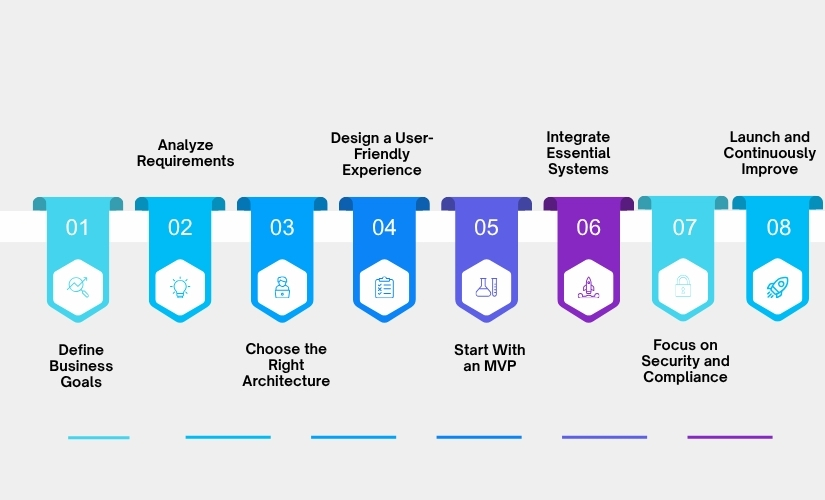
1. Define Business Goals
The first step is to understand why the software is being built and what challenges it needs to solve. Some insurance businesses may want to automate claims processing, while others may focus on improving underwriting, digitizing policy management, or enhancing customer service. Clearly defining these goals helps create a strong foundation for the entire project and ensures the final solution supports real business needs.
2. Analyze Requirements
Once the goals are clear, the next step is to identify the features, workflows, and user roles the platform should support. This includes understanding how customers, agents, brokers, underwriters, claims teams, and administrators will interact with the system. At this stage, businesses should map out important processes such as onboarding, premium calculation, policy issuance, renewals, claims filing, and reporting to make sure the platform improves efficiency across all operations.
3. Choose the Right Architecture
The technical structure of the platform plays a major role in its performance and scalability. Businesses need to decide whether they need a web platform, mobile app, or omnichannel solution, and whether the software should be built using a modular or cloud-based architecture. A strong technical foundation ensures the platform can handle future growth, support integrations, and remain flexible as business needs evolve.
4. Design a User-Friendly Experience
Insurance software is used by multiple stakeholders, including customers, agents, claims handlers, and internal teams. Each user needs a smooth and intuitive experience based on their role. A well-designed interface improves usability, speeds up tasks, reduces errors, and increases adoption. This makes UI/UX design a key step in building software that is not only functional but also easy to use.
5. Start With an MVP
Instead of building a large, feature-heavy platform all at once, businesses should begin with a Minimum Viable Product (MVP). This means launching the most essential features first, such as policy management, claims submission, dashboards, and basic reporting. An MVP helps reduce development risk, speeds up time to market, and allows businesses to gather feedback before expanding the platform with advanced features.
6. Integrate Essential Systems
Insurance businesses often rely on multiple tools such as CRMs, payment gateways, KYC solutions, document management systems, and analytics platforms. Custom insurance software should be designed to integrate with these systems so that data can move smoothly across departments. Strong integration reduces manual work, improves accuracy, and creates a more connected digital ecosystem.
7. Focus on Security and Compliance
Security and compliance should be a priority throughout the development process. Insurance companies handle sensitive customer and financial data, so the software must include features such as encryption, role-based access, audit trails, and secure authentication. It should also support compliance-ready workflows that help businesses meet industry and regulatory requirements with confidence.
8. Launch and Continuously Improve
Once the software is developed and tested, the next step is deployment. A successful launch should include team training, performance monitoring, and user feedback collection. After launch, the platform should continue to evolve through updates, optimizations, and new feature additions. Insurance software should grow with the business and adapt to changing customer expectations and market demands.
Cost to Develop Custom Insurance Software
The cost of building custom insurance software varies widely depending on features, complexity, integrations, security needs, AI capabilities, and deployment scale. A simple internal insurance dashboard may cost far less than a full enterprise-grade platform with policy administration, claims automation, mobile apps, customer portals, AI engines, analytics, and compliance tooling.
Software Type / Scope | Estimated Cost Range (USD) | Typical Timeline | Best For |
Basic MVP / Internal Tool | $20,000 – $50,000 | 2–4 months | Startups, pilot projects, internal workflows |
Mid-Level Insurance Platform | $50,000 – $120,000 | 4–8 months | SMEs, brokers, digital policy management |
Advanced Custom Insurance Software | $120,000 – $250,000 | 6–12 months | Growing insurers, TPAs, MGAs |
Enterprise-Grade Insurance Ecosystem | $250,000 – $500,000+ | 9–18+ months | Large insurers, multi-product carriers |
AI-Driven Insurance Platform | Add $30,000 – $150,000+ | Depends on scope | Fraud detection, smart claims, predictive analytics |
Emerging Technologies in the InsurTech
The insurance industry is evolving quickly as technology continues to reshape how insurers manage risk, process claims, and serve customers. In 2026 and beyond, InsurTech is focused on creating faster, smarter, and more connected insurance ecosystems. As competition increases and customer expectations rise, insurance businesses are adopting advanced technologies to improve efficiency, strengthen security, and deliver better digital experiences.
1. Artificial Intelligence
Artificial intelligence and machine learning are transforming insurance by helping businesses automate tasks, improve decision-making, and personalize services. These technologies are widely used in claims processing, underwriting, fraud detection, customer support, and risk analysis. They help insurers work faster, reduce errors, and gain better insights from data.
2. Blockchain Technology
Blockchain is gaining attention in InsurTech because it offers secure, transparent, and tamper-resistant records. It can improve policy verification, claims validation, fraud prevention, and data sharing between insurers and partners. This makes insurance operations more trustworthy and efficient.
3. Internet of Things (IoT)
IoT allows insurers to collect real-time data through connected devices such as telematics, wearables, and smart home sensors. This helps insurance companies create usage-based policies, assess risks more accurately, and improve loss prevention. It also supports more personalized pricing models.
4. Robotic Process Automation (RPA)
RPA helps automate repetitive tasks such as data entry, form verification, policy updates, and claims processing. By reducing manual work, it improves speed, lowers operational costs, and increases efficiency across insurance operations. It is especially useful for back-office workflows.
5. Predictive Analytics and Big Data
Predictive analytics helps insurers use large amounts of data to make smarter business decisions. It can improve underwriting, pricing, fraud detection, and customer retention strategies. By identifying patterns and future risks, insurers can move toward more proactive and data-driven operations.
6. Cloud Computing
Cloud computing gives insurance businesses the flexibility to scale their software, access data securely, and deploy updates faster. It supports remote access, better system integration, and cost-effective infrastructure management. Cloud-based insurance platforms are becoming essential for digital transformation.
7. Computer Vision
Computer vision helps insurance software analyze images, videos, and scanned documents. It is commonly used for vehicle damage assessment, property inspections, and document verification. This speeds up claims processing and reduces the need for manual review.
Conclusion
At ToXSL Technologies, we understand that every insurance business has unique operational challenges and goals. That’s why we deliver custom insurance software solutions designed to match your exact workflows, integrate with your existing systems, and support future innovation. Whether you need a policy administration platform, claims management system, customer portal, or AI-powered insurance solution, our team focuses on building reliable, future-ready software that drives real business value. Contact us to learn more.
Frequently Asked Questions
1. What are custom insurance software development services?
Custom insurance software development services refer to the process of designing, developing, testing, and maintaining software solutions specifically tailored to the operational needs of insurance businesses. These solutions can include policy administration systems, claims management platforms, underwriting tools, customer portals, mobile apps, broker dashboards, and AI-powered automation systems.
2. Why is custom insurance software better than off-the-shelf software?
Off-the-shelf software may be faster to deploy, but it often lacks flexibility. Custom software is designed around your exact workflows, product offerings, compliance needs, and customer experience goals. It helps businesses avoid unnecessary features while gaining full control over performance, security, and future upgrades.
3. How long does it take to build custom insurance software?
The timeline depends on the complexity of the platform. A simple MVP can take around 2 to 4 months, while a mid-level platform may take 4 to 8 months. Enterprise-grade insurance ecosystems with advanced AI, integrations, and compliance modules can take 9 to 18 months or more.
4. What features should custom insurance software include?
The ideal feature set depends on your insurance business type, but most modern platforms include policy administration, claims management, customer onboarding, underwriting, payment integration, analytics, document management, customer self-service, and role-based dashboards. AI-driven features are also becoming increasingly important.
5. Can custom insurance software be integrated with existing legacy systems?
Yes, custom insurance software can be designed to integrate smoothly with existing legacy systems and third-party tools. Many insurance businesses already rely on older policy administration systems, CRMs, payment gateways, KYC solutions, and document management platforms.