





































The global supply chain landscape is evolving faster than ever. From fluctuating customer demands and rising logistics costs to supplier disruptions and global trade uncertainties, businesses today need more control, visibility, and agility across their operations. This is where custom supply chain management software becomes a game-changing investment.
According to market estimates, the Supply Chain Management Software market size is projected to reach $56.62 billion by 2031, growing at a CAGR of 11.5%. This rapid growth reflects the increasing need for smarter, more connected, and highly adaptable supply chain systems across industries.
While off-the-shelf supply chain solutions can support basic operational requirements, they often fail to meet the unique workflows, scalability needs, and integration demands of modern businesses. In contrast, custom supply chain management software is specifically built around your business processes, allowing you to optimize inventory, automate procurement, improve logistics, and gain real-time visibility into every stage of the supply chain.
Key Highlights
- Custom SCM software improves visibility, efficiency, control, and supply chain decision-making.
- It helps businesses automate procurement, inventory, warehousing, and logistics operations.
- Real-time data tracking reduces delays, stockouts, errors, and operational inefficiencies.
- Custom solutions integrate easily with ERP, CRM, IoT, and analytics tools.
- Businesses gain scalability, flexibility, and workflows tailored to unique supply chains.
- Development costs vary based on features, integrations, complexity, and deployment model.
Why Does Your Business Need Custom Supply Chain Management Software in 2026?
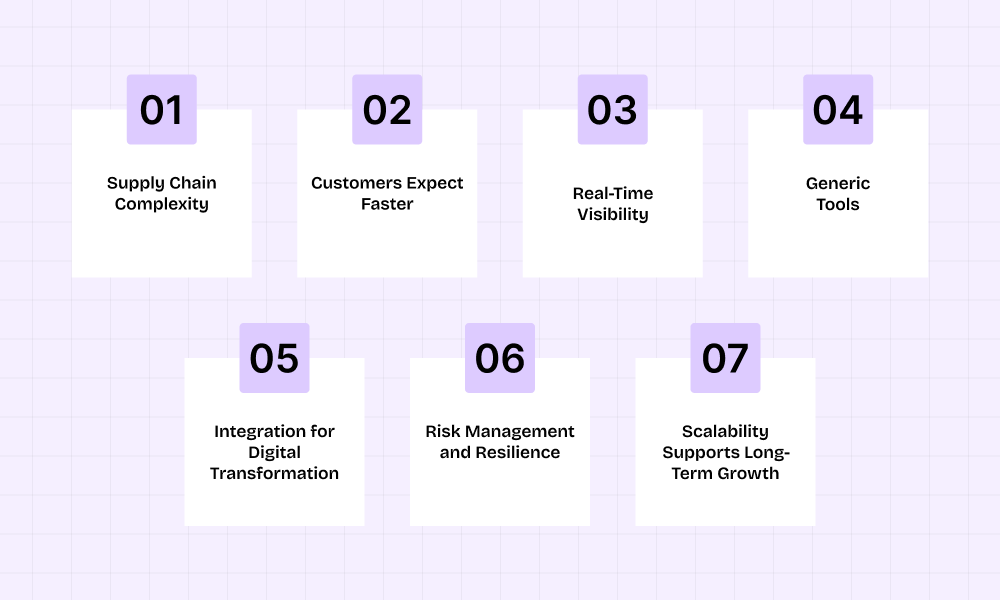
In 2026, supply chains are no longer just operational back-office functions - they are strategic growth drivers. Businesses that rely on disconnected spreadsheets, manual approvals, or outdated legacy systems risk falling behind in speed, efficiency, and customer satisfaction. Here’s why your business needs custom supply chain management software in 2026:
1. Supply Chain Complexity
Modern supply chains involve multiple suppliers, warehouses, transport providers, and sales channels. Managing these moving parts manually or through rigid software creates inefficiencies. Custom SCM software provides centralized control and real-time coordination across all touchpoints.
2. Customers Expect Faster
Today’s customers expect accurate delivery timelines, real-time order updates, and product availability. Custom SCM software helps businesses optimize inventory levels, track shipments in real time, and improve fulfillment accuracy.
3. Real-Time Visibility
In 2026, businesses need instant access to supply chain data to respond quickly to disruptions offers dashboards, alerts, and analytics that enable proactive decision-making instead of reactive firefighting.
4. Generic Tools
Every business has unique supplier relationships, approval hierarchies, inventory models, and logistics strategies. Off-the-shelf platforms may force businesses to adapt to software limitations. Custom SCM software is designed around your exact processes, not the other way around.
5. Integration for Digital Transformation
Businesses are increasingly using ERP systems, CRM tools, accounting platforms, IoT devices, AI engines, and warehouse automation technologies. Custom supply chain software can integrate seamlessly with these systems, creating a connected digital ecosystem.
6. Risk Management and Resilience
From supplier shortages to transportation delays and geopolitical uncertainties, disruptions are common. Custom SCM software helps businesses build resilience through predictive analytics, supplier diversification tracking, automated alerts, and contingency planning.
7. Scalability Supports Long-Term Growth
As your business expands into new markets, adds product lines, or increases order volume, your supply chain becomes more complex. Custom SCM software grows with your business, allowing new modules, integrations, and capabilities to be added without replacing the entire system.
Benefits of Custom Supply Chain Management Software
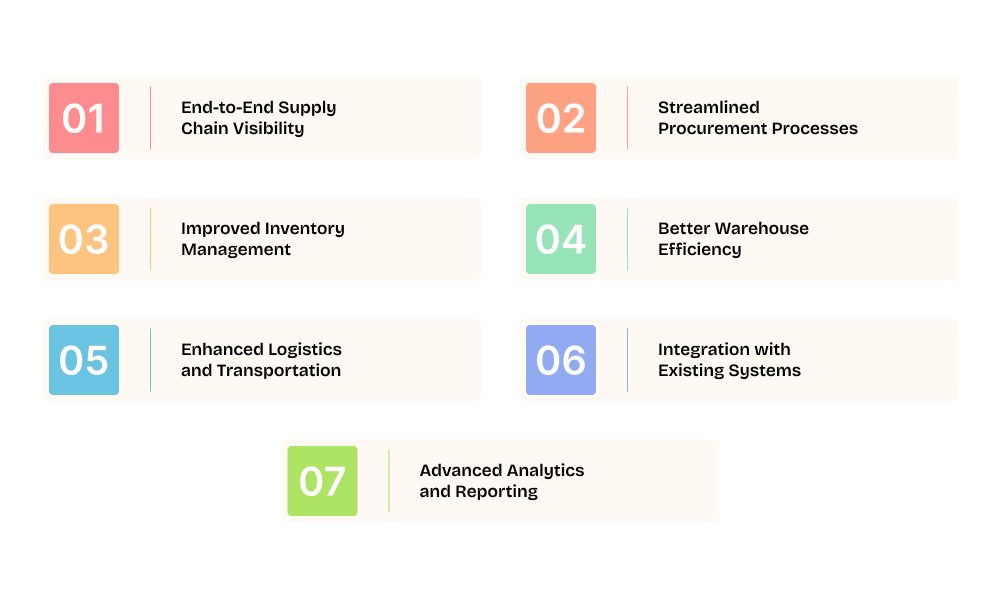
Investing in custom supply chain management software goes beyond basic automation. It empowers businesses to gain full control over their operations, improve efficiency, reduce costs, and make smarter decisions. With a tailored solution, companies can align their supply chain processes with specific business goals, ensuring long-term scalability and growth.
1. End-to-End Supply Chain Visibility
Real-time visibility is essential for managing complex supply chain operations efficiently. Custom SCM software allows businesses to monitor every stage of the supply chain with complete transparency.
- Track inventory levels, supplier performance, and shipment status in real time
- Identify bottlenecks, delays, and inefficiencies early to avoid disruptions
- Enable faster, data-driven decision-making across departments
2. Streamlined Procurement Processes
Procurement is a critical function that directly impacts cost and efficiency. Custom SCM solutions simplify and automate procurement workflows for better control and accuracy.
- Automate vendor onboarding, purchase requests, and approval workflows
- Reduce manual errors and improve compliance with procurement policies
- Strengthen supplier relationships through faster and more transparent processes
3. Improved Inventory Management
Efficient inventory management helps businesses balance supply and demand while minimizing costs and losses.
- Monitor stock levels with automated tracking and real-time updates
- Set reorder alerts and use demand forecasting to prevent stockouts
- Reduce excess inventory and optimize storage and carrying costs
4. Better Warehouse Efficiency
Warehouse operations play a key role in order fulfillment and customer satisfaction. Custom SCM software enhances warehouse productivity and accuracy.
- Optimize storage layouts and streamline picking and packing processes
- Track goods movement within the warehouse for better control
- Minimize handling errors and improve order accuracy and speed
5. Enhanced Logistics and Transportation
Managing transportation efficiently ensures timely deliveries and cost savings. Custom SCM systems provide better control over logistics operations.
- Monitor delivery schedules, routes, and carrier performance
- Optimize transportation routes to reduce delays and fuel costs
- Improve last-mile delivery efficiency and customer satisfaction
6. Integration with Existing Systems
Seamless integration with existing tools ensures smooth data flow and eliminates operational silos within the organization.
- Connect with ERP, CRM, accounting software, and eCommerce platforms
- Integrate barcode scanners, IoT devices, and GPS tracking systems
- Reduce manual data entry and improve overall operational efficiency
7. Advanced Analytics and Reporting
Data-driven insights are essential for improving supply chain performance and planning future strategies effectively.
- Generate detailed reports on supplier performance and lead times
- Analyze inventory turnover, procurement costs, and order fulfillment rates
- Use insights for better forecasting, planning, and decision-making
Top Use Cases of Custom Supply Chain Management Software
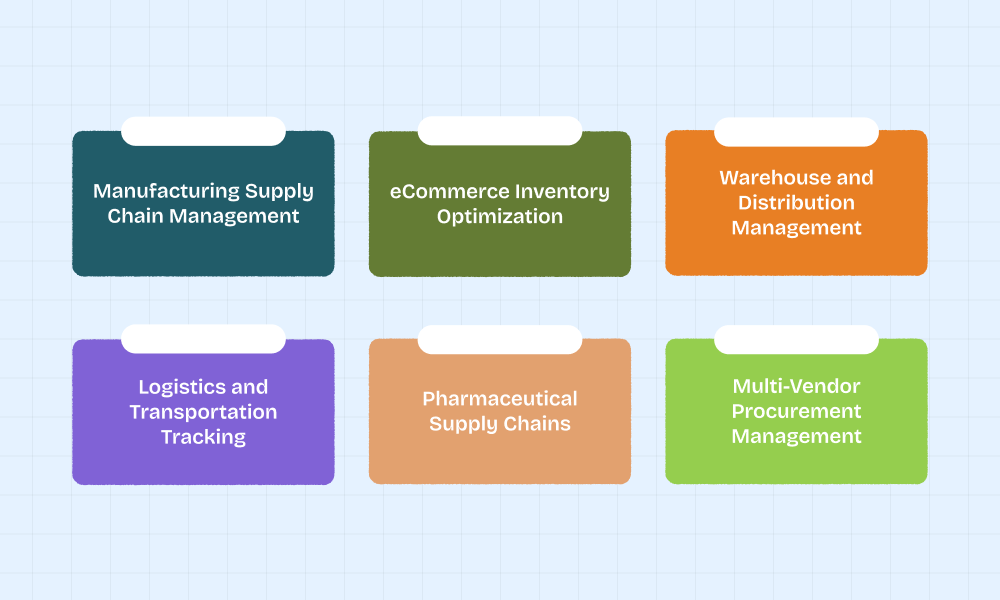
Custom SCM software can be adapted for a wide variety of industries and operational models. Here are some of the most common use cases:
1. Manufacturing Supply Chain Management
Manufacturers need to coordinate raw material sourcing, production planning, inventory control, and distribution. Custom SCM software helps track material availability, reduce downtime, and synchronize production with demand.
2. eCommerce Inventory Optimization
Retailers and eCommerce businesses need accurate stock visibility across multiple sales channels, warehouses, and suppliers. A custom SCM system ensures synchronized inventory and prevents overselling or stock shortages.
3. Warehouse and Distribution Management
Distribution businesses often manage high SKU volumes, multiple warehouse locations, and fast-moving orders. Custom SCM software helps optimize storage, picking, dispatching, and transfer management.
4. Logistics and Transportation Tracking
Logistics companies need route planning, delivery monitoring, vehicle tracking, and proof-of-delivery systems. A custom SCM platform improves shipment visibility and transportation efficiency.
5. Pharmaceutical Supply Chains
Healthcare organizations require strict control over medical inventory, vendor compliance, expiration dates, and cold-chain logistics. Custom SCM software ensures accuracy, traceability, and regulatory readiness.
6. Multi-Vendor Procurement Management
Enterprises working with multiple vendors often struggle with price comparisons, lead times, and supplier performance tracking. Custom SCM software centralizes vendor data and streamlines procurement decisions.
Steps to Develop Custom Supply Chain Management Software
Developing custom supply chain management software requires a structured approach to ensure the solution aligns with your business operations, supply chain workflows, and long-term goals. Below are the key steps involved in the custom supply chain software development process.
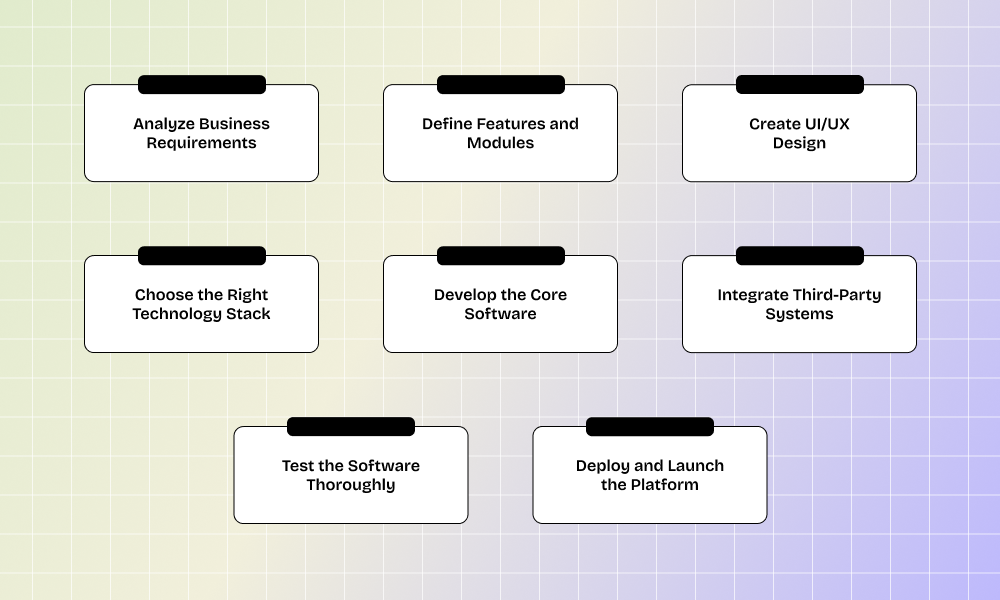
1. Analyze Business Requirements
Understanding your business needs is the foundation of building effective SCM software. This step focuses on identifying challenges, workflows, and goals to ensure the solution aligns with your operations.
- Identify key supply chain challenges and operational gaps
- Define business goals and expected outcomes
- Analyze workflows across procurement, inventory, and logistics
- Prioritize processes that need automation and improvement
2. Define Features and Modules
Once requirements are clear, outlining the right features and modules helps shape a structured development roadmap for your SCM system.
- List essential modules like inventory and supplier management
- Define features such as order tracking and reporting tools
- Plan analytics dashboards for data-driven decisions
- Create a clear roadmap for development phases
3. Create UI/UX Design
A well-designed interface ensures the software is easy to use for all teams involved in the supply chain process.
- Design intuitive dashboards and user-friendly layouts
- Create wireframes and user journey maps
- Build role-based interfaces for different users
- Focus on improving usability and user experience
4. Choose the Right Technology Stack
Selecting suitable technologies ensures your SCM software performs efficiently and scales with business growth.
- Choose reliable backend and frontend technologies
- Select secure and scalable database solutions
- Decide on cloud infrastructure and hosting platforms
- Ensure compatibility with web and mobile platforms
5. Develop the Core Software
This phase involves turning ideas into a functional system by building the main modules and workflows.
- Develop backend logic and system architecture
- Build interactive frontend dashboards
- Implement automation rules and workflows
- Create modules for inventory, procurement, and logistics
6. Integrate Third-Party Systems
Integration ensures smooth data flow between your SCM software and other essential business tools.
- Connect with ERP, CRM, and accounting systems
- Integrate barcode, RFID, and GPS technologies
- Enable connections with eCommerce platforms
- Support IoT devices for real-time tracking
7. Test the Software Thoroughly
Testing ensures the system is reliable, secure, and ready for real-world operations without errors.
- Perform functional and performance testing
- Conduct security and usability checks
- Identify and fix bugs or system issues
- Ensure system stability under real conditions
8. Deploy and Launch the Platform
After testing, the software is deployed and made ready for business use with proper setup and onboarding.
- Configure servers and cloud environments
- Manage deployment with DevOps practices
- Onboard users and provide initial training
- Plan phased rollout for smooth adoption
How Much Does It Cost to Develop a Custom Supply Chain Management Software?
The cost to develop custom supply chain management software depends on the platform’s complexity, features, integrations, and business requirements. A basic solution with essential modules like inventory tracking, procurement management, and order monitoring will cost less than an advanced system with warehouse automation, shipment tracking, ERP integrations, analytics dashboards, and AI-based forecasting.
Development Stage / Module | Estimated Cost (USD) | Description |
|---|---|---|
Discovery & Requirement Analysis | $3,000 – $8,000 | Business analysis, process mapping, project planning, and feature finalization. |
UI/UX Design | $4,000 – $12,000 | Designing dashboards, user flows, wireframes, and responsive interfaces. |
Basic SCM MVP Development | $30,000 – $60,000 | Core modules like inventory management, procurement, vendor management, and reporting. |
Mid-Level Custom SCM Solution | $60,000 – $120,000 | Includes warehouse management, shipment tracking, integrations, and analytics. |
Enterprise-Grade SCM Platform | $120,000 – $250,000+ | Advanced automation, AI forecasting, multi-location support, and scalable architecture. |
Mobile App Development (Optional) | $15,000 – $50,000 | Mobile access for warehouse staff, managers, and delivery teams. |
Third-Party Integrations | $5,000 – $30,000 | ERP, CRM, accounting software, GPS, barcode/RFID, and API integrations. |
QA Testing & Security | $5,000 – $20,000 | Functional testing, performance checks, security validation, and bug fixing. |
Deployment & Cloud Setup | $3,000 – $15,000 | Cloud hosting, server setup, DevOps, and production deployment. |
Annual Maintenance & Support | 15% – 25% of project cost | Ongoing updates, monitoring, bug fixes, and future enhancements. |
Key Factors Affecting Custom Supply Chain Software Cost
The cost of custom supply chain management software can vary significantly depending on the features, integrations, scalability, and level of automation required. Since every business has different supply chain workflows, the final development cost is influenced by multiple technical and operational factors. Understanding these factors helps businesses plan their budget more effectively and choose the right app development approach.
- Project Complexity: A basic SCM platform with limited modules costs less than a complex enterprise-grade solution with advanced automation and analytics.
- Number of Features & Modules: Adding modules like inventory management, procurement, warehouse management, logistics tracking, demand forecasting, and reporting increases the overall cost.
- UI/UX Design Requirements: Custom dashboards, role-based access panels, mobile responsiveness, and user-friendly interfaces require more design and development effort.
- Third-Party Integrations: Integrating with ERP, CRM, WMS, TMS, accounting software, GPS, RFID, barcode systems, or eCommerce platforms adds to the development budget.
- Web and Mobile Platform Support: A web-only SCM system is usually more affordable, while adding iOS or Android mobile apps increases cost and development time.
- Cloud Infrastructure & Deployment: The choice of cloud hosting, server architecture, DevOps setup, and deployment model affects the total project cost.
Conclusion
At ToXSL Technologies, we understand that every business has unique supply chain challenges and goals. As a trusted software development company, we specialize in building custom supply chain management solutions that are scalable, secure, and aligned with your operational needs. Whether you need a basic SCM platform, an advanced enterprise solution, or a feature-rich system with AI and automation, our team can help you transform your supply chain into a smarter, more efficient digital ecosystem.
If you’re planning to modernize your operations in 2026 and beyond, ToXSL Technologies is here to help you design and develop a powerful custom SCM solution that drives productivity, reduces costs, and supports sustainable business growth. Contact us today.
Frequently Asked Questions
1. What is custom supply chain management software?
Custom supply chain management software is a tailored digital solution designed specifically to manage and optimize your business’s supply chain operations. Unlike ready-made software, it is built according to your workflows, processes, and business goals, making it more flexible and efficient for long-term use.
- Designed around your unique business operations
- Helps manage procurement, inventory, logistics, and warehousing
- Offers better flexibility than off-the-shelf solutions
- Can scale as your business grows
2. How long does it take to build custom supply chain management software?
The time to develop a custom SCM software varies depending on the project scope, feature set, and technical complexity. A simple MVP can be developed faster, while advanced platforms with multiple modules and integrations require more time.
- Basic MVP may take 3–5 months
- Mid-level solutions often take 5–8 months
- Enterprise-grade platforms may take 8–12+ months
- Timelines depend on features, integrations, and testing needs
3. How secure is custom supply chain management software?
Security is critical as SCM systems handle sensitive business and operational data. Custom solutions offer advanced security features tailored to business needs.
- Implements data encryption and secure authentication methods
- Provides role-based access control to restrict sensitive information
- Ensures compliance with industry security standards and protocols
- Regular updates and monitoring to prevent cyber threats
4. Can custom SCM software support multi-location and global operations?
Modern businesses often operate across multiple locations and regions. Custom SCM solutions are designed to manage such complex operations efficiently.
- Centralizes data across warehouses, suppliers, and distribution centers
- Supports multi-currency and multi-language functionalities
- Enables real-time tracking of global shipments and inventory
5. Why choose custom supply chain management software over off-the-shelf solutions?
Custom supply chain management software gives businesses greater flexibility, better integration capabilities, and features tailored to their exact operational requirements. While off-the-shelf tools may work for general use, they often lack the customization and scalability needed for complex supply chains.
- Built for your specific workflows and processes
- Easier integration with existing business systems
- More scalable for future growth
- Better long-term ROI and operational efficiency
- Eliminates unnecessary features found in generic software
6. What role does automation play in SCM software?
Automation is one of the key benefits of custom SCM software, helping businesses reduce manual effort and errors.
- Automates repetitive tasks like order processing and inventory updates
- Reduces human errors and improves operational accuracy
- Speeds up workflows across procurement, warehousing, and logistics
- Enhances productivity and reduces operational costs