







































Financial software development has become one of the most critical pillars of modern digital transformation. From banking apps and trading platforms to accounting systems and fintech startups, financial software powers the global economy by enabling secure, fast, and intelligent financial operations.
With increasing digital adoption, regulatory pressure, and demand for real-time financial insights, businesses are investing heavily in custom financial software solutions that are scalable, secure, and user-centric.
The global custom software development market is expected to experience rapid expansion, reaching a projected revenue of $334.49 billion by 2034, driven by a strong CAGR of 22.71% (2025–2034). This growth reflects the increasing reliance on tailored software systems across industries, especially in finance, where precision and security are non-negotiable. In this guide, we explore everything you need to know about financial software development - its components, technologies, architecture, benefits, challenges, and future trends.
Key Highlights
- Financial software development is a core driver of digital transformation in banking, fintech, insurance, and investment industries.s
- Security and compliance remain the highest priorities, with technologies such as encryption, MFA, and regulatory frameworks.
- Modern financial systems increasingly rely on AI, machine learning, and automation to enhance fraud detection, risk analysis, customer support, and financial forecasting.
- Cloud-native and microservices-based architectures are becoming standard, offering scalability, and flexibility.
- Custom financial software solutions provide significant advantages over off-the-shelf products.
Why Financial Software is Important Today
Financial operations are no longer limited to physical branches or manual spreadsheets. Businesses now require automated systems that offer speed, transparency, and intelligence. Key reasons financial software is essential:
- Enables real-time financial decision-making
- Reduces human error in transactions
- Enhances data security and fraud prevention
- Supports regulatory compliance
- Improves customer experience in banking and fintech services
As digital transactions continue to grow globally, financial software becomes the backbone of modern economic systems.
Must Have Features of Financial Software
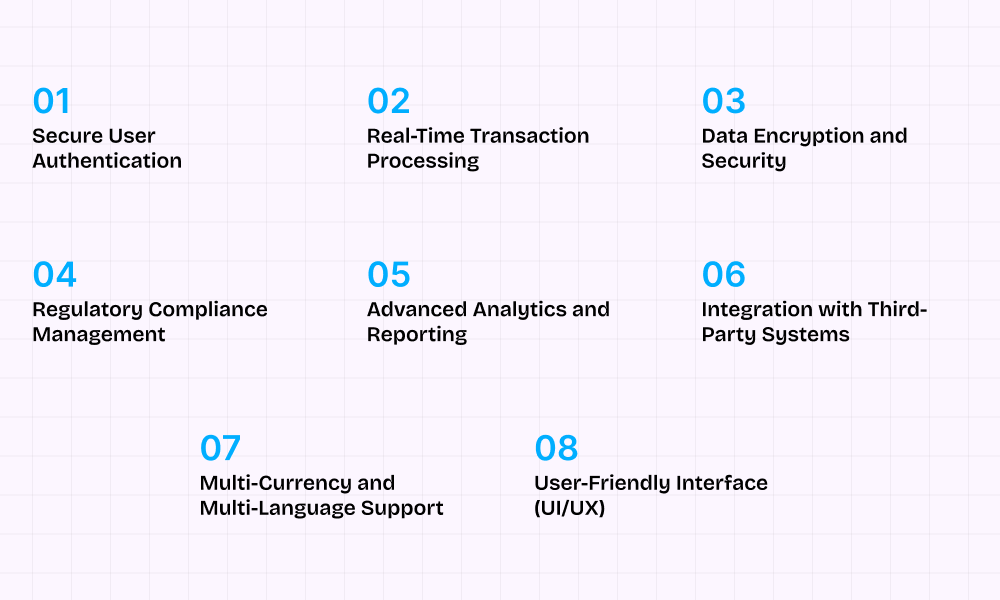
Financial software must be built with a strong focus on security, usability, performance, and compliance. The right set of features ensures smooth financial operations, accurate data management, and a seamless user experience. Below are the essential features every modern financial software solution should include.
1. Secure User Authentication
Secure user authentication is a critical feature in financial software to prevent unauthorized access and protect sensitive data. It includes multi-factor authentication (MFA), biometric login, and secure password management. These measures ensure that only verified users can access the system, reducing the risk of fraud and cyber threats.
2. Real-Time Transaction Processing
Real-time transaction processing allows users to perform financial activities instantly without delays. Whether it is payments, transfers, or updates, this feature ensures that all transactions are processed and reflected immediately. It enhances user experience, improves efficiency, and supports faster financial decision-making.
3. Data Encryption and Security
Financial software must include strong encryption mechanisms to protect sensitive financial information during storage and transmission. Advanced security protocols ensure data confidentiality and integrity. This feature safeguards against cyberattacks, data breaches, and unauthorized access, helping businesses maintain trust and comply with security standards.
4. Regulatory Compliance Management
Compliance management ensures that the software adheres to financial regulations such as KYC, AML, GDPR, and PCI DSS. Built-in compliance features automate verification, reporting, and audit processes. This reduces legal risks, ensures transparency, and helps organizations meet regulatory requirements efficiently without manual intervention.
5. Advanced Analytics and Reporting
Analytics and reporting features provide valuable insights into financial data through dashboards and detailed reports. Businesses can track performance, monitor cash flow, and identify trends in real time. This helps in making informed decisions, improving forecasting, and enhancing overall financial planning and strategy.
6. Integration with Third-Party Systems
Financial software should support seamless integration with external systems such as banks, payment gateways, accounting tools, and CRMs. APIs enable smooth data exchange and connectivity. This feature enhances functionality, improves operational efficiency, and ensures that all financial processes are interconnected and streamlined.
7. Multi-Currency and Multi-Language Support
For businesses operating globally, multi-currency and multi-language support is essential. This feature allows users to perform transactions in different currencies and access the system in their preferred language. It improves accessibility, expands market reach, and enhances the overall user experience for international users.
8. User-Friendly Interface (UI/UX)
A simple and intuitive user interface is essential for financial software to ensure ease of use. Clear navigation, responsive design, and well-organized dashboards help users perform tasks efficiently. A good UI/UX reduces errors, increases user satisfaction, and builds trust in the software system.
Steps to Develop Financial Software
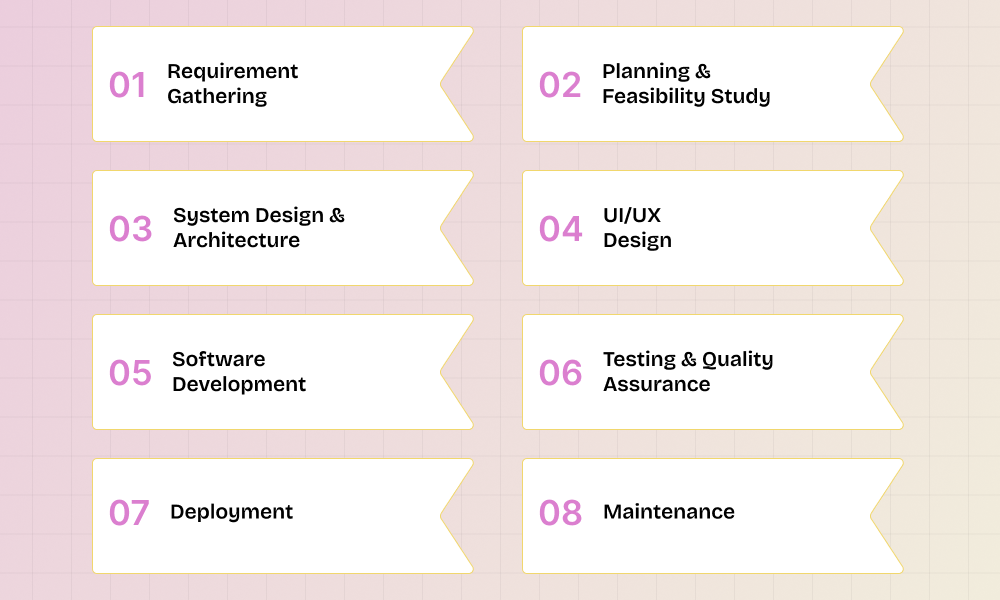
Developing financial software is a structured process that requires careful planning, strong security measures, and compliance with financial regulations. Each step plays a crucial role in building a reliable and scalable solution.
1. Requirement Gathering
Requirement gathering is the first and most critical phase of financial software development. It focuses on understanding business objectives, identifying target users, and defining the core functionality of the system. This stage ensures clarity in scope and helps align the development process with regulatory and operational needs.
- Identify target users such as banks, fintech firms, or enterprises
- Define the core problems the software will solve
- List essential features like payments, reporting, and analytics
- Ensure compliance with standards like KYC, AML, GDPR, and PCI DSS
2. Planning & Feasibility Study
This phase involves creating a clear roadmap for development while evaluating the project's practicality. It helps determine whether the project can be successfully executed within the available time, budget, and resources, while also identifying potential risks early.
- Define project timeline, budget, and resource allocation
- Assess technical and financial feasibility
- Identify potential risks and challenges
- Plan strategies to mitigate scalability and security issues
3. System Design & Architecture
System design lays the technical foundation of the software by defining how different components will work together. It ensures that the system is scalable, secure, and capable of handling complex financial operations efficiently.
- Choose between monolithic or microservices architecture
- Design a secure and efficient database structure
- Plan APIs for third-party integrations
- Implement security layers like encryption and access control
4. UI/UX Design
UI/UX design focuses on creating an intuitive and user-friendly interface for financial software. Since financial applications deal with complex data, simplicity and clarity are essential to enhance user experience and build trust.
- Create wireframes and interactive prototypes
- Focus on simple and intuitive user flows
- Ensure responsiveness across mobile and web platforms
- Maintain consistent design elements and navigation
5. Software Development
This is the execution phase where the actual development of the software takes place. Both frontend and backend components are built while ensuring seamless functionality, integration, and strong security.
- Develop interactive frontend interfaces and dashboards
- Implement backend logic for transactions and data processing
- Integrate APIs with payment systems and banking networks
- Embed security measures to protect financial data
6. Testing & Quality Assurance
Testing ensures that the software is reliable, secure, and ready for real-world use. It involves validating functionality, identifying vulnerabilities, and ensuring compliance with financial regulations.
- Perform functional testing for feature validation
- Conduct security testing to identify vulnerabilities
- Execute performance testing under high loads
- Ensure compliance with industry standards
7. Deployment
Deployment is the process of launching the software in a live environment. It involves setting up infrastructure, ensuring system stability, and preparing the application for real users.
- Host the application on cloud platforms like AWS or Azure
- Configure servers and databases for optimal performance
- Implement monitoring tools for real-time tracking
- Set up backup and disaster recovery systems
8. Maintenance
Maintenance is an ongoing process that ensures the software remains secure, efficient, and up-to-date. It helps in adapting to new requirements and maintaining system performance over time.
- Release updates to fix bugs and improve features
- Apply security patches to prevent threats
- Add new functionalities based on user feedback
- Monitor system performance and scalability continuously
Types of Financial Software
Financial software solutions are designed to manage, automate, and optimize different financial operations across industries such as banking, fintech, insurance, and corporate finance. Each type of financial software serves a specific purpose, ranging from handling daily accounting tasks to enabling complex investment trading systems. These solutions help organizations improve accuracy, ensure compliance, reduce manual effort, and make faster financial decisions.
Below are the most common types of financial software solutions along with their key purposes and features.
Type of Financial Software | Description | Key Features | Primary Users |
Banking Software | Banking software is used by financial institutions to manage core banking operations such as customer accounts, deposits, withdrawals, loans, and transaction processing. | Account management, loan processing, transaction tracking, mobile banking, core banking integration | Banks, credit unions, financial institutions |
Accounting Software | Accounting software helps businesses record, manage, and analyze financial transactions and maintain accurate financial statements. | Bookkeeping, invoicing, payroll, expense tracking, tax management, financial reporting | Small businesses, enterprises, accountants |
Investment & Trading Software | This software enables users to buy, sell, and manage investments in real time across financial markets. | Portfolio management, real-time trading, stock analysis, risk assessment, market analytics | Traders, investors, brokerage firms |
Payment Processing Software | Payment systems facilitate secure digital transactions between customers, merchants, and financial institutions. | Online payments, payment gateway integration, digital wallets, fraud detection, multi-currency support | E-commerce platforms, businesses, fintech companies |
Insurance Management Software | Insurance software is used to manage policies, claims, underwriting, and customer data within insurance companies. | Policy administration, claims processing, risk evaluation, customer management, automation | Insurance companies, agents, brokers |
Financial Analytics Software | This software helps organizations analyze financial data and generate insights for better decision-making and forecasting. | Data visualization, reporting dashboards, predictive analytics, KPI tracking, budgeting tools | CFOs, analysts, enterprises |
How Much Does it Cost to Develop Financial Software?
The cost of developing financial software can vary significantly depending on multiple factors such as the complexity of the application, the number of features, security requirements, compliance standards, technology stack, and the development team's location and expertise. Financial software is typically more expensive than other types of applications because it requires advanced security measures, regulatory compliance, and high-performance architecture.
A simple financial app with basic features like expense tracking or invoicing may cost much less compared to a complex fintech platform that includes real-time transactions, AI-based analytics, multi-currency support, and third-party integrations. Additionally, ongoing costs such as maintenance, updates, and security enhancements should also be considered as part of the total investment. Below is an estimated cost breakdown based on different levels of complexity:
Complexity Level | Description | Estimated Cost | Development Time |
|---|---|---|---|
Basic Software | Includes simple features like expense tracking, basic accounting, or invoicing with minimal integrations and standard UI/UX design. | $10,000 – $30,000 | 2 – 4 months |
Mid-Level Software | Includes advanced features such as dashboards, reporting, API integrations, multi-user access, and enhanced security measures. | $30,000 – $80,000 | 4 – 8 months |
Complex Software | Includes real-time transaction processing, payment gateways, AI/ML features, blockchain integration, and high-level security compliance. | $80,000 – $200,000+ | 8 – 18+ months |
Benefits of Financial Software Development
Following are the benefits you get by developing a financial software:
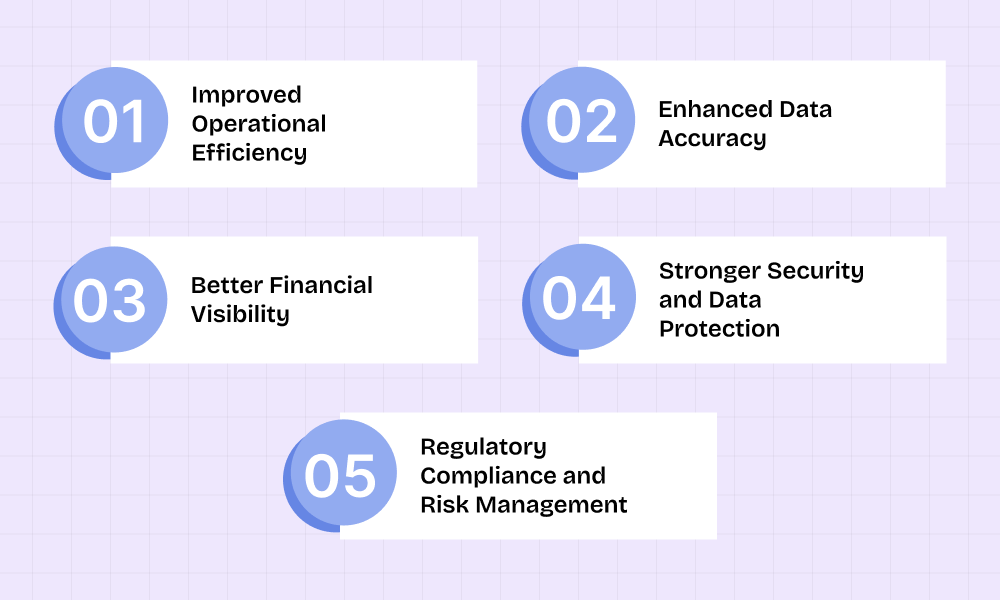
1. Improved Operational Efficiency
Financial software significantly enhances operational efficiency by automating repetitive and time-consuming tasks such as data entry, invoicing, payroll processing, and financial reconciliation. Instead of relying on manual processes that are prone to delays and inconsistencies, businesses can streamline their workflows through automation. This not only reduces the workload on employees but also speeds up overall operations, allowing teams to focus on strategic decision-making and business growth. Over time, this efficiency leads to higher productivity and better resource utilization across the organization.
2. Enhanced Data Accuracy
Accuracy is critical in financial management, and even small errors can lead to major financial losses or compliance issues. Financial software ensures high levels of accuracy by minimizing human intervention in calculations and data handling. Automated systems perform precise computations, maintain consistent records, and update financial data in real time. This eliminates the risk of duplication, incorrect entries, or miscalculations, ensuring that businesses always have reliable financial information for reporting and decision-making.
3. Better Financial Visibility
One of the biggest advantages of financial software is the ability to provide clear and comprehensive visibility into a company’s financial health. Advanced dashboards, real-time analytics, and detailed reporting tools allow businesses to monitor cash flow, revenue, expenses, and profitability at any given moment. This level of transparency helps stakeholders make informed decisions quickly and confidently. It also enables businesses to identify trends, forecast future performance, and plan strategies more effectively.
4. Stronger Security and Data Protection
Financial data is highly sensitive, making security a top priority for any organization. Financial software is built with advanced security features such as data encryption, multi-factor authentication, secure access controls, and continuous monitoring systems. These measures protect against cyber threats, unauthorized access, and data breaches. Additionally, many financial systems include fraud detection mechanisms that can identify suspicious activities in real time. This ensures that both business and customer data remain safe and secure at all times.
5. Regulatory Compliance and Risk Management
Financial software helps businesses stay compliant with complex and ever-changing financial regulations such as KYC, AML, GDPR, and PCI DSS. Compliance features are often built directly into the system, ensuring that all financial processes align with legal requirements. Automated compliance checks, audit trails, and reporting tools make it easier for organizations to maintain transparency and accountability. This reduces the risk of legal penalties, financial losses, and reputational damage while simplifying the overall compliance process.
Future Trends in Financial Software Development
The financial software industry is evolving rapidly, driven by technological innovation, changing customer expectations, and increasing regulatory demands. As businesses move toward digital-first operations, financial software is becoming smarter, faster, and more secure. Below are the key trends that will shape the future of financial software development in the coming years.
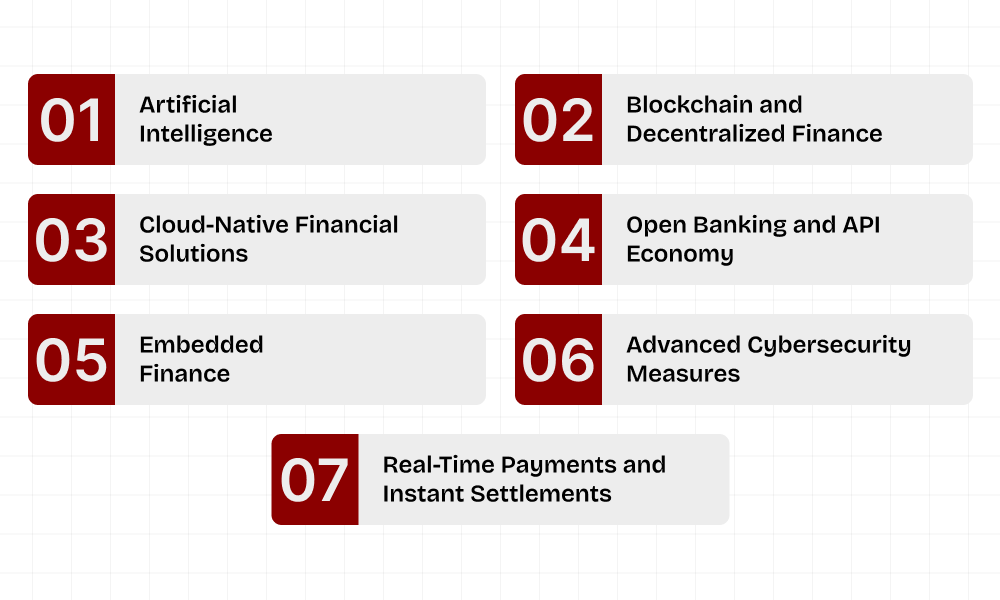
1. Artificial Intelligence
Artificial Intelligence (AI) and Machine Learning (ML) are transforming how financial systems operate. These technologies enable software to analyze vast amounts of financial data, detect patterns, and make intelligent predictions. Financial institutions are increasingly using AI for fraud detection, credit scoring, and risk assessment. AI-powered chatbots and virtual assistants are also enhancing customer support by providing instant responses and personalized financial advice. In the future, AI will play a bigger role in automating complex financial decision-making processes.
2. Blockchain and Decentralized Finance
Blockchain technology is revolutionizing financial transactions by offering transparency, security, and decentralization. It eliminates the need for intermediaries, reducing costs and increasing efficiency. Decentralized Finance (DeFi) platforms are enabling peer-to-peer financial services such as lending, borrowing, and trading without traditional banks. As adoption grows, financial software will increasingly incorporate blockchain for secure transactions, smart contracts, and digital identity verification.
3. Cloud-Native Financial Solutions
Cloud computing is becoming the backbone of modern financial software. Cloud-native applications provide scalability, flexibility, and cost efficiency, allowing businesses to handle large volumes of transactions without infrastructure limitations. Financial institutions are shifting from traditional on-premise systems to cloud-based platforms to improve performance and accessibility. This trend will continue as organizations seek faster deployment, real-time updates, and seamless global access.
4. Open Banking and API Economy
Open banking is reshaping the financial ecosystem by allowing third-party developers to access financial data through secure APIs. This enables the creation of innovative financial services such as budgeting apps, payment solutions, and investment tools. The API economy is fostering collaboration between banks, fintech companies, and other industries. In the future, financial software will be more interconnected, enabling users to manage multiple financial services from a single platform.
5. Embedded Finance
Embedded finance refers to integrating financial services directly into non-financial platforms such as e-commerce websites, ride-hailing apps, or social media platforms. This allows users to access services like payments, lending, or insurance without leaving the platform they are using. As consumer demand for convenience grows, embedded finance will become a standard feature, driving the development of more versatile and integrated financial software solutions.
6. Advanced Cybersecurity Measures
With the rise of digital financial transactions, cybersecurity threats are also increasing. Future financial software will focus heavily on advanced security measures such as biometric authentication, behavioral analytics, and AI-driven threat detection. Zero-trust security models and continuous monitoring systems will become standard to protect sensitive financial data. Ensuring robust security will remain a top priority for developers and financial institutions alike.
7. Real-Time Payments and Instant Settlements
Consumers and businesses now expect instant financial transactions. Real-time payment systems are becoming more common, enabling immediate fund transfers and settlements. Financial software will continue to evolve to support faster processing speeds, cross-border payments, and reduced transaction delays. This trend will enhance user experience and improve operational efficiency across financial platforms.
Conclusion
Financial software development is no longer a luxury, it is a necessity for businesses operating in the modern digital economy. From enhancing transaction security to enabling real-time financial insights, these systems are transforming how organizations manage money and make decisions.
At ToXSL Technologies, we specialize in building advanced, secure, and scalable financial software solutions tailored to the evolving needs of businesses worldwide. Our expertise in emerging technologies such as AI, cloud computing, and blockchain enables us to deliver future-ready financial platforms that drive innovation, efficiency, and growth. As financial ecosystems continue to evolve, we remain committed to helping businesses stay ahead with powerful digital solutions designed for long-term success. Contact us to learn more.
Frequently Asked Questions
1. What is financial software development?
Financial software development involves creating digital systems that manage financial operations, transactions, and data processing.
- Used in banking, fintech, and accounting
- Automates financial processes
- Ensures accuracy and security
- Supports real-time data handling
2. What role does AI play in financial software development?
Artificial Intelligence is transforming financial software by enabling automation, predictive analytics, and smarter decision-making. It enhances efficiency and improves user experience.
- Detects fraud through pattern recognition
- Automates customer support with chatbots
- Provides predictive financial insights
- Enhances risk assessment and credit scoring
3. What technologies are used in financial software development?
Modern financial systems use advanced and scalable technologies.
- Frontend: React, Angular
- Backend: Node.js, Java, Python
- Cloud: AWS, Azure, GCP
- Security: Encryption, MFA
4. How long does it take to develop financial software?
Financial Software Development time depends on complexity and features.
- Simple apps: 2–4 months
- Medium systems: 4–8 months
- Complex platforms: 8–18 months
- Includes testing and deployment
5. What are the challenges in financial software development?
Financial software requires strict compliance and high security standards.
- Regulatory compliance issues
- Data security risks
- System scalability challenges
- Integration with legacy systems
6. What are the key security measures in financial software?
Security is the backbone of financial software, ensuring protection against cyber threats and unauthorized access to sensitive data.
- Use end-to-end data encryption
- Implement multi-factor authentication (MFA)
- Monitor systems with real-time threat detection
- Follow secure coding and compliance practices