




































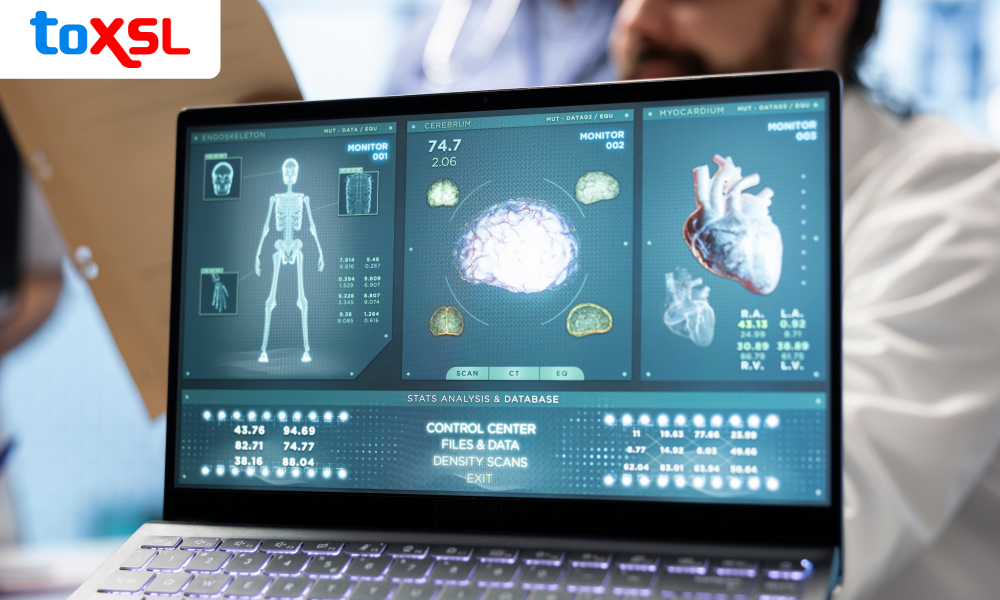
The healthcare industry is undergoing a technological revolution, and artificial intelligence (AI) is at the forefront of this transformation. Did you know that AI in healthcare is expected to reach $45.2 billion by 2026, growing at a rate of over 50% annually? Or that up to 30% of medical diagnoses involve errors, many of which could be reduced with AI-assisted tools? These statistics highlight both the immense potential and urgent need for AI-driven solutions in modern healthcare.
Have you ever wondered how hospitals could detect diseases earlier, personalize treatments for every patient, or predict health risks before they become critical? What if medical staff could spend less time on paperwork and more time caring for patients? AI-driven healthcare software promises to do exactly that - improving patient outcomes, reducing human error, and streamlining operations.
From machine learning algorithms analyzing massive datasets to natural language processing (NLP) extracting actionable insights from electronic health records, AI is no longer just a buzzword—it is actively transforming how care is delivered. In this blog, we explore how AI-driven healthcare software is developed, what it costs, the factors influencing these costs, and how it is reshaping patient care around the world.
Key Takeaways
- AI-driven healthcare software enhances patient care, reduces errors, and streamlines hospital operations.
- Developing such software requires high-quality data, regulatory compliance, and integration with existing systems.
- AI technologies like machine learning, NLP, and computer vision enable predictive analytics and personalized treatment.
- Costs depend on complexity, data volume, compliance needs, and integration requirements.
- Investing in AI healthcare software delivers long-term benefits including improved outcomes, efficiency, and cost savings.
The Rise of AI in Healthcare
AI in healthcare is no longer a futuristic concept, it’s a present-day reality. AI applications range from machine learning algorithms that predict disease outbreaks to natural language processing tools that help manage patient data efficiently. These innovations are enhancing clinical decision-making, reducing human errors, and providing patients with timely and personalized care.
For healthcare organizations, integrating AI-driven software can mean faster diagnosis, optimized workflows, and more effective patient management. However, creating such software requires careful planning, adherence to regulations, and a deep understanding of both healthcare and AI technologies.
Steps to Develop AI-Driven Healthcare Software
Developing AI-driven healthcare software requires a systematic approach that balances advanced technology with clinical accuracy, data security, and regulatory compliance. Below are the key steps involved in building reliable and effective AI-powered healthcare solutions.
1. Define the Healthcare Problem and Objectives
The foundation of successful AI-driven healthcare software lies in clearly defining the problem it aims to solve and the outcomes it should achieve. A well-defined objective ensures the AI solution delivers real clinical and operational value.
- Identify specific healthcare challenges such as disease prediction, diagnostics, patient monitoring, or workflow automation
- Define measurable goals like reducing diagnosis errors, improving treatment accuracy, or optimizing hospital operations
- Determine the target users, including doctors, nurses, administrators, or patients
- Align AI capabilities with clinical needs and business objectives
2. Conduct Market and Regulatory Research
Healthcare software development operates within a highly regulated environment, making market and compliance research essential before development begins. This step ensures the solution is both competitive and legally compliant.
- Analyze existing AI healthcare solutions to identify gaps and opportunities
- Study regulatory requirements such as HIPAA, GDPR, HL7, and regional healthcare standards
- Understand data privacy, security, and ethical guidelines related to patient information
- Define compliance strategies early to avoid legal and deployment issues later
3. Collect, Prepare, and Secure Healthcare Data
AI models rely heavily on high-quality data to deliver accurate and reliable outcomes. Preparing healthcare data properly is one of the most critical steps in AI-driven software development.
- Gather relevant medical data such as patient records, lab reports, imaging data, and clinical notes
- Clean and preprocess data to remove inconsistencies, duplicates, and missing values
- Anonymize and encrypt patient data to maintain privacy and security
- Structure data in formats suitable for AI model training and analysis
4. Choose the Right AI Technologies and Models
Selecting appropriate AI technologies ensures the software performs effectively for its intended healthcare use case. Different AI techniques serve different clinical and operational purposes.
- Use machine learning for predictive analytics, risk assessment, and outcome forecasting
- Apply natural language processing to analyze unstructured data like clinical notes and EHRs
- Implement computer vision for medical imaging tasks such as X-rays, MRIs, and CT scans
- Choose scalable AI frameworks that support future enhancements and integrations
5. Develop the Software and Integrate AI Models
This phase focuses on building the actual healthcare software and embedding AI models into a secure, user-friendly system. Seamless integration is key to ensuring adoption by healthcare professionals.
- Develop a robust backend capable of processing large datasets and AI workloads
- Design intuitive front-end interfaces tailored for clinicians and healthcare staff
- Integrate AI models with hospital systems such as EHRs, PACS, and medical devices
- Ensure interoperability and smooth data exchange across platforms
6. Test, Validate, and Ensure Clinical Accuracy
Testing and validation are essential to ensure the AI-driven healthcare software delivers accurate, reliable, and safe results in real-world environments.
- Validate AI models using real clinical data to measure accuracy and performance
- Conduct functional, performance, and security testing across multiple scenarios
- Identify and reduce bias in AI predictions to ensure fair and ethical outcomes
- Verify compliance with healthcare regulations and data security standards
7. Deploy, Monitor, and Continuously Improve
Once the software is deployed, continuous monitoring and improvement are necessary to maintain accuracy, compliance, and performance over time.
- Deploy the software in live healthcare environments with minimal disruption
- Monitor AI performance, system stability, and user feedback in real time
- Update AI models regularly using new data to improve accuracy and relevance
- Ensure ongoing compliance with evolving healthcare regulations and standards
How Much Does it Cost to Develop AI-Driven Healthcare Software
Developing AI-driven healthcare software is a significant investment, but the potential benefits for hospitals, clinics, and patients make it worthwhile. The overall cost depends on the complexity of the AI solution, the type and volume of data, integration requirements, regulatory compliance, and the expertise of the development team.
For simple AI healthcare applications, such as basic predictive models or appointment scheduling tools, costs are generally lower. Mid-level solutions that include predictive analytics, decision support, or basic imaging analysis require more sophisticated AI algorithms and data handling, making them more expensive. Advanced platforms that integrate multiple AI technologies, handle large datasets, and offer real-time diagnostics can be quite costly due to the technical complexity and stringent regulatory requirements.
It is also important to consider ongoing expenses. AI-driven healthcare software is not a one-time investment. Continuous monitoring, software updates, model retraining with new data, and regulatory compliance checks are essential to ensure the software remains accurate, reliable, and secure.
Type of AI Healthcare Software | Features Included | Estimated Development Cost | Time to Develop | Notes |
|---|---|---|---|---|
Basic AI Applications | Appointment scheduling, basic predictive analytics, simple EHR tools | $50,000 – $100,000 | 4–6 months | Suitable for small clinics or pilot projects |
Moderate Complexity Solutions | Predictive analytics for patient readmissions, decision support, basic medical imaging | $100,000 – $250,000 | 6–12 months | Ideal for hospitals and medium-scale healthcare organizations |
Advanced AI Platforms | Multi-modal AI (machine learning, NLP, computer vision), real-time diagnostics, integration with multiple systems, personalized treatment recommendations | $250,000 – $500,000+ | 12–18+ months | Best for large hospitals, research institutions, or AI-driven telemedicine platforms |
Factors Affecting the Cost of AI-Driven Healthcare Software
The cost of developing AI healthcare software is influenced by multiple interconnected factors. Understanding these elements is crucial for healthcare organizations and startups planning to invest in AI solutions. While every project is unique, the following are the primary cost drivers:
1. Complexity of AI Algorithms
The sophistication of the AI algorithms plays a major role in determining cost. Basic machine learning models that predict patient re-admissions or generate simple reports are relatively inexpensive to develop. In contrast, advanced AI systems that use deep learning for medical imaging, real-time diagnostics, or natural language processing (NLP) to analyze clinical notes require highly skilled data scientists and longer development cycles. The more complex the algorithm, the more expensive it becomes due to increased development time, specialized talent, and computational resources.
2. Quality and Volume of Data
Data is the foundation of AI. High-quality, structured, and comprehensive medical datasets are essential to train accurate AI models. The cost rises significantly when large volumes of data need to be collected, cleaned, anonymized, and labeled. For example, training a computer vision model to detect tumors from MRI scans requires thousands of annotated images, which may involve hiring medical experts to verify and label each scan. Poor-quality data not only increases cost but can also compromise model accuracy, leading to costly revisions.
3. Regulatory Compliance and Security Requirements
Healthcare is one of the most heavily regulated industries worldwide. Software must comply with standards such as HIPAA in the United States, GDPR in Europe, or equivalent local regulations. Ensuring compliance requires extensive documentation, robust encryption, secure storage, access control systems, and audit trails. Non-compliance can lead to legal penalties, fines, or reputational damage. Therefore, regulatory adherence significantly impacts development time, technical implementation, and cost.
4. Integration with Existing Systems
AI-driven software rarely operates in isolation. Hospitals and clinics typically have multiple systems such as electronic health records (EHR), laboratory information systems (LIS), radiology PACS, and billing platforms. Integrating AI software with these existing systems requires custom APIs, data mapping, and extensive testing to ensure smooth interoperability. The more complex the existing infrastructure, the higher the integration cost.
5. User Interface and Experience (UI/UX)
Even the most advanced AI models are ineffective if healthcare professionals cannot use them efficiently. Designing intuitive dashboards, easy-to-read reports, automated alerts, and interactive interfaces is essential for adoption. Creating a high-quality UI/UX involves additional design expertise, prototyping, and user testing, which increases development costs.
Benefits of AI-Driven Healthcare Software
AI-driven healthcare software is transforming the way medical professionals deliver care, offering a wide range of benefits that extend from clinicians to patients. By leveraging advanced algorithms, machine learning, and data analytics, healthcare organizations can achieve higher efficiency, better outcomes, and a more personalized approach to treatment.
1. Improved Diagnostic Accuracy
One of the most significant benefits of AI in healthcare is its ability to enhance diagnostic accuracy. AI models can analyze complex medical data, including lab results, imaging scans, and patient histories, with incredible speed and precision. This reduces the chances of human error, allows clinicians to make faster decisions, and ensures patients receive timely treatment.
2. Predictive Analytics for Proactive Patient Care
AI-driven software can predict potential health risks by analyzing patterns in patient data. For instance, it can identify patients at high risk of readmission, detect early signs of chronic diseases, or forecast complications after surgery. Predictive analytics enables healthcare providers to take proactive measures, improving patient outcomes and reducing emergency situations.
3. Streamlined Hospital Operations
AI software can automate repetitive administrative tasks such as scheduling, billing, and inventory management. By handling these routine processes, staff can focus more on patient care, leading to higher productivity and reduced operational bottlenecks. This optimization also helps hospitals manage resources more efficiently and reduce operational costs.
4. Personalized Treatment Plans
Every patient is unique, and AI enables a personalized approach to healthcare. By analyzing patient-specific data such as genetic information, medical history, and lifestyle factors, AI systems can recommend tailored treatment plans. This improves treatment effectiveness, reduces side effects, and enhances patient satisfaction.
5. Cost Savings Over Time
Although AI-driven healthcare software requires an initial investment, it can significantly reduce costs in the long term. By improving diagnostic accuracy, reducing hospital re-admissions, and optimizing workflow efficiency, healthcare organizations can lower unnecessary expenditures while maintaining high-quality patient care.
Conclusion
At ToXSL Technologies, we understand that AI-driven healthcare software is not just a technological investment - it’s a transformative tool that has the power to redefine patient care, streamline hospital operations, and enhance clinical decision-making. Developing such software requires a careful balance of cutting-edge AI technologies, high-quality medical data, strict regulatory compliance, and intuitive design.
From predictive analytics to advanced imaging diagnostics and personalized treatment plans, AI healthcare solutions are helping medical professionals make faster, more accurate, and data-driven decisions. While the development process involves significant effort and investment, the long-term benefits - improved patient outcomes, operational efficiency, and reduced errors - far outweigh the costs.
Our team at ToXSL Technologies specializes in designing and developing AI-driven healthcare solutions tailored to the unique needs of hospitals, clinics, and healthcare organizations. By combining technical expertise, domain knowledge, and a patient-first approach, we help our clients implement AI software that is reliable, scalable, and fully compliant with industry standards.
Investing in AI-powered healthcare software today is not just about keeping up with technology - it’s about shaping the future of healthcare. With the right development partner, hospitals and healthcare providers can deliver smarter, safer, and more personalized care, ultimately transforming the healthcare experience for patients and practitioners alike. Contact us to learn more.
Frequently Asked Questions
1. What types of healthcare applications benefit most from AI integration?
AI can be applied across various healthcare domains to improve outcomes and operational efficiency.
- Clinical decision support systems for diagnosis and treatment
- Medical imaging and radiology analysis
- Patient monitoring and predictive health analytics
- Administrative automation and electronic health record management
2. How long does it take to develop an AI-driven healthcare software?
The time to develop AI healthcare software varies based on complexity, features, and regulatory compliance. Planning and phased implementation are essential to ensure quality and accuracy.
- Simple healthcare apps with basic AI features can take 4–6 months to develop
- Advanced apps with predictive analytics, imaging, or NLP may take 9–12 months or more
- Integration with hospital systems (EHR, PACS) and regulatory compliance can extend the timeline
- Continuous testing, validation, and post-launch monitoring are part of the overall development cycle
3. How secure is patient data in AI-driven healthcare software?
Security is a top priority. AI healthcare software must comply with regulations like HIPAA, GDPR, and other local standards. This involves encrypting data, anonymizing sensitive information, implementing secure access controls, and maintaining audit logs. When properly implemented, patient data is safe and protected from unauthorized access.
4. How does AI improve accuracy in medical diagnosis and treatment?
AI enhances clinical accuracy by supporting healthcare professionals with data-backed insights and pattern recognition.
- Analyzes large datasets beyond human capacity
- Identifies early signs of diseases from medical images and records
- Assists doctors with evidence-based treatment recommendations
- Reduces diagnostic errors through predictive modeling
5. What challenges are involved in developing AI healthcare software?
Developing AI-driven healthcare software involves technical, ethical, and regulatory complexities.
- Managing large volumes of sensitive patient data
- Ensuring model accuracy and minimizing bias
- Meeting strict regulatory and compliance requirements
- Integrating AI with existing healthcare systems