




























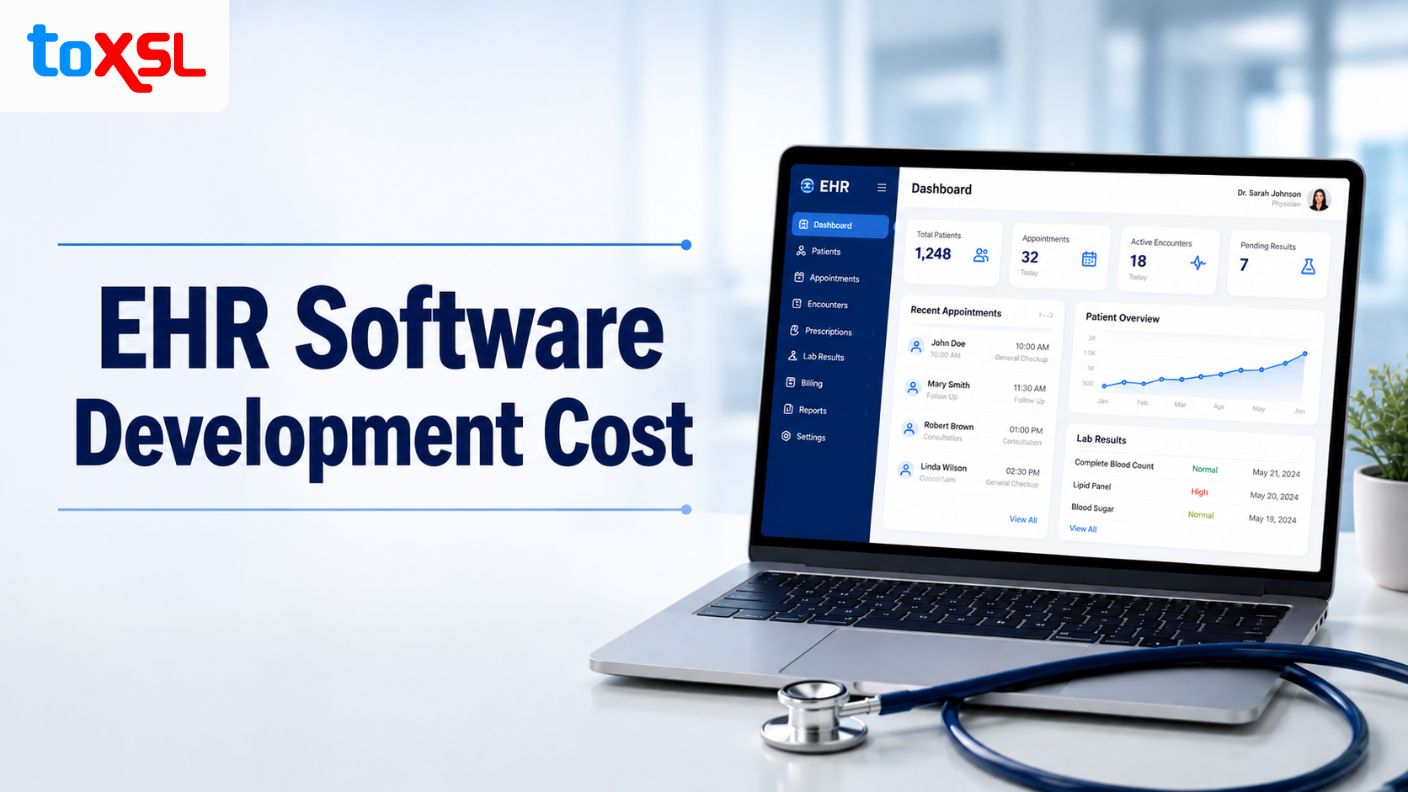
The healthcare industry is rapidly embracing digital transformation, and Electronic Health Record software has become one of the most critical technologies for healthcare providers. EHR systems enable hospitals, clinics, physicians, and healthcare organizations to digitally store, manage, and access patient records, improving efficiency, accuracy, and patient care.
As healthcare facilities increasingly prioritize data-driven decision-making, regulatory compliance, and seamless patient experiences, investing in custom EHR software has become a strategic necessity. However, one of the most common questions healthcare organizations ask is: "How much does EHR software development cost?"
The cost of developing an EHR system depends on multiple factors, including feature complexity, technology stack, integrations, compliance requirements, development team location, and deployment model. A basic EHR platform may cost significantly less than a fully customized enterprise-grade solution with advanced analytics, AI-powered capabilities, telemedicine integrations, and cloud infrastructure.
Key Takeaways
- EHR software development costs vary based on project complexity, features, integrations, and compliance requirements.
- Basic EHR systems typically cost less than enterprise-grade healthcare platforms with advanced functionalities.
- HIPAA, GDPR, and healthcare compliance requirements significantly impact development efforts and pricing.
- Integration with laboratories, pharmacies, insurance systems, and medical devices increases project complexity.
- Cloud-based EHR platforms offer greater scalability and flexibility compared to traditional on-premise solutions.
- AI, predictive analytics, telemedicine, and patient engagement features can enhance software value but increase costs.
- Choosing an experienced healthcare software development company helps reduce risks and ensure compliance.
Comprehensive EHR Software Development Process
Developing an Electronic Health Record (EHR) system requires a structured approach to ensure security, compliance, interoperability, and scalability. From gathering requirements to post-launch maintenance, every stage plays a crucial role in delivering a reliable healthcare solution that improves patient care and operational efficiency.
1. Requirement Analysis
The development process begins with understanding the healthcare organization's goals, workflows, challenges, and regulatory requirements. This phase helps define the project scope, required features, user roles, and technical specifications while creating a roadmap for successful development.
- Stakeholder consultations
- Workflow analysis
- Requirement gathering
- Compliance assessment
- Project roadmap creation
- Budget and timeline planning
2. UI/UX Design
An EHR system should be easy for doctors, nurses, administrative staff, and patients to use. Designers create wireframes and prototypes that streamline workflows, improve usability, and reduce the time required to access critical patient information.
- User journey mapping
- Wireframing
- Interactive prototyping
- Dashboard design
- Mobile responsiveness
3. System Architecture
A robust architecture ensures the EHR system can securely manage large volumes of patient data while maintaining high performance. Developers design databases, APIs, cloud infrastructure, and security frameworks to support future growth and integrations.
- Database modeling
- API architecture
- Security framework design
- Scalability planning
- Disaster recovery strategy
4. Core EHR Module Development
This phase focuses on building the primary functionalities required for healthcare operations. Developers create modules that manage patient records, appointments, prescriptions, billing, and clinical documentation while ensuring compliance with healthcare standards.
- Patient record management
- Appointment scheduling
- E-prescriptions
- Clinical documentation
- Billing systems
- Reporting tools
5. Third-Party Integrations
Modern EHR platforms must connect with external healthcare systems to facilitate seamless data exchange. Integrations improve efficiency and enable healthcare providers to access critical information from multiple sources.
- HL7 and FHIR implementation
- Laboratory integrations
- Pharmacy integrations
- Insurance system connectivity
- Telemedicine integration
- Medical device synchronization
6. Security Implementation
Healthcare data is highly sensitive and must be protected from cyber threats. Developers implement advanced security measures and ensure compliance with regulations such as HIPAA, GDPR, and other healthcare data protection standards.
- Data encryption
- Multi-factor authentication
- Role-based access controls
- Audit trail implementation
- Security testing
- Compliance validation
7. Quality Assurance and Deployment
Before launch, the EHR system undergoes extensive testing to identify and resolve issues related to functionality, performance, security, and usability. Once approved, the software is deployed in the production environment.
- Functional testing
- Performance testing
- Security testing
- User acceptance testing
- Data migration
- Production deployment
8. Maintenance and Support
After deployment, continuous monitoring and maintenance are essential for ensuring optimal performance and compliance. Regular updates help organizations adapt to evolving healthcare regulations and emerging technologies.
- Bug fixing and updates
- Performance optimization
- Compliance updates
- Security patch management
- Feature enhancements
- AI and analytics integration
Essential Features of Modern EHR Software
Modern Electronic Health Record software serves as the digital backbone of healthcare organizations, enabling providers to manage patient information, streamline clinical workflows, improve communication, and ensure regulatory compliance. As healthcare continues to evolve, EHR systems have expanded beyond basic record-keeping to include advanced functionalities that enhance patient care, operational efficiency, and data-driven decision-making. The following features are considered essential for a robust and future-ready EHR solution.
1. Patient Record Management
Patient record management is the core feature of any Electronic Health Record system development. It allows healthcare providers to store, access, and update comprehensive patient information in a centralized digital environment. This feature ensures that medical histories, diagnoses, treatments, medications, allergies, and test results are readily available, enabling healthcare professionals to make informed decisions and deliver better patient care.
2. Appointment Scheduling and Management
An integrated appointment scheduling system helps healthcare organizations efficiently manage patient visits while reducing administrative workload. It allows patients to book appointments online, receive automated reminders, and reschedule visits when necessary. This feature improves patient engagement, minimizes no-shows, and optimizes resource utilization within healthcare facilities.
3. Electronic Prescription Management
Electronic prescribing, commonly known as e-prescription, enables healthcare providers to create and send prescriptions digitally to pharmacies. This feature reduces paperwork, minimizes prescription errors, improves medication tracking, and enhances communication between healthcare professionals and pharmacies. It also helps ensure patient safety by identifying potential drug interactions and allergies.
4. Clinical Documentation and Charting
Clinical documentation tools allow physicians and healthcare staff to create, manage, and access patient notes efficiently. Modern custom EHR software solutions support customizable templates, digital forms, voice recognition, and automated charting capabilities that reduce documentation time while maintaining accuracy. This feature helps improve workflow efficiency and ensures comprehensive patient records.
5. Billing and Revenue Cycle Management
A robust billing module streamlines financial operations by automating invoicing, insurance claims processing, payment tracking, and reimbursement management. By integrating clinical and financial data, healthcare organizations can reduce billing errors, accelerate payment cycles, and improve overall revenue management while maintaining compliance with healthcare regulations.
6. Telemedicine and Virtual Care Integration
With the growing adoption of remote healthcare services, telemedicine has become an essential EHR feature. Integrated telehealth capabilities enable healthcare providers to conduct virtual consultations, exchange secure messages, share medical documents, and monitor patients remotely. This feature improves accessibility and enhances the overall patient experience.
EHR Software Development Cost: Pricing and Factors
The overall EHR software development cost depends on project scope, required features, integrations, compliance needs, and team expertise. Organizations can choose between basic, medium-complexity, or enterprise-grade solutions depending on their business objectives.
EHR Type | Estimated Cost Range | Development Timeline |
Basic EHR Software | $20,000 – $35,000 | 3 – 6 Months |
Mid-Level EHR Platform | $35,000 – $70,000 | 6 – 10 Months |
Advanced EHR System | $70,000 – $100,000+ | 10 – 15 Months |
Enterprise Healthcare Platform | $100,000 – $150,000+ | 12 – 24 Months |
AI-Powered EHR Solution | $150,000+ | 15 – 24 Months |
Factors Affecting EHR Software Development Cost
Several variables influence the final development budget of an EHR solution.
1. Feature Complexity
The number and sophistication of features significantly impact development efforts and project costs. Cost Influencers:
- Telemedicine functionality
- AI capabilities
- Analytics dashboards
- Patient portals
- Advanced workflows
2. Regulatory Compliance
Healthcare software must comply with strict industry regulations and security standards. Compliance Requirements:
- HIPAA compliance
- GDPR compliance
- Audit logging
- Data encryption
- Security monitoring
3. Third-Party Integrations
Integrating external healthcare systems increases development complexity and testing requirements. Common Integrations:
- Laboratories
- Pharmacies
- Insurance providers
- Payment gateways
- Medical devices
4. Deployment Model
The choice between cloud-based and on-premise deployment affects infrastructure costs and maintenance requirements. Deployment Options:
- Public cloud
- Private cloud
- Hybrid cloud
- On-premise hosting
- Multi-cloud infrastructure
5. Development Team Location
Development rates vary significantly depending on geographic region and expertise level. Typical Regions:
- North America
- Western Europe
- Eastern Europe
- Asia-Pacific
- Middle East
6. Security Requirements
Healthcare systems require advanced security measures to protect sensitive patient information. Security Features:
- MFA authentication
- Encryption
- Access control
- Intrusion detection
- Security auditing
7. Maintenance and Support
Ongoing maintenance ensures software reliability, security, compliance, and feature enhancements. Maintenance Services:
- Bug fixing
- Performance optimization
- Compliance updates
- Feature upgrades
- Security patches
Technology Stack for EHR Software Development
Selecting the right technology stack is one of the most important decisions in Healthcare IT solutions development. The chosen technologies directly impact the software's performance, scalability, security, interoperability, and long-term maintenance. Since EHR platforms handle sensitive patient information and require seamless integration with healthcare systems, developers must use reliable and healthcare-compliant technologies.
Technology Layer | Recommended Technologies | Purpose |
|---|---|---|
Frontend Development | React.js, Angular, Vue.js, HTML5, CSS3, JavaScript | Creates responsive, interactive, and user-friendly interfaces for healthcare professionals and patients. |
Backend Development | Node.js, Python (Django), Java, .NET Core, Laravel | Handles business logic, API development, user authentication, and application processing. |
Mobile App Development | Flutter, React Native, Swift, Kotlin | Enables cross-platform and native mobile EHR applications for healthcare providers and patients. |
Database Management | PostgreSQL, MySQL, MongoDB, Microsoft SQL Server, Oracle Database | Stores and manages patient records, appointments, prescriptions, and clinical data securely. |
Cloud Infrastructure | AWS, Microsoft Azure, Google Cloud Platform (GCP) | Provides scalable hosting, data storage, backup, disaster recovery, and high availability. |
API Development | REST APIs, GraphQL APIs | Facilitates communication between EHR systems, mobile apps, and third-party healthcare services. |
Healthcare Interoperability Standards | HL7, FHIR, DICOM, CDA, X12 | Ensures seamless exchange of healthcare information across different systems and providers. |
Telemedicine Integration | Twilio, Agora, Zoom SDK, Vonage API | Enables secure video consultations, messaging, and remote healthcare services. |
Payment Gateway Integration | Stripe, PayPal, Razorpay, Authorize.Net | Supports billing, payments, insurance processing, and financial transactions. |
Reporting & Analytics | Power BI, Tableau, Google Looker Studio | Generates operational, financial, and clinical reports for informed decision-making. |
Artificial Intelligence & Machine Learning | TensorFlow, PyTorch, OpenAI APIs, Scikit-learn | Powers predictive analytics, clinical decision support, and intelligent healthcare insights. |
Conclusion
Developing a robust Electronic Health Record (EHR) system requires a strategic balance of technology, compliance, security, and user-centric design. From managing sensitive patient data to enabling seamless interoperability across healthcare systems, every component of an EHR platform plays a vital role in improving clinical efficiency and patient outcomes.
As healthcare continues to evolve with digital transformation, organizations need scalable, secure, and intelligent medical software development services that can adapt to future demands such as AI-driven insights, telemedicine expansion, and advanced analytics. Investing in the right development approach and technology stack ensures long-term value, operational efficiency, and regulatory compliance.
ToXSL Technologies is a leading Healthcare software development company, building custom EHR software solutions tailored to the unique needs of hospitals, clinics, and healthcare enterprises. Our expertise in healthcare compliance, secure system architecture, and cutting-edge technologies enables us to deliver scalable and future-ready EHR platforms that enhance patient care and streamline healthcare operations. We focus on innovation, security, and performance to help healthcare providers digitally transform their services with confidence. Contact us to learn more.
Frequently Asked Questions
1. What is the average cost of developing EHR software?
The cost of EHR software development typically ranges from $20,000 to $150,000+, depending on features, complexity, integrations, compliance requirements, and technology stack used.
2. How long does it take to build an EHR system?
Development time can vary from 3 months for a basic system to 12–24 months for an advanced or enterprise-level EHR solution with multiple integrations and custom features.
3. What are the key features of a modern EHR system?
Modern EHR systems include patient record management, appointment scheduling, e-prescriptions, billing, telemedicine integration, analytics, patient portals, and strong security controls.
- Patient record management and history tracking
- Appointment scheduling and calendar management
- E-prescription and medication tracking
- Billing and insurance claim management
4. Why is compliance important in EHR software development?
Compliance ensures that patient data is protected according to healthcare regulations such as HIPAA and GDPR, reducing legal risks and ensuring secure handling of sensitive medical information.
- Ensures protection of sensitive patient data
- Helps meet legal regulations like HIPAA and GDPR
- Reduces risk of data breaches and penalties
- Builds trust between patients and healthcare providers
5. Can EHR software be customized for different healthcare organizations?
Yes, EHR software can be fully customized based on the needs of hospitals, clinics, or specialty practices, including workflows, integrations, and feature sets tailored to specific operations.
- Workflows can be tailored for hospitals, clinics, or specialty practices
- Features can be added or removed as needed
- Integration with existing healthcare systems is possible
- Scalability allows future expansion and upgrades