







































Key Takeaways
- RegTech software automates regulatory compliance, reducing manual effort and improving operational efficiency.
- AI and machine learning enable real-time fraud detection, risk analysis, and regulatory monitoring.
- Automated KYC, AML, and identity verification help organizations meet global compliance standards faster.
- Cloud-based RegTech solutions offer scalability, security, and cost-effective compliance management.
- Development costs depend on software complexity, features, technology stack, integrations, and compliance requirements.
- Modern RegTech platforms improve customer trust while minimizing regulatory penalties and operational risks.
- Investing in custom RegTech software provides businesses with long-term compliance, flexibility, and competitive advantages.
The financial services industry is experiencing an unprecedented wave of regulatory changes. Governments and financial authorities across the globe are introducing stricter compliance requirements to combat money laundering, financial fraud, cybercrime, tax evasion, and data privacy violations. As regulations become increasingly complex, businesses are finding it difficult to manage compliance manually while maintaining operational efficiency.
This is where RegTech (Regulatory Technology) software is transforming the financial landscape. By combining technologies such as Artificial Intelligence (AI), Machine Learning (ML), Big Data, Cloud Computing, Robotic Process Automation (RPA), and Blockchain, RegTech solutions automate regulatory compliance, streamline reporting, improve risk management, and reduce operational costs. These platforms enable financial institutions, fintech companies, insurance providers, investment firms, payment gateways, healthcare organizations, and other regulated businesses to stay compliant without slowing down innovation.
The global RegTech market is also witnessing remarkable growth as organizations increasingly invest in digital compliance solutions. Businesses are adopting RegTech software to automate Know Your Customer (KYC), Anti-Money Laundering (AML), fraud detection, transaction monitoring, regulatory reporting, identity verification, and risk assessment processes.
In this comprehensive guide, we'll explore the key benefits, essential features, development process, estimated development costs, future trends, and everything businesses need to know before investing in RegTech software development.
Why RegTech Software Has Become a Business Necessity?
Businesses operating in highly regulated industries must comply with constantly evolving legal requirements while maintaining efficiency and customer trust. Manual compliance processes often lead to delays, human errors, higher operational costs, and increased regulatory risks. RegTech software addresses these challenges by automating compliance workflows, enhancing transparency, and enabling organizations to adapt quickly to changing regulations. Below are the major benefits businesses gain from investing in RegTech software.
1. Automated Regulatory Compliance
RegTech software continuously monitors changing regulations and automatically updates compliance workflows. This reduces manual intervention, minimizes errors, and ensures businesses remain aligned with industry standards while improving overall operational efficiency.
- Automatically adapts to evolving regulatory requirements.
- Reduces compliance-related human errors.
- Minimizes administrative workload.
- Ensures consistent policy enforcement.
2. Faster KYC and Customer Onboarding
Digital identity verification and automated document validation significantly reduce customer onboarding time. Businesses can verify identities within minutes while ensuring compliance with KYC regulations and improving customer experience.
- Speeds up customer verification.
- Reduces manual document processing.
- Improves customer satisfaction.
- Supports global identity verification.
3. Improved Fraud Detection and Prevention
AI-powered monitoring systems analyze transactions continuously to identify suspicious activities before they become major financial threats. Businesses can proactively detect fraud and reduce financial losses.
- Detects suspicious transactions instantly.
- Uses AI for behavioral analysis.
- Minimizes financial fraud.
- Enhances customer confidence.
4. Reduced Operational Costs
Automation replaces repetitive compliance tasks that traditionally require large teams. Businesses save significant operational costs while increasing productivity and reducing paperwork.
- Lowers staffing requirements.
- Reduces paperwork.
- Improves workflow efficiency.
- Optimizes resource utilization.
5. Better Risk Management
Advanced analytics help businesses identify compliance risks, monitor financial activities, and prioritize corrective actions before regulatory violations occur.
- Monitors enterprise-wide risks.
- Predicts compliance issues.
- Supports informed decision-making.
- Improves governance.
6. Real-Time Regulatory Reporting
RegTech platforms generate compliance reports automatically using live operational data. This ensures accurate, timely reporting while reducing reporting errors.
- Generates reports automatically.
- Improves reporting accuracy.
- Saves preparation time.
- Meets regulatory deadlines.
Core Features Every Modern RegTech Software Should Include
As regulatory requirements continue to evolve, businesses need intelligent software that can automate compliance processes, improve transparency, and reduce operational risks. Modern RegTech solutions integrate technologies such as Artificial Intelligence (AI), Machine Learning (ML), Big Data, Cloud Computing, and Automation to streamline compliance management and strengthen risk mitigation. These platforms not only simplify complex regulatory tasks but also help organizations improve decision-making, enhance security, and maintain compliance across multiple jurisdictions. Below are the essential features every modern RegTech software solution should include.
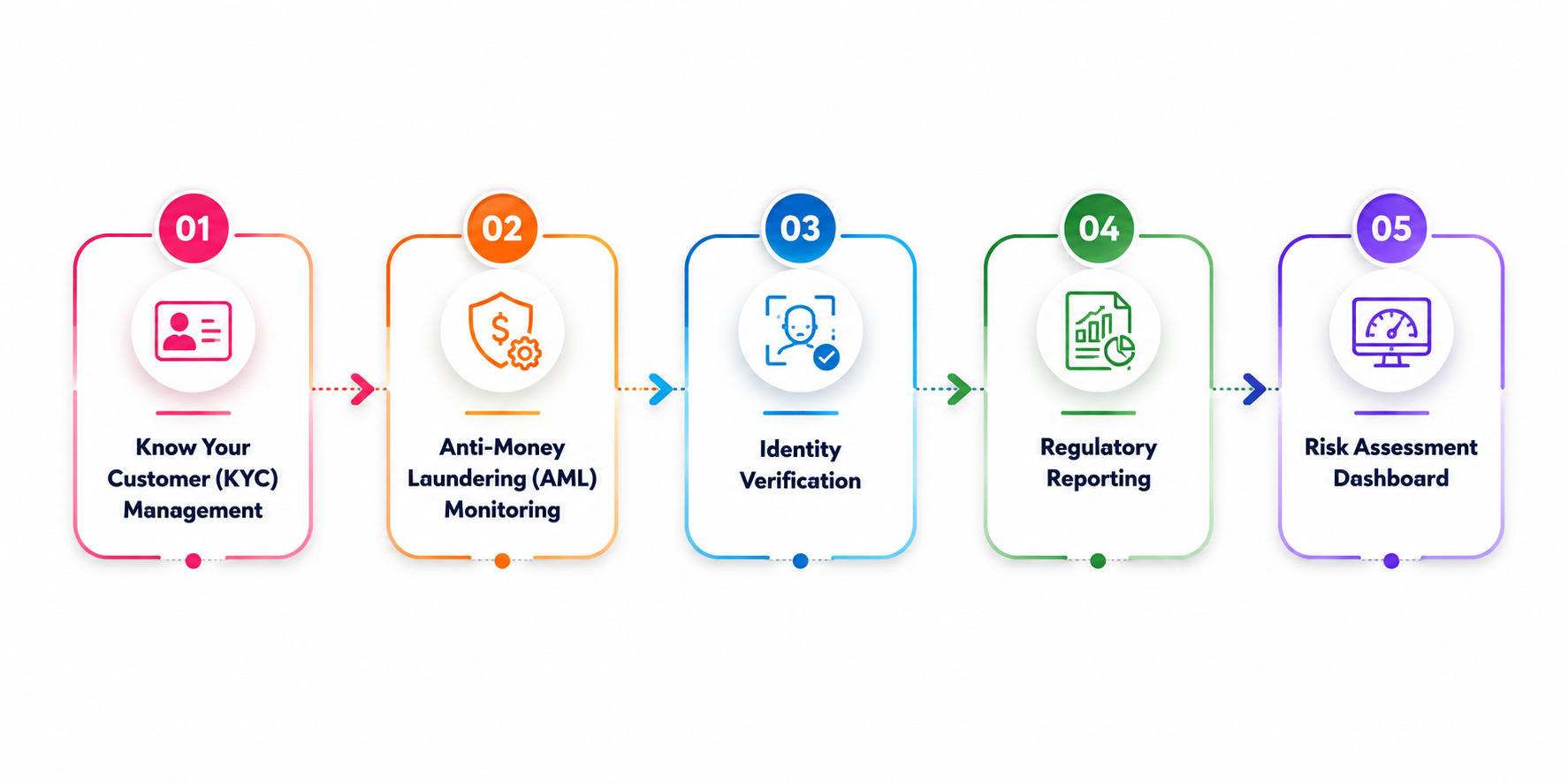
1. Know Your Customer (KYC) Management
KYC management is one of the most critical components of RegTech software. It automates customer identity verification during onboarding by validating personal information, government-issued IDs, passports, driving licenses, and other official documents. Advanced KYC systems leverage Optical Character Recognition (OCR), facial recognition, biometric verification, and AI-powered document analysis to reduce manual verification efforts while ensuring compliance with global regulatory standards.
2. Anti-Money Laundering (AML) Monitoring
AML monitoring enables organizations to continuously analyze financial transactions and identify suspicious activities that may indicate money laundering, terrorist financing, or other financial crimes. AI-powered algorithms monitor transaction patterns in real time, detect unusual behavior, and generate alerts for further investigation. Automated AML solutions help businesses comply with international financial regulations while reducing false positives and improving investigation efficiency.
3. Identity Verification
Identity verification ensures that customers are genuine before granting access to financial products or services. Modern RegTech platforms support digital identity verification using biometric authentication, facial recognition, liveness detection, electronic signatures, and government database verification. By automating identity validation, businesses can reduce fraud, improve customer trust, and meet regulatory compliance requirements while providing a seamless onboarding experience across digital channels.
4. Regulatory Reporting
Preparing regulatory reports manually can be time-consuming, error-prone, and resource-intensive. RegTech software automates data collection, validation, formatting, and report generation based on the latest regulatory standards. Businesses can generate accurate reports in real time and submit them to regulatory authorities without manual intervention.
5. Risk Assessment Dashboard
A centralized risk assessment dashboard provides businesses with complete visibility into their compliance status, operational risks, suspicious activities, and regulatory performance. Interactive dashboards consolidate data from multiple sources, allowing compliance teams to monitor key risk indicators (KRIs), investigate incidents, and prioritize corrective actions.
With AI-driven analytics and predictive insights, businesses can proactively identify emerging compliance risks before they escalate into regulatory violations or financial losses.
Step-by-Step RegTech Software Development Process
Developing a RegTech software solution involves much more than building a standard business application. It requires a deep understanding of regulatory frameworks, industry standards, cybersecurity, data privacy, and emerging technologies. Since regulations frequently evolve, businesses need a scalable and future-ready platform that can quickly adapt to changing compliance requirements without disrupting operations.
1. Requirement Analysis
The first step in RegTech software development is understanding the client's business objectives, regulatory challenges, target audience, and operational workflows. Developers collaborate with stakeholders to identify compliance requirements, business goals, technical expectations, and future scalability needs.
2. Regulatory Research
RegTech software must comply with various regional and international regulations depending on the industry and target market. During this stage, compliance experts analyze applicable regulatory frameworks such as Know Your Customer (KYC), Anti-Money Laundering (AML), GDPR, PCI DSS, HIPAA, PSD2, FATCA, and other financial or industry-specific regulations.
3. UI/UX Design
An intuitive and user-friendly interface is essential for compliance officers, administrators, auditors, and business users who interact with the platform daily. Designers create wireframes, interactive prototypes, dashboards, workflow screens, reporting modules, and administrative panels that simplify complex compliance tasks. The UI/UX design focuses on accessibility, responsive layouts, smooth navigation, and role-based interfaces to improve productivity and reduce the learning curve for end users.
4. Software Architecture
Before coding begins, developers design the technical architecture of the platform. This includes selecting the appropriate technology stack, cloud infrastructure, databases, APIs, microservices architecture, AI frameworks, cybersecurity tools, and deployment model. A scalable architecture enables the platform to handle growing transaction volumes, regulatory updates, and third-party integrations without affecting system performance.
5. RegTech Software Development
This is the core phase where developers build the application based on the approved architecture and project requirements. Frontend and backend teams work together to develop dashboards, compliance modules, AI-powered fraud detection systems, customer onboarding workflows, identity verification, regulatory reporting, notification systems, and API integrations.
6. Security Implementation
Since RegTech platforms manage sensitive financial and customer information, implementing robust security measures is a top priority. Developers incorporate enterprise-grade security protocols such as end-to-end encryption, multi-factor authentication (MFA), role-based access control (RBAC), secure API communication, intrusion detection, and continuous security monitoring.
7. Quality Assurance
Before deployment, the software undergoes extensive testing to ensure functionality, performance, security, and regulatory compliance. Quality assurance teams conduct functional testing, integration testing, usability testing, load testing, penetration testing, vulnerability assessments, and compliance validation. Testing helps identify bugs, eliminate security vulnerabilities, and verify that the platform performs reliably under real-world conditions.
8. Deployment and Ongoing Maintenance
After successful testing, the RegTech platform is deployed on cloud, hybrid, or on-premises infrastructure based on business requirements. The deployment process includes configuration, user training, system integration, and production monitoring to ensure a smooth launch. Post-deployment support is equally important, as regulations continuously evolve. Regular software updates, security patches, feature enhancements, compliance modifications, and performance monitoring ensure the platform remains secure, efficient, and compliant over time.
RegTech Software Development Cost
The cost of developing RegTech software depends on several factors, including the application's complexity, compliance requirements, AI capabilities, third-party integrations, security standards, deployment model, and customization needs. A basic compliance management solution costs significantly less than an enterprise-grade RegTech platform equipped with AI-powered fraud detection, real-time analytics, blockchain integration, and advanced regulatory reporting.
Businesses should also account for ongoing expenses such as cloud hosting, software updates, security enhancements, compliance audits, and regular maintenance to ensure the platform remains aligned with evolving regulatory standards.
Development Stage | Estimated Cost (USD) | Timeline |
|---|---|---|
Discovery & Requirement Analysis | $3,000 – $8,000 | 2–3 Weeks |
UI/UX Design | $5,000 – $12,000 | 3–4 Weeks |
MVP RegTech Software | $20,000 – $40,000 | 2–3 Months |
Mid-Level RegTech Platform | $40,000 – $80,000 | 4–6 Months |
Enterprise RegTech Solution | $80,000 – $180,000+ | 6–12 Months |
AI-Based Fraud Detection Module | $15,000 – $40,000 | 4–8 Weeks |
KYC & AML Integration | $10,000 – $30,000 | 3–6 Weeks |
Regulatory Reporting Module | $8,000 – $20,000 | 2–4 Weeks |
Third-Party API Integrations | $5,000 – $25,000 | Varies |
Testing & Quality Assurance | 15–20% of Development Cost | Throughout Development |
Annual Maintenance & Support | 15–25% of Project Cost | Ongoing |
Factors Affecting RegTech Software Development Cost
- Feature Complexity: Advanced features like AI-driven risk assessment, predictive analytics, blockchain verification, and automated compliance workflows increase development costs.
- Regulatory Requirements: Compliance with regulations such as AML, KYC, GDPR, PCI DSS, HIPAA, or region-specific financial laws requires additional development and testing.
- Third-Party Integrations: Integrating banking APIs, payment gateways, identity verification services, and government databases adds to the overall budget.
- Security & Data Protection: Implementing end-to-end encryption, multi-factor authentication, role-based access control, and audit logging requires specialized expertise.
- Technology Stack: The choice of cloud infrastructure, AI frameworks, databases, and backend technologies impacts both development time and cost.
- Deployment Model: Cloud-based, on-premises, or hybrid deployments have different infrastructure and maintenance expenses.
- Development Team Location: Hiring experienced RegTech developers from different regions can significantly influence project costs.
The Future of RegTech Software
The future of RegTech software is being shaped by rapid advancements in artificial intelligence, automation, blockchain, and cloud computing. As regulatory frameworks become more dynamic and data-intensive, businesses will increasingly rely on intelligent compliance solutions that can adapt in real time. Future RegTech platforms will move beyond reactive compliance to predictive and proactive risk management, enabling organizations to identify potential issues before they become regulatory violations.
Artificial intelligence and machine learning will continue to improve fraud detection, transaction monitoring, and compliance analytics by identifying hidden patterns and unusual behaviors with greater accuracy. Predictive analytics will help businesses anticipate regulatory changes, assess compliance risks, and implement preventive measures without disrupting operations.
Another emerging trend is the integration of Generative AI and Intelligent Automation, which can automate policy analysis, summarize regulatory updates, generate compliance reports, and assist compliance teams in making faster decisions. Real-time regulatory intelligence platforms will continuously monitor legal updates from regulatory authorities and automatically recommend necessary compliance actions.
Conclusion
Regulatory compliance is no longer just a legal obligation, it has become a strategic business priority. As regulations grow more complex and customer expectations continue to rise, organizations need intelligent solutions that simplify compliance while improving efficiency, security, and transparency. RegTech software empowers businesses to automate regulatory processes, strengthen fraud prevention, reduce operational costs, and respond quickly to evolving compliance requirements.
Whether you are a fintech startup, bank, insurance provider, payment company, healthcare organization, or any business operating in a regulated industry, investing in a custom RegTech solution can deliver long-term value through improved risk management and streamlined operations.
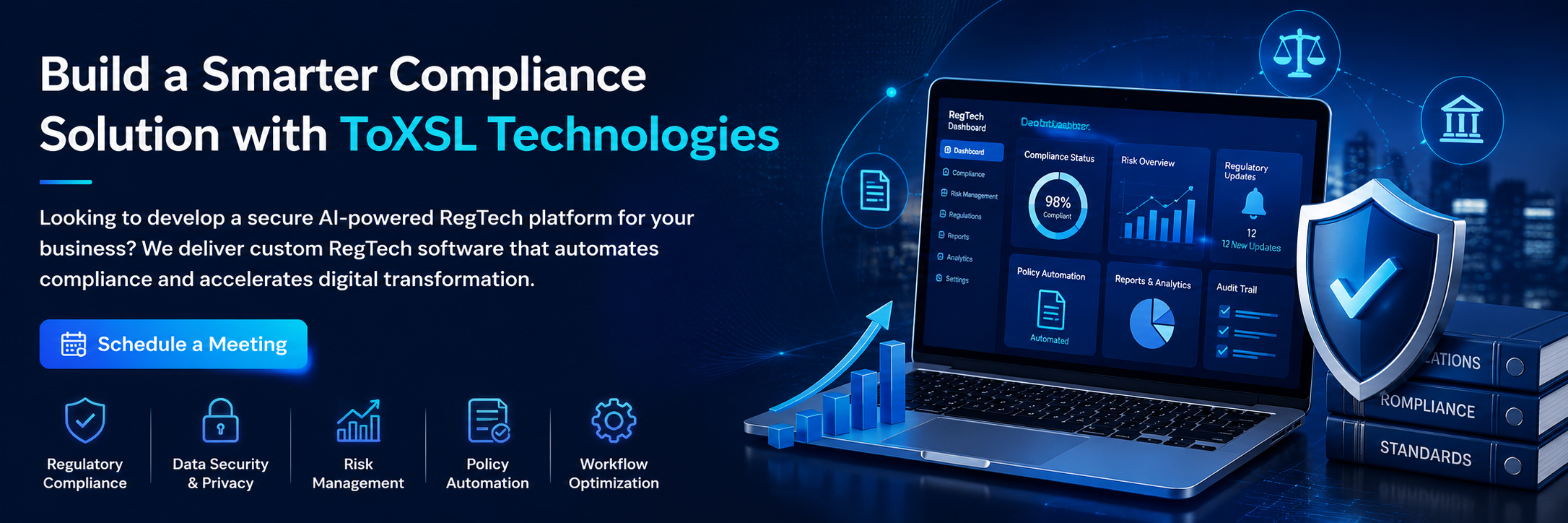
At ToXSL Technologies, we specialize in developing secure, scalable, and AI-powered RegTech software tailored to your business needs. Our experienced development team combines deep industry expertise with the latest technologies to build intelligent compliance solutions that automate workflows, ensure regulatory adherence, and support sustainable business growth. From initial consultation and UI/UX design to development, integration, deployment, and ongoing support, we help businesses build future-ready RegTech platforms that drive innovation with confidence.
Frequently Asked Questions
1. Why should businesses invest in custom RegTech software instead of off-the-shelf solutions?
Custom RegTech software is designed around your business processes, regulatory obligations, and scalability requirements, providing greater flexibility, stronger security, and seamless integration with existing enterprise systems.
- Tailored to business-specific compliance needs.
- Easily integrates with existing systems.
- Supports future business growth.
- Offers greater customization and flexibility.
2. Which industries benefit the most from RegTech software?
RegTech solutions are valuable for any industry with strict regulatory requirements, helping organizations automate compliance, manage risks, and improve operational efficiency.
- Banking and financial services.
- FinTech and payment providers.
- Insurance companies.
- Healthcare and pharmaceutical organizations.
3. How long does it take to develop RegTech software?
Development timelines depend on project complexity, integrations, and compliance requirements. While an MVP may take a few months, enterprise-grade solutions require a longer development cycle.
- MVP: 2–3 months.
- Mid-sized platform: 4–6 months.
- Enterprise solution: 6–12 months.
- Timeline depends on customization.
4. What technologies are commonly used in RegTech software development?
Modern RegTech platforms leverage advanced technologies to automate compliance, enhance security, and deliver intelligent business insights.
- Artificial Intelligence and Machine Learning.
- Cloud Computing.
- Blockchain Technology.
- Big Data Analytics and APIs.
5. Can RegTech software integrate with existing enterprise systems?
Yes. Modern RegTech platforms are built with APIs that enable seamless integration with banking systems, ERP software, CRMs, payment gateways, identity verification services, and government databases.
- API-based integrations.
- Real-time data synchronization.
- Supports third-party compliance tools.
- Improves operational efficiency.
6. What security measures should a RegTech platform include?
Security is critical for protecting sensitive financial and customer data while maintaining regulatory compliance.
- End-to-end encryption.
- Multi-factor authentication.
- Role-based access control.
- Continuous audit logging.
7. How can ToXSL Technologies help businesses develop RegTech software?
ToXSL Technologies provides end-to-end RegTech software development services, from consulting and UI/UX design to development, AI integration, cloud deployment, maintenance, and compliance support.
- Custom RegTech software development.
- AI-powered compliance automation.
- Secure cloud-based architecture.
- Ongoing maintenance and support.