





























The electric vehicle (EV) industry is transforming the future of transportation by offering sustainable, efficient, and intelligent mobility solutions. As governments worldwide encourage clean energy adoption and consumers increasingly shift toward electric mobility, the demand for advanced software solutions has grown significantly. Modern electric vehicles rely on software to manage battery performance, optimize charging, monitor vehicle health, provide navigation, enable remote diagnostics, and deliver seamless user experiences.
The global electric vehicle (EV) market is experiencing remarkable growth, driven by rising environmental awareness, government incentives, and rapid advancements in battery technology. Valued at USD 927.69 billion in 2025, the market is projected to reach USD 2,190.37 billion by 2034, growing at a CAGR of 9.97%. Asia-Pacific remains the dominant regional market, capturing 51.78% of the global market share in 2025, fueled by strong EV adoption and manufacturing capabilities.
Electric Vehicle Software Development involves designing and developing software applications, embedded systems, cloud platforms, and mobile apps that enhance the functionality, safety, and intelligence of EVs. From Battery Management Systems (BMS) and charging station software to fleet management solutions and connected vehicle applications, software plays a crucial role in making electric vehicles smarter and more efficient.
According to industry reports, the global electric vehicle market continues to grow at an impressive pace, driven by technological advancements, government incentives, and increasing environmental awareness. As EV adoption accelerates, businesses need innovative software solutions to stay competitive and meet evolving customer expectations.
Whether you're an automotive manufacturer, EV startup, charging infrastructure provider, or fleet operator, investing in custom electric vehicle software development can streamline operations, improve vehicle performance, and create exceptional customer experiences.
Key Takeaways
- EV software powers smart, connected, and efficient electric mobility.
- Custom EV solutions improve battery management, charging, and fleet operations.
- AI, IoT, cloud computing, and telematics enhance EV performance and user experience.
- A structured development process ensures secure, scalable, and reliable software.
- Development costs depend on features, integrations, and project complexity.
Benefits of Electric Vehicle Software Development
Electric vehicle software development plays a vital role in building intelligent, connected, and sustainable mobility solutions. It enables manufacturers, fleet operators, and EV startups to improve vehicle performance, streamline operations, enhance user experiences, and meet evolving industry standards. By integrating advanced technologies like AI, IoT, cloud computing, and real-time analytics, businesses can create software that supports efficient energy management, predictive maintenance, secure connectivity, and seamless charging experiences.
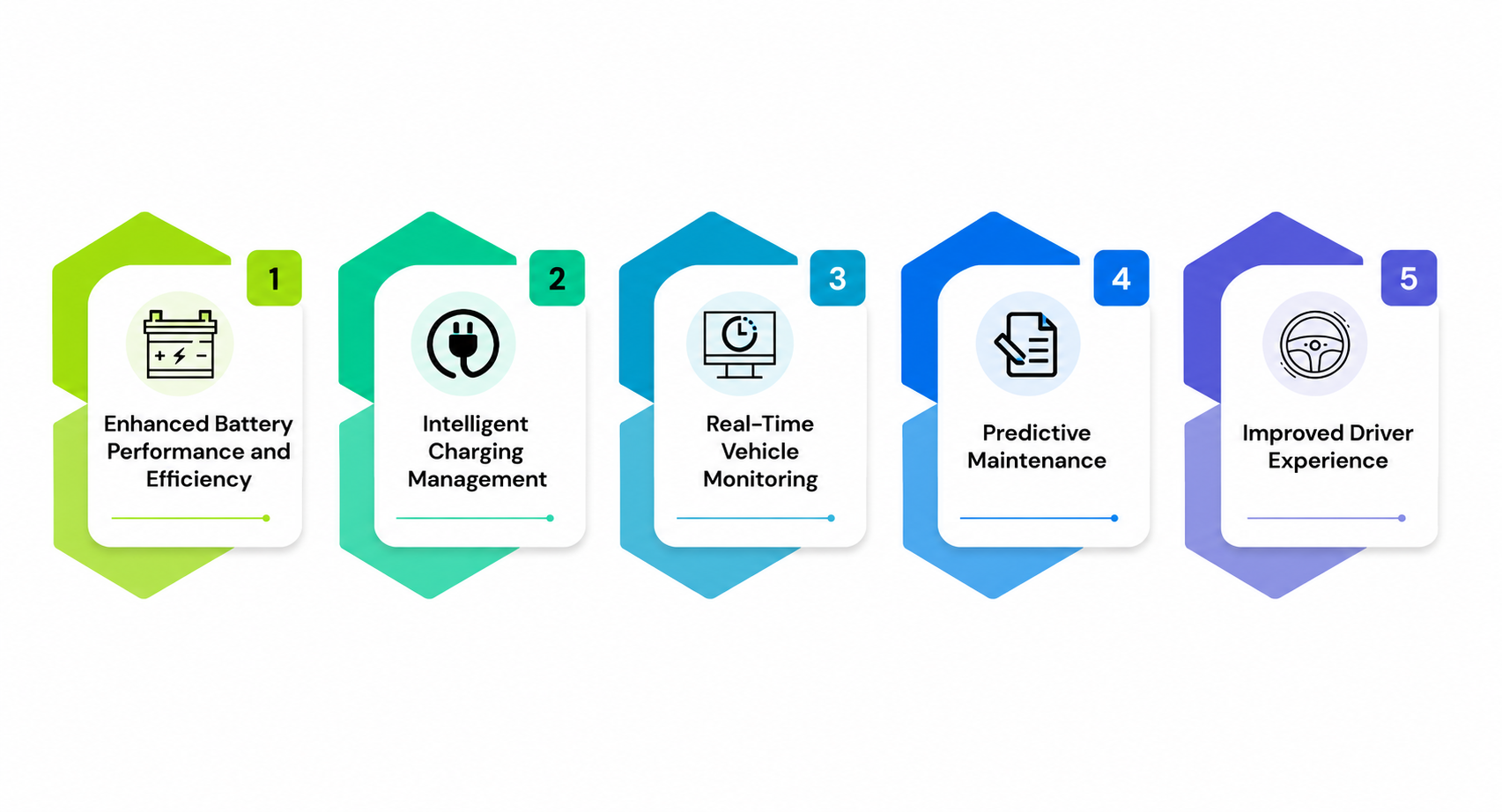
1. Enhanced Battery Performance and Efficiency
Battery performance directly impacts an electric vehicle's driving range, reliability, and lifespan. Advanced Battery Management Software (BMS) continuously monitors battery health, temperature, voltage, charging cycles, and energy consumption to optimize overall efficiency. Intelligent software ensures balanced charging, prevents battery degradation, and helps maximize the vehicle's operational life while improving safety and reducing long-term maintenance costs.
- Monitors battery health in real time
- Optimizes charging and discharging cycles
- Prevents overheating and overcharging
- Extends battery lifespan
- Improves driving range
- Reduces battery replacement costs
2. Intelligent Charging Management
Smart charging software simplifies the charging experience by allowing users to locate nearby charging stations, schedule charging sessions, monitor charging progress remotely, and optimize energy consumption. Businesses can also integrate payment gateways, charging analytics, and dynamic pricing features to create a seamless charging ecosystem that enhances convenience while reducing electricity costs and improving charging infrastructure utilization.
- Enables smart charging scheduling
- Locates nearby charging stations
- Supports remote charging control
- Optimizes energy consumption
- Reduces charging costs
- Integrates secure payment options
3. Real-Time Vehicle Monitoring
Modern EV software continuously collects and analyzes vehicle data, allowing users and fleet managers to monitor battery status, motor performance, vehicle location, energy consumption, and overall health. Real-time monitoring improves operational visibility, enables proactive maintenance, and provides actionable insights that help maximize vehicle efficiency and minimize unexpected failures.
- Tracks vehicle performance in real time
- Monitors battery and motor health
- Provides live GPS tracking
- Generates performance reports
- Detects operational anomalies
- Enhances fleet visibility
4. Predictive Maintenance
Predictive maintenance uses artificial intelligence and data analytics to identify potential mechanical or electrical issues before they result in costly breakdowns. By analyzing sensor data and historical performance, EV software recommends timely maintenance, improves vehicle reliability, reduces downtime, and minimizes repair expenses while ensuring uninterrupted vehicle operations.
- Detects faults before failures occur
- Minimizes unexpected downtime
- Reduces maintenance costs
- Improves vehicle reliability
- Increases component lifespan
- Automates maintenance scheduling
5. Improved Driver Experience
Electric vehicle software enhances the driving experience by providing intelligent navigation, personalized vehicle settings, remote vehicle access, voice-enabled controls, and real-time notifications. A user-friendly mobile application combined with connected vehicle technologies ensures greater convenience, comfort, and engagement throughout every journey.
- Offers personalized driving preferences
- Enables remote vehicle management
- Provides intelligent route planning
- Supports voice commands
- Sends instant vehicle notifications
- Improves customer satisfaction
Electric Vehicle Software Development Process: From Concept to Connected Mobility
Developing high-performance electric vehicle software requires a strategic and well-defined development process that ensures reliability, scalability, security, and seamless integration with vehicle hardware and cloud ecosystems. From understanding business requirements to deployment and continuous maintenance, every phase plays a critical role in delivering intelligent EV solutions.
1. Requirement Analysis and Project Planning
The development journey begins with understanding the client's business objectives, target audience, technical requirements, compliance standards, and software expectations. This phase establishes the project scope, identifies key functionalities, estimates timelines, and creates a roadmap that aligns with business goals while minimizing development risks.
2. UI/UX Design and System Architecture
An intuitive user interface and a scalable system architecture form the foundation of successful EV software. Designers create user-friendly interfaces, while architects develop secure and flexible software structures that enable seamless communication between vehicles, cloud platforms, charging stations, and mobile applications.
3. Embedded Software Development
Embedded software powers the core functionalities of electric vehicles by managing communication between hardware components such as battery systems, motors, sensors, and controllers. This software ensures smooth vehicle operation, real-time data processing, and efficient energy management while maintaining high levels of safety and reliability.
4. Mobile and Web Application Development
Modern electric vehicles require companion mobile and web applications that allow users to monitor vehicle health, control charging, locate charging stations, access navigation, and receive real-time notifications. These applications enhance customer engagement and provide convenient remote access to vehicle functions.
5. Cloud Integration and Backend Development
Cloud platforms enable secure data storage, real-time analytics, remote diagnostics, software updates, and seamless communication between vehicles and connected applications. A robust backend infrastructure ensures high availability, scalability, and secure management of vehicle data across multiple platforms.
Electric Vehicle Software Development Cost
The cost of electric vehicle software development depends on several factors, including the project's complexity, the number of features, platform compatibility, third-party integrations, UI/UX design, cloud infrastructure, security requirements, and the development team's expertise. Simple EV applications with basic monitoring features require a lower investment, while enterprise-grade solutions with AI, IoT, Battery Management Systems (BMS), fleet management, and real-time analytics involve higher development costs.
Businesses should also consider expenses related to testing, cloud hosting, maintenance, cybersecurity, software updates, and regulatory compliance. Choosing a custom electric vehicle software development company ensures that the solution is scalable, secure, and tailored to specific business requirements, ultimately delivering a higher return on investment.
Software Type | Estimated Development Cost (USD) | Estimated Timeline |
|---|---|---|
Basic EV Mobile Application | $15,000 – $35,000 | 2–4 Months |
EV Charging Station Application | $25,000 – $60,000 | 3–5 Months |
Battery Management System (BMS) Software | $40,000 – $90,000 | 4–7 Months |
Fleet Management Software | $50,000 – $120,000 | 5–8 Months |
Connected Vehicle Platform | $70,000 – $180,000 | 6–10 Months |
Electric Vehicle Telematics Software | $60,000 – $150,000 | 5–9 Months |
Smart Charging Management Platform | $50,000 – $140,000 | 5–8 Months |
AI-Powered EV Analytics Platform | $80,000 – $200,000+ | 7–12 Months |
Enterprise Electric Vehicle Software Suite | $150,000 – $500,000+ | 9–18 Months |
Services You Can Get Under Electric Vehicle Software Development
Electric vehicle software development companies offers a wide range of services designed to support manufacturers, EV startups, fleet operators, charging infrastructure providers, and mobility businesses. These services help organizations build secure, scalable, and feature-rich solutions that improve vehicle performance, streamline operations, enhance user experiences, and accelerate digital transformation in the rapidly evolving electric mobility ecosystem.
1. Electric Vehicle Mobile App Development
Electric vehicle mobile applications allow users to remotely monitor battery status, control charging sessions, locate charging stations, access navigation, receive maintenance alerts, and manage various vehicle functions from their smartphones. These applications enhance convenience, improve customer engagement, and deliver a seamless connected driving experience for EV owners.
2. Battery Management System Software Development
Battery Management System software monitors battery health, voltage, temperature, charging cycles, and energy consumption in real time. It optimizes battery performance, prevents overheating, extends battery lifespan, improves vehicle safety, and ensures efficient power distribution, making it one of the most critical components of modern electric vehicles.
3. EV Charging Station Software Development
Charging station software enables operators to manage charging infrastructure efficiently through real-time monitoring, user authentication, payment processing, station availability tracking, and remote diagnostics. It also supports smart charging schedules, usage analytics, and seamless integration with mobile applications for an enhanced charging experience.
4. Connected Vehicle and Telematics Solutions
Connected vehicle software integrates GPS, IoT sensors, cloud platforms, and telematics systems to provide real-time vehicle tracking, remote diagnostics, performance monitoring, driver behavior analysis, and predictive maintenance. These intelligent solutions improve operational efficiency, vehicle safety, and overall fleet performance through continuous connectivity.
5. EV Fleet Management Software Development
Fleet management software enables businesses to monitor multiple electric vehicles through a centralized platform. It offers route optimization, battery monitoring, charging management, driver performance tracking, maintenance scheduling, and operational analytics, helping organizations reduce costs, maximize fleet utilization, and improve overall business productivity.
Essential Features of Modern Electric Vehicle Apps
Electric vehicle (EV) applications have become an integral part of the connected mobility ecosystem, enabling users to manage their vehicles efficiently from anywhere. These apps offer intelligent features that simplify charging, monitor vehicle performance, improve safety, and enhance the overall driving experience. By integrating technologies such as IoT, AI, GPS, cloud computing, and real-time analytics, EV apps provide convenience, operational efficiency, and seamless connectivity for both individual vehicle owners and fleet operators.
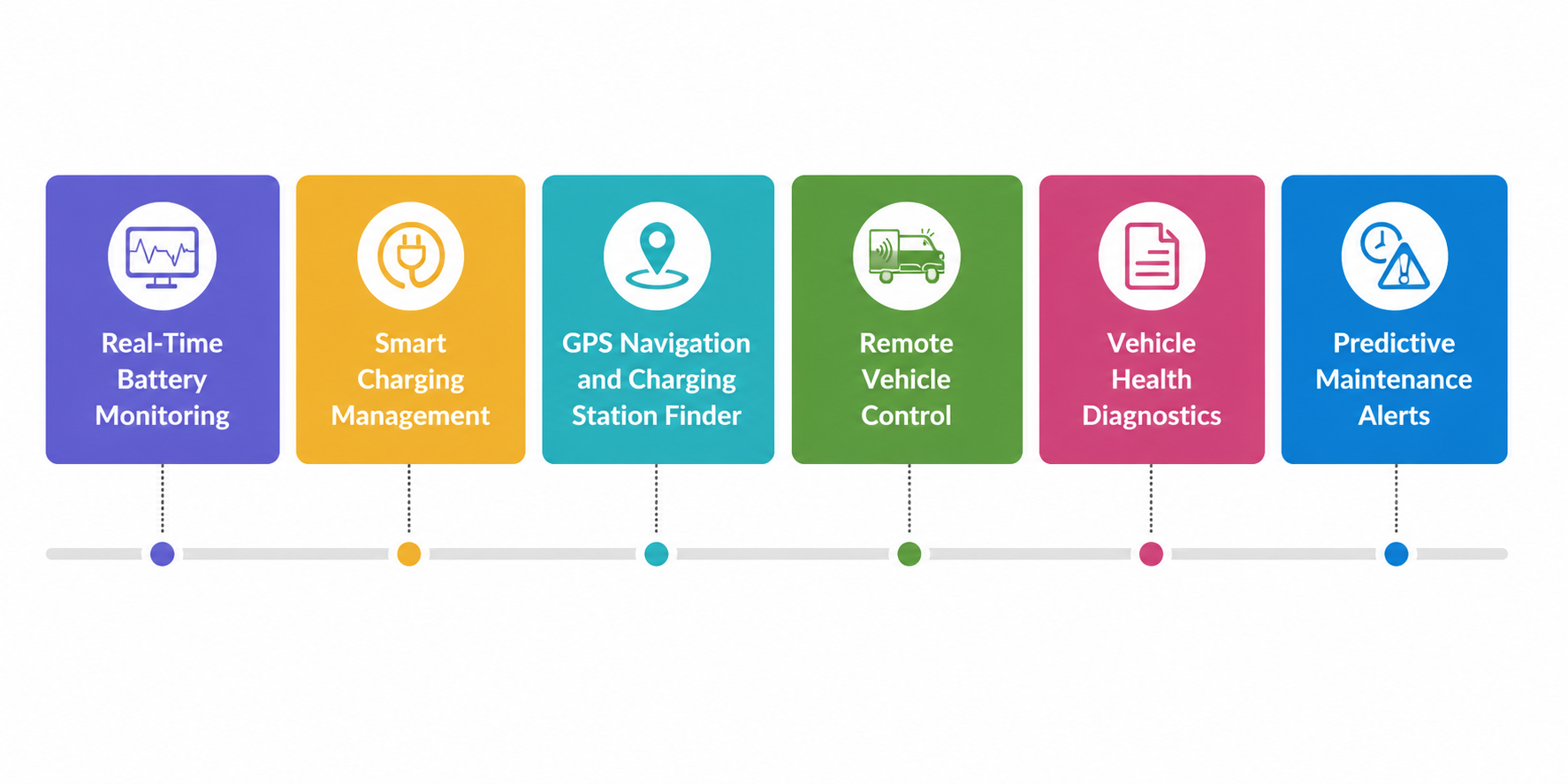
1. Real-Time Battery Monitoring
A battery monitoring feature provides users with instant insights into their vehicle's battery health, charge level, estimated driving range, temperature, and energy consumption. It helps drivers make informed decisions, optimize battery usage, and avoid unexpected power shortages during their journeys.
2. Smart Charging Management
Smart charging functionality enables users to schedule charging sessions, remotely start or stop charging, monitor charging progress, and locate compatible charging stations. It optimizes electricity usage, reduces charging costs, and improves the overall charging experience for EV owners.
3. GPS Navigation and Charging Station Finder
Integrated navigation helps drivers locate nearby charging stations, plan efficient travel routes, estimate battery usage, and receive real-time traffic updates. This feature minimizes range anxiety while ensuring users can easily access available charging infrastructure during long-distance travel.
4. Remote Vehicle Control
Remote vehicle management allows users to control essential vehicle functions directly from their smartphones. Owners can lock or unlock doors, start climate control, locate their vehicle, and monitor various systems without being physically present.
5. Vehicle Health Diagnostics
Vehicle diagnostics continuously monitor the condition of key vehicle components and notify users about potential issues before they become major problems. This feature supports preventive maintenance and improves overall vehicle reliability.
6. Predictive Maintenance Alerts
AI-powered predictive maintenance analyzes vehicle data to identify wear and performance issues early. Timely alerts help users schedule maintenance before failures occur, reducing repair costs and minimizing unexpected downtime.
Types of Electric Vehicle Apps
The growing adoption of electric vehicles has led to the development of a wide range of applications that cater to different users and business needs. Whether it's helping drivers locate charging stations, enabling fleet operators to monitor vehicles, or providing manufacturers with real-time vehicle insights, EV apps play a crucial role in improving efficiency, convenience, and connectivity. Choosing the right type of application depends on your business model, target audience, and operational requirements.
App Type | Description | Primary Users |
|---|---|---|
EV Charging Station App | Helps users locate nearby charging stations, check real-time availability, reserve charging slots, start or stop charging sessions remotely, and make secure digital payments. | EV Owners, Charging Network Operators |
Battery Management App | Monitors battery health, charging cycles, temperature, voltage, energy consumption, and overall battery performance to maximize efficiency and extend battery lifespan. | EV Owners, Manufacturers |
Fleet Management App | Enables businesses to monitor vehicle locations, optimize routes, schedule maintenance, analyze driver behavior, and manage charging activities from a centralized dashboard. | Fleet Operators, Logistics Companies |
Connected Vehicle App | Provides remote vehicle access, live diagnostics, GPS tracking, software updates, and real-time communication between vehicles, cloud platforms, and mobile devices. | EV Owners, Automotive Companies |
Navigation & Route Planning App | Offers intelligent route optimization based on battery range, charging station availability, traffic conditions, and estimated energy consumption for uninterrupted travel. | EV Drivers, Ride-Sharing Services |
EV Companion App | Acts as a digital control hub that allows users to monitor vehicle status, control charging, manage climate settings, access trip history, and receive maintenance notifications. | Individual EV Owners |
Charging Network Management App | Enables charging infrastructure providers to monitor charging stations, manage user accounts, track station performance, process payments, and generate operational reports. | Charging Network Providers |
Conclusion
Electric vehicle software development is driving the next generation of smart, connected, and sustainable transportation. From battery management and intelligent charging to fleet management, connected vehicle technologies, and predictive maintenance, software has become the foundation of modern electric mobility. Businesses that invest in innovative EV software solutions can improve operational efficiency, enhance user experiences, reduce maintenance costs, and gain a competitive advantage in the rapidly evolving automotive market.
As the demand for electric vehicles continues to grow, partnering with an experienced software development company is essential for building scalable, secure, and future-ready solutions. At ToXSL Technologies, we specialize in delivering custom Electric Vehicle Software Development services tailored to the unique needs of automotive manufacturers, EV startups, fleet operators, and charging infrastructure providers. Contact us to learn more.
Frequently Asked Questions
1. What is Electric Vehicle Software Development?
Electric Vehicle Software Development is the process of designing and building software solutions that power various functions of electric vehicles. These solutions include mobile applications, Battery Management Systems (BMS), charging management platforms, telematics software, fleet management systems, and connected vehicle technologies that enhance vehicle performance, safety, and user experience.
Key points:
- Improves battery efficiency
- Enables real-time vehicle monitoring
- Integrates with charging infrastructure
- Enhances driver convenience
2. Why is software important for electric vehicles?
Software acts as the intelligence behind modern electric vehicles by managing battery performance, optimizing energy consumption, enabling remote diagnostics, and supporting connected mobility features. It helps manufacturers deliver safer, smarter, and more efficient vehicles while improving customer satisfaction and operational efficiency.
Key points:
- Optimizes vehicle performance
- Improves battery life
- Enables predictive maintenance
- Supports remote vehicle management
3. How much does Electric Vehicle Software Development cost?
The cost depends on several factors, including project complexity, required features, platform compatibility, third-party integrations, cloud infrastructure, security requirements, and customization needs. A basic EV application may cost significantly less than an enterprise-level platform with AI, IoT, and fleet management capabilities.
Key points:
- Depends on software complexity
- Influenced by platform selection
- Varies based on custom features
- Scales with business requirements
4. What technologies are commonly used in Electric Vehicle Software Development?
Electric vehicle software is built using modern technologies such as Artificial Intelligence (AI), Internet of Things (IoT), cloud computing, GPS, embedded systems, telematics, machine learning, big data analytics, and secure APIs. These technologies work together to create intelligent, connected, and scalable mobility solutions.
Key points:
- Artificial Intelligence (AI)
- Internet of Things (IoT)
- Cloud Computing
- GPS and Telematics
- Machine Learning and Analytics
5. Which businesses can benefit from Electric Vehicle Software Development?
A wide range of organizations can benefit from EV software solutions, including automotive manufacturers, EV startups, charging station operators, logistics companies, fleet operators, mobility service providers, and energy companies looking to improve efficiency and deliver innovative electric mobility services.
Key points:
- EV manufacturers
- Fleet management companies
- Charging infrastructure providers
- Automotive startups
6. Why choose ToXSL Technologies for Electric Vehicle Software Development?
ToXSL Technologies delivers end-to-end Electric Vehicle Software Development services with a focus on innovation, scalability, and security. Our experienced developers create customized EV solutions that integrate advanced technologies to meet evolving business requirements and support the future of connected mobility.
Key points:
- Custom EV software solutions
- Experienced development team
- AI and IoT expertise
- Scalable and secure architecture
- End-to-end development and support