




























Key Takeaways
- AI automates repetitive business processes, reducing manual effort and increasing productivity.
- AI-powered analytics help businesses make faster and more accurate decisions using real-time data.
- Custom AI solutions improve customer experiences through personalization and intelligent automation.
- AI development companies build scalable solutions tailored to specific business requirements.
- AI enhances operational efficiency by optimizing workflows, reducing errors, and lowering costs.
- Businesses across healthcare, finance, retail, manufacturing, and logistics are adopting AI to gain a competitive advantage.
- Investing in AI today prepares organizations for future innovation, digital transformation, and sustainable growth.
Artificial Intelligence (AI) has evolved from being an emerging technology into a fundamental driver of digital transformation. Businesses across every industry are leveraging AI to automate repetitive tasks, analyze vast amounts of data, improve customer experiences, and make faster, data-driven decisions. Whether it's a startup looking to scale efficiently or an enterprise aiming to optimize complex operations, AI is enabling organizations to boost productivity, reduce operational costs, and unlock new growth opportunities.
The rapid adoption of AI is also reflected in its remarkable market growth. According to a report, the global artificial intelligence market size is projected to grow from USD 539.5 billion in 2026 to USD 3,497.3 billion by 2033, registering an impressive CAGR of 30.6% during the forecast period (2026–2033). This extraordinary growth highlights the increasing reliance on AI technologies as businesses invest in intelligent automation, predictive analytics, machine learning, and generative AI to remain competitive in an increasingly digital economy.
However, adopting AI successfully requires much more than implementing ready-made tools. Businesses need customized AI solutions that align with their unique objectives, integrate seamlessly with existing systems, and deliver measurable returns on investment. This is where an experienced AI development company becomes a valuable technology partner. From AI strategy and consulting to model development, deployment, and continuous optimization, these experts help organizations transform ideas into intelligent, scalable, and future-ready solutions.
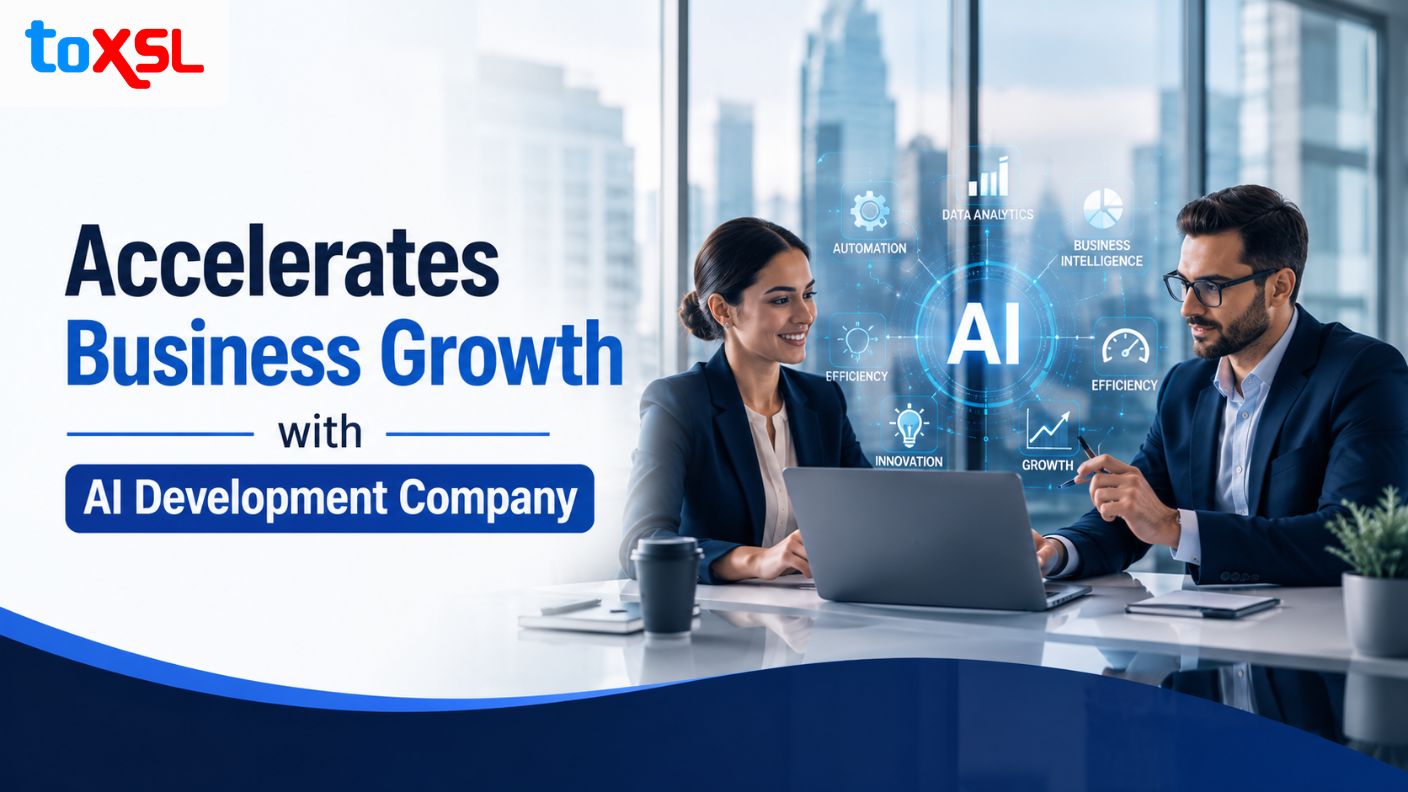
In this blog, we will explore how AI works in modern businesses, the key benefits of AI adoption, why organizations are investing heavily in AI solutions, real-world industry use cases, and how partnering with the right AI development company can accelerate business growth, improve efficiency, and drive long-term success.
How AI Transforms Modern Business Operations
AI is transforming businesses by combining machine learning, automation, natural language processing, and predictive analytics to solve complex operational challenges. Instead of replacing human expertise, AI enhances decision-making, streamlines workflows, and enables organizations to operate more efficiently while delivering better customer experiences and improving overall business performance.
1. Data Collection and Processing
AI systems gather information from multiple sources, including customer interactions, websites, mobile applications, IoT devices, ERP platforms, and business databases. Advanced algorithms organize and process this data to identify valuable insights that help organizations understand customer behavior, operational trends, and emerging market opportunities.
2. Machine Learning and Pattern Recognition
Machine learning enables AI systems to recognize patterns, learn from historical information, and improve predictions over time. Businesses use these capabilities for demand forecasting, fraud detection, recommendation engines, predictive maintenance, and customer segmentation, allowing organizations to make proactive rather than reactive decisions.
3. Intelligent Decision-Making
AI analyzes structured and unstructured data significantly faster than traditional methods. It provides business leaders with real-time recommendations, risk assessments, and predictive insights that improve strategic planning, inventory management, pricing strategies, and resource allocation while minimizing uncertainty and improving operational outcomes.
4. Process Automation
AI automates repetitive and time-consuming tasks such as invoice processing, customer support, report generation, appointment scheduling, document verification, and workflow management. Automation reduces human errors, increases operational consistency, and allows employees to focus on innovation, strategic planning, and higher-value responsibilities.
5. Continuous Learning and Improvement
Unlike traditional software, AI continuously learns from new information and user interactions. As more data becomes available, AI models become increasingly accurate and efficient, enabling businesses to improve customer experiences, optimize operations, adapt to changing market conditions, and achieve sustainable long-term growth.
Top Benefits of AI That Drive Business Growth
Artificial intelligence delivers measurable business value by improving productivity, enhancing customer engagement, reducing operational costs, and supporting smarter decision-making. Organizations implementing AI solutions gain greater efficiency, scalability, and agility, enabling them to respond quickly to market changes while creating innovative products, services, and personalized customer experiences.
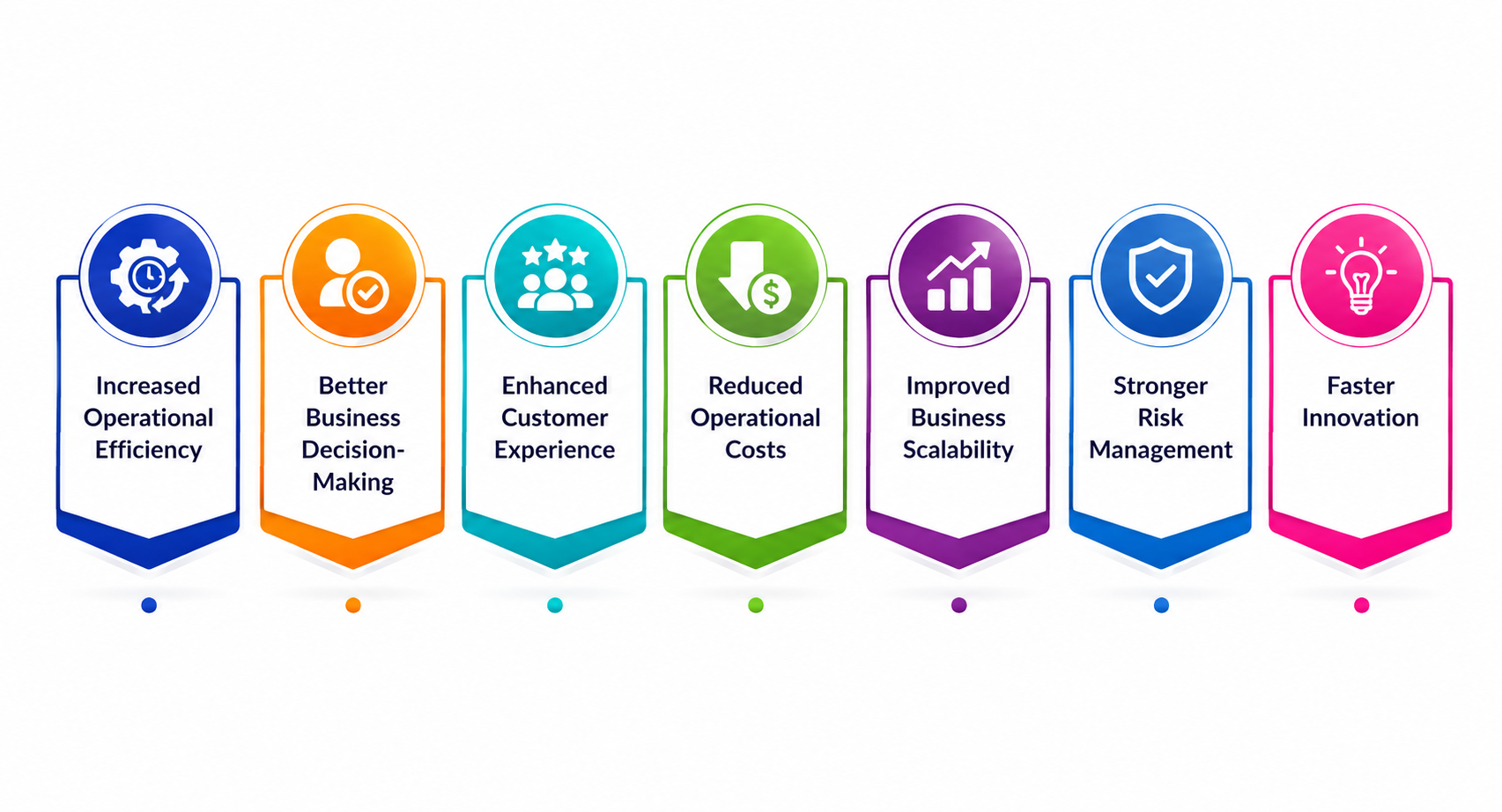
1. Increased Operational Efficiency
AI automates repetitive processes and optimizes business workflows, reducing manual intervention across departments. From document processing to inventory management, AI minimizes delays and improves productivity. Organizations can complete tasks faster, allocate resources more effectively, and achieve higher operational efficiency without significantly increasing workforce requirements.
Key Advantages
- Reduces repetitive manual work
- Improves workflow efficiency
- Minimizes operational bottlenecks
- Enhances employee productivity
2. Better Business Decision-Making
AI-powered analytics convert large datasets into actionable insights that support informed business decisions. Predictive models identify trends, customer preferences, and operational risks, enabling organizations to plan strategically. Decision-makers gain access to real-time intelligence that improves forecasting accuracy and supports long-term business growth.
Key Advantages
- Real-time business insights
- Improved forecasting accuracy
- Data-driven strategic planning
- Reduced business risks
3. Enhanced Customer Experience
AI enables businesses to provide personalized customer interactions through intelligent recommendations, virtual assistants, and automated support systems. By understanding customer preferences and behaviors, organizations deliver faster responses, customized experiences, and proactive engagement, leading to increased satisfaction, stronger customer relationships, and higher retention rates.
Key Advantages
- Personalized customer interactions
- Faster response times
- 24/7 customer support
- Higher customer satisfaction
4. Reduced Operational Costs
Automation powered by AI decreases dependency on manual processes while reducing errors and unnecessary operational expenses. Businesses optimize resource utilization, improve process efficiency, and eliminate repetitive workloads. These improvements contribute to significant cost savings while maintaining high service quality and operational consistency.
Key Advantages
- Lower labor costs
- Fewer manual errors
- Optimized resource utilization
- Improved operational profitability
5. Improved Business Scalability
AI solutions adapt to growing business requirements without requiring proportional increases in workforce or infrastructure. Whether processing higher transaction volumes or managing expanding customer bases, AI systems scale efficiently, helping organizations maintain performance, productivity, and service quality during business expansion.
Key Advantages
- Supports business expansion
- Handles growing workloads efficiently
- Maintains service consistency
- Enables sustainable long-term growth
6. Stronger Risk Management
AI identifies anomalies, predicts potential risks, and monitors business operations continuously. Industries such as finance, healthcare, and cybersecurity leverage AI to detect fraud, identify security threats, ensure compliance, and minimize operational disruptions before they become major business challenges.
Key Advantages
- Early fraud detection
- Continuous risk monitoring
- Better regulatory compliance
- Improved cybersecurity protection
7. Faster Innovation
AI accelerates research, product development, and service innovation by analyzing market trends and customer feedback. Businesses can test ideas more efficiently, identify emerging opportunities, and launch innovative products faster, helping them remain competitive in rapidly changing industries.
Key Advantages
- Faster product development
- Improved market adaptability
- Better competitive positioning
- Continuous innovation opportunities
Why Businesses Are Prioritizing AI Investments for Long-Term Success
As competition increases across industries, businesses are investing in AI to improve efficiency, reduce operational costs, deliver personalized customer experiences, and gain valuable insights from data. AI has shifted from being an experimental technology to becoming a strategic investment that helps organizations innovate faster, improve profitability, and build sustainable competitive advantages.
1. Growing Demand for Business Automation
Organizations are adopting AI to automate repetitive and time-consuming tasks that traditionally required significant manual effort. From customer service and document processing to workflow management and reporting, automation improves productivity, reduces human errors, and allows employees to focus on strategic initiatives that generate greater business value.
2. Data-Driven Decision Making
Modern businesses generate enormous amounts of data every day. AI transforms this information into meaningful insights by identifying trends, customer behaviors, and business opportunities. Decision-makers can use predictive analytics to improve planning, optimize operations, and respond proactively to market changes with greater confidence.
3. Increasing Customer Expectations
Today's customers expect fast responses, personalized recommendations, and seamless digital experiences. AI enables businesses to meet these expectations through intelligent chatbots, recommendation engines, virtual assistants, and personalized marketing campaigns. Delivering consistent customer experiences strengthens brand loyalty and improves customer retention.
4. Competitive Market Advantage
Companies investing in AI gain a significant edge over competitors by improving operational efficiency and accelerating innovation. AI enables organizations to launch products faster, optimize pricing strategies, predict market demand, and identify new revenue opportunities, allowing businesses to adapt quickly in dynamic market environments.
5. Cost Optimization
AI reduces operational expenses by automating manual processes, minimizing errors, and improving resource allocation. Businesses achieve higher productivity without proportionally increasing workforce costs. Better utilization of time, infrastructure, and business resources contributes to improved profitability and long-term financial sustainability.
6. Improved Risk Management
AI continuously monitors business operations to identify anomalies, detect fraud, predict equipment failures, and assess operational risks. Early detection enables organizations to take preventive actions before issues escalate, reducing financial losses while improving business continuity and regulatory compliance.
Real-World AI Development Company Use Cases Across Industries
AI development companies build customized solutions that address industry-specific challenges and business objectives. From intelligent automation and predictive analytics to computer vision and conversational AI, businesses across multiple sectors are leveraging AI to improve productivity, customer engagement, and operational performance.
1. Healthcare
AI is revolutionizing healthcare by improving diagnostics, patient management, medical imaging, and administrative workflows. Hospitals and healthcare providers use AI to analyze medical data, support clinical decision-making, automate documentation, and deliver personalized patient care while reducing operational burdens on medical professionals.
2. Retail and E-commerce
Retail businesses use AI to personalize shopping experiences, recommend products, forecast inventory demand, and optimize pricing strategies. AI also improves customer support through virtual assistants and enhances supply chain efficiency, enabling businesses to increase sales while delivering better customer satisfaction.
3. Banking and Financial Services
Financial institutions leverage AI to strengthen fraud detection, automate loan processing, improve customer service, and perform risk analysis. AI analyzes large financial datasets in real time, helping organizations make accurate decisions while ensuring regulatory compliance and enhancing overall financial security.
4. Manufacturing
Manufacturers implement AI to optimize production processes, improve quality control, reduce equipment downtime, and enhance supply chain visibility. Predictive maintenance powered by AI identifies potential machine failures before they occur, minimizing production interruptions and increasing manufacturing efficiency.
5. Logistics and Transportation
AI in logistics helps companies optimize route planning, fleet management, warehouse operations, and delivery scheduling. Predictive analytics improve demand forecasting, while intelligent automation reduces transportation costs and enhances overall operational efficiency across the supply chain.
6. Education
Educational institutions use AI to personalize learning experiences, automate administrative tasks, evaluate student performance, and provide intelligent tutoring. AI-powered education platforms support adaptive learning that helps students learn according to their individual pace and learning preferences.
7. Human Resources
AI simplifies recruitment, employee engagement, and workforce management by automating resume screening, interview scheduling, onboarding, and performance evaluation. HR teams save time while identifying suitable candidates more efficiently using intelligent recruitment solutions.
8. Real Estate
AI in Real estate helps companies to analyze market trends, estimate property values, recommend investment opportunities, and improve customer engagement. AI-powered chatbots also assist buyers and tenants by providing instant responses and property recommendations.
The Future of AI in Business: Trends That Will Shape Tomorrow
Artificial intelligence is rapidly evolving, transforming how businesses innovate, operate, and compete. Emerging AI technologies are enabling organizations to automate complex processes, improve decision-making, and deliver highly personalized experiences. As AI adoption continues to grow, businesses that embrace these innovations will be better positioned to drive sustainable growth, enhance operational efficiency, and maintain a competitive edge in the digital economy.
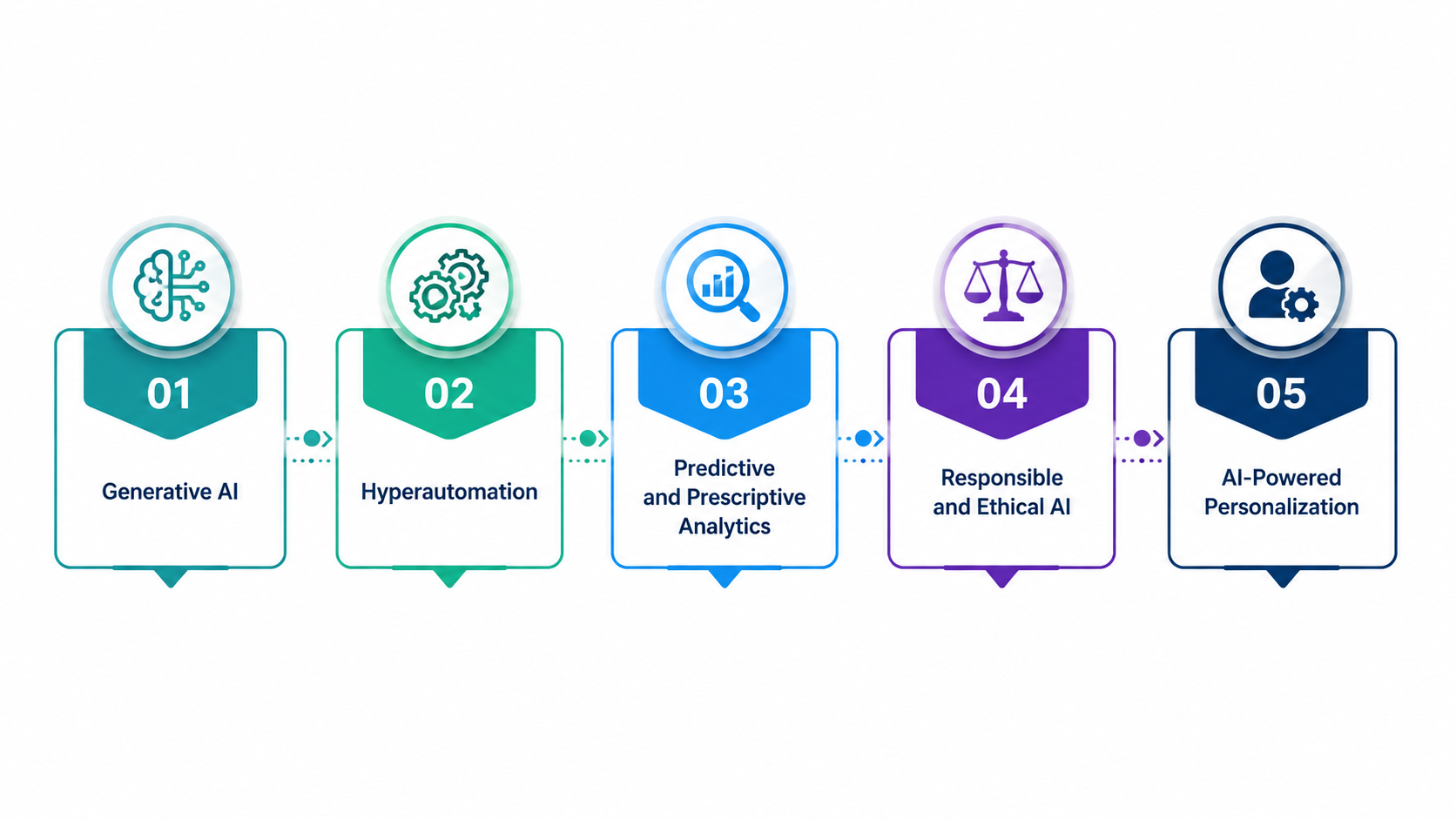
1. Generative AI
Generative AI will move beyond content creation to support product design, software development, customer service, marketing, and business operations. Organizations will use AI-powered assistants to improve productivity, accelerate innovation, and automate knowledge-based tasks, allowing employees to focus on strategic initiatives and creative problem-solving.
2. Hyperautomation
Businesses will increasingly combine AI, robotic process automation (RPA), and intelligent workflows to automate entire business processes. From finance and HR to supply chain management and customer support, hyperautomation will reduce manual effort, minimize errors, improve operational efficiency, and accelerate business performance.
3. Predictive and Prescriptive Analytics
Future AI systems will not only predict business outcomes but also recommend the best actions to achieve desired results. Companies will leverage advanced analytics for demand forecasting, inventory optimization, financial planning, and risk management, enabling faster, data-driven decisions and improved business agility.
4. Responsible and Ethical AI
As AI adoption expands, organizations will focus on building transparent, secure, and ethical AI systems. Businesses will implement governance frameworks to ensure data privacy, reduce algorithmic bias, comply with evolving regulations, and build customer trust through responsible AI practices.
5. AI-Powered Personalization
AI will deliver highly personalized interactions across websites, mobile apps, and digital platforms by analyzing customer preferences and behaviors in real time. Businesses will provide tailored recommendations, proactive support, and customized marketing campaigns that increase customer satisfaction, strengthen loyalty, and drive higher conversion rates.
Conclusion
Artificial Intelligence is no longer a futuristic concept, it is a powerful business tool that is transforming the way organizations operate, innovate, and grow. From automating repetitive processes and improving decision-making to delivering personalized customer experiences and reducing operational costs, AI has become a key driver of business success across industries. However, achieving meaningful results with AI requires more than adopting off-the-shelf tools.
Businesses need tailored AI solutions that align with their goals, integrate seamlessly with existing systems, and scale as their operations grow. This is where partnering with an experienced AI development company makes all the difference. With the right expertise, organizations can implement AI strategically, maximize return on investment, and stay ahead in an increasingly competitive digital landscape.
At ToXSL Technologies, we specialize in delivering innovative AI development services that empower businesses to accelerate growth, streamline operations, and unlock new opportunities. Our team designs custom AI solutions, machine learning models, intelligent automation systems, AI chatbots, predictive analytics platforms, and enterprise AI applications tailored to your unique business requirements. Whether you're starting your AI journey or expanding existing capabilities, ToXSL Technologies is your trusted technology partner for building future-ready AI solutions that drive long-term success.
Frequently Asked Questions
1. What does an AI development company do?
An AI development company designs, develops, and deploys customized artificial intelligence solutions that help businesses automate processes, analyze data, improve customer experiences, and optimize decision-making. Services often include machine learning, generative AI, AI chatbots, predictive analytics, computer vision, and AI integration with existing business systems.
2. How can AI help businesses grow?
AI helps businesses grow by automating repetitive tasks, reducing operational costs, improving productivity, enhancing customer engagement, and providing data-driven insights. It enables organizations to make smarter decisions, improve efficiency, identify new business opportunities, and scale operations more effectively.
3. Which industries benefit the most from AI development services?
AI is widely used across healthcare, finance, retail, manufacturing, logistics, education, real estate, insurance, eCommerce, travel, and customer service. Nearly every industry can leverage AI to improve operational efficiency, enhance customer experiences, and gain a competitive advantage.
4. What AI solutions do businesses commonly implement?
Businesses commonly implement AI-powered chatbots, virtual assistants, recommendation engines, predictive analytics, fraud detection systems, document processing automation, computer vision solutions, demand forecasting tools, intelligent workflow automation, and generative AI applications for content creation and business operations.
5. How long does it take to develop an AI solution?
The development timeline depends on the complexity of the project, data availability, integration requirements, and business objectives. A simple AI chatbot may take 4–8 weeks, while advanced enterprise AI platforms or machine learning applications may require 3–9 months or longer.
6. Why should I choose ToXSL Technologies for AI development?
ToXSL Technologies offers end-to-end AI development services tailored to your business needs. Our experienced AI engineers build scalable, secure, and high-performance AI solutions using the latest technologies. From AI strategy and consulting to deployment and ongoing support, we help businesses accelerate digital transformation and achieve measurable business outcomes.