







































Key Takeaways
- LangChain agents combine LLMs, tools, memory, prompts, and workflows to accomplish complex tasks.
- Agents can reason about user requests and dynamically select appropriate tools or actions.
- LangChain supports integrations with APIs, databases, search engines, vector stores, and business systems.
- Developers can build agents for customer service, research, sales, analytics, coding, and automation.
- Scalable agents require strong security, monitoring, error handling, testing, and human oversight.
- A well-designed LangChain architecture can help businesses turn generative AI capabilities into practical intelligent applications.
Artificial intelligence is moving beyond simple chatbots and rule-based automation toward intelligent systems that can understand goals, make decisions, use tools, and complete multi-step tasks. AI agents represent this next generation of intelligent software, allowing businesses to automate complex workflows while maintaining flexibility and context.
LangChain has emerged as a popular framework for building applications powered by large language models (LLMs). Its agent capabilities help developers connect language models with tools, APIs, databases, retrieval systems, and custom business logic. Instead of simply generating an answer, a LangChain agent can determine what action is required, select the appropriate tool, execute it, evaluate the result, and continue until the objective is completed.
This makes LangChain agents useful for customer support, research, data analysis, sales automation, software development, document processing, and many other applications. In this guide, we explore how LangChain agents work, their architecture, development process, real-world use cases, and best practices for creating scalable intelligent AI solutions.
According to McKinsey's Global Survey on AI, 78% of organizations reported using AI in at least one business function, while 71% reported regular use of generative AI in at least one function. This growing adoption highlights the increasing demand for intelligent systems that can move beyond content generation and actively perform business tasks.
For businesses, this shift creates an opportunity to use AI agents for repetitive workflows, decision support, information retrieval, customer interactions, and operational automation. Frameworks such as LangChain can help developers connect powerful language models with the tools and systems required to turn these capabilities into functional AI applications.
What Are LangChain Agents and How Do They Work?
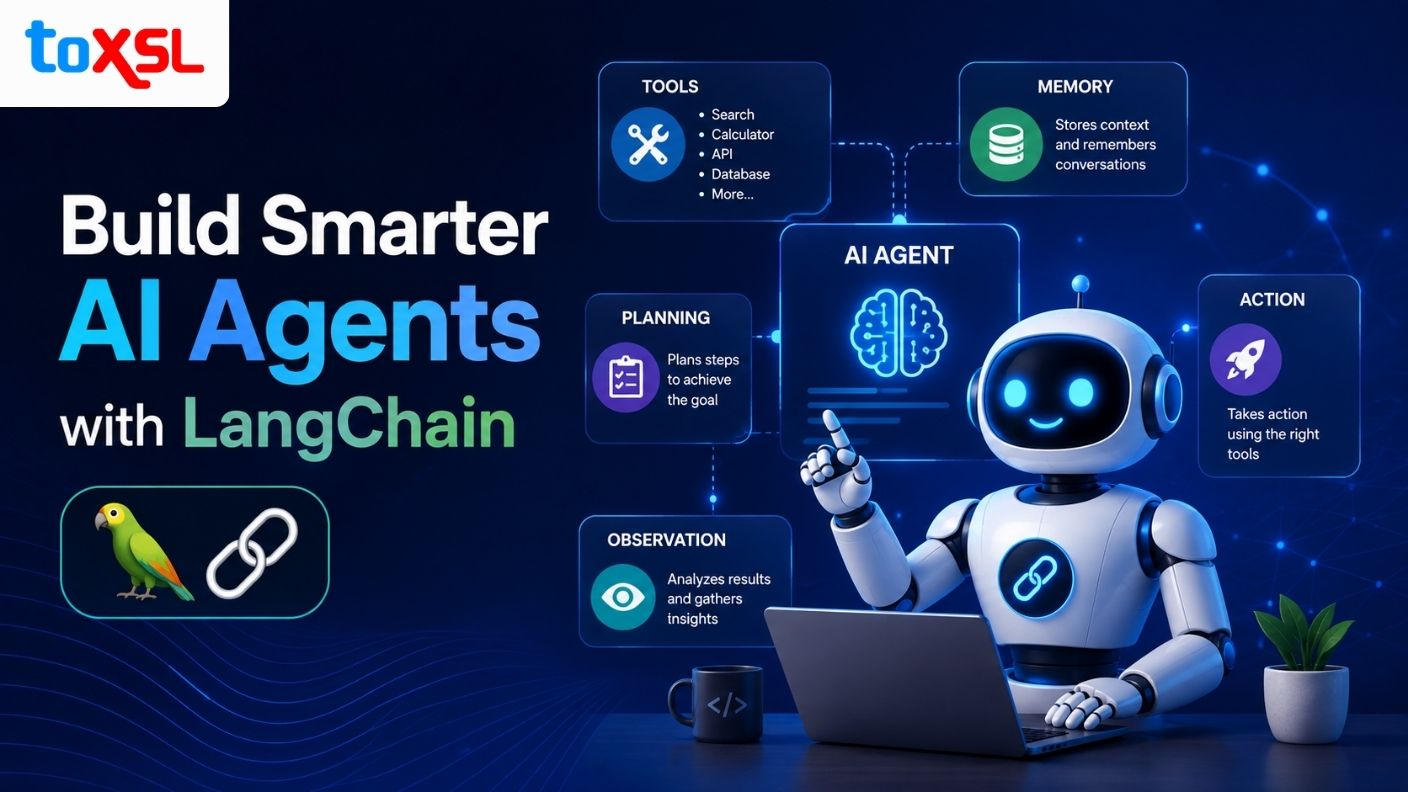
LangChain agents are AI-powered systems that use a language model as a reasoning engine while connecting it with external tools and actions. Rather than following only a fixed sequence of instructions, an agent can determine which action should be performed based on the user's objective.
For example, if a customer asks, "Check my order status and tell me when it will arrive," an agent could identify the customer's order, call an order-management API, retrieve shipment information, interpret the result, and provide a natural-language response. A typical LangChain agent follows a continuous decision-making process:
User Request → Understand Goal → Select Tool → Execute Action → Evaluate Result → Continue or Respond
The language model determines the next appropriate step, while tools perform actions that the model cannot accomplish by itself. These tools can include web search, calculators, databases, APIs, CRM systems, document retrieval systems, or internal business applications. This architecture makes agents different from traditional chatbots. A conventional chatbot may simply generate a response from its trained knowledge or provided context. An agent can actively interact with external systems and complete tasks.
Building the Core Architecture of a LangChain Agent
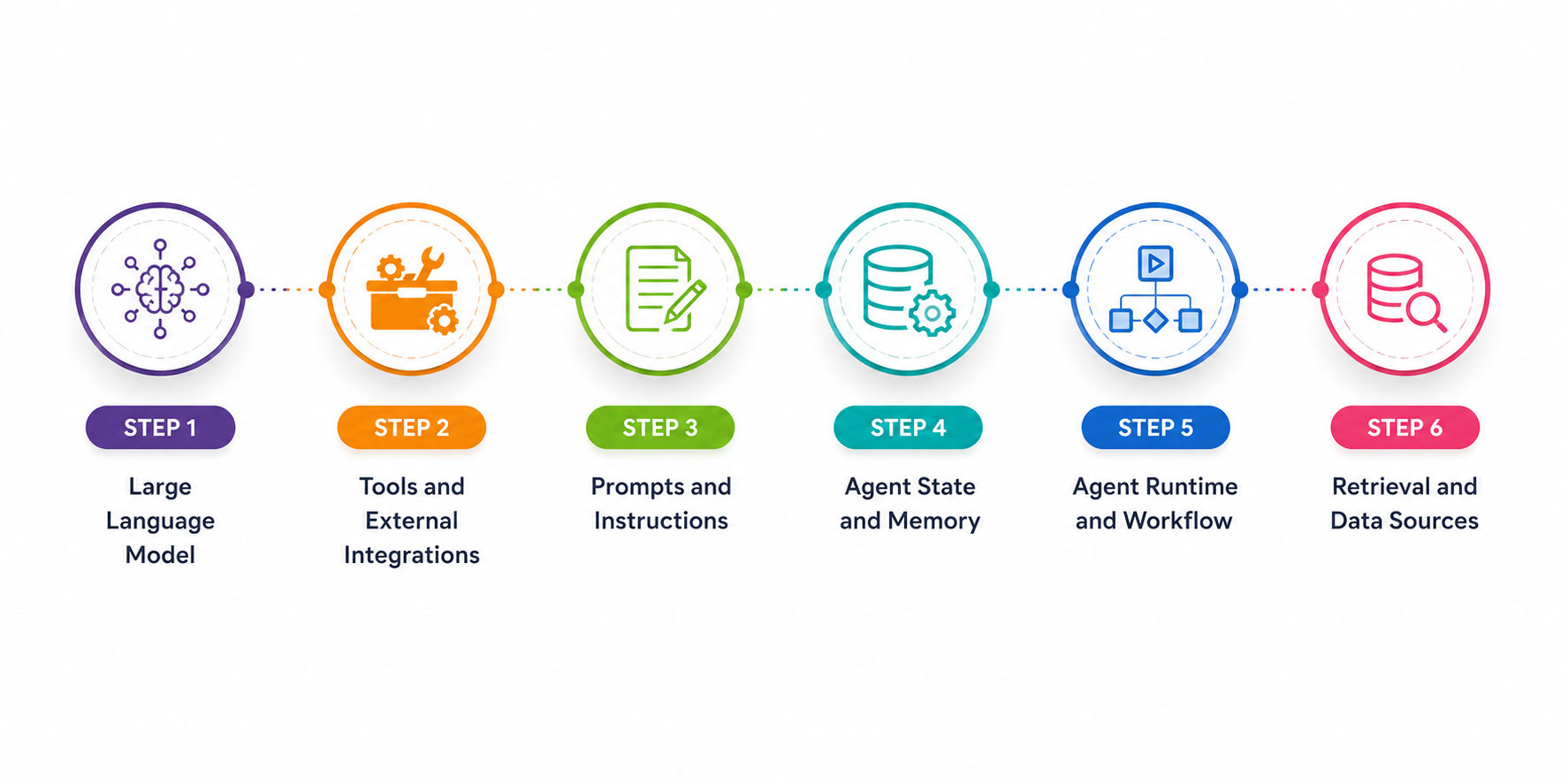
A successful LangChain agent depends on several components working together. Each component has a specific responsibility, from understanding user instructions to executing external actions and managing results.
1. Large Language Model
The LLM serves as the reasoning and language-processing engine of the agent. It interprets user instructions, understands context, decides what should happen next, and generates responses. Developers can connect compatible models from different providers depending on requirements such as performance, cost, latency, context length, and enterprise needs.
2. Tools and External Integrations
Tools give agents the ability to interact with the outside world. A tool can perform a calculation, retrieve information, query a database, call an API, search documents, or update a business system. LangChain allows developers to define tools that agents can select dynamically according to the task they need to complete.
3. Prompts and Instructions
Prompts establish the agent's role, objectives, limitations, and behavioral rules. A strong prompt can tell an agent which tools to use, how to respond to users, what information to request, and when to stop. Clear instructions reduce unnecessary actions and help maintain consistent behavior across different interactions and workflows.
4. Agent State and Memory
State allows an agent to maintain relevant information during execution. Depending on the application, this may include conversation history, intermediate results, tool outputs, user preferences, or workflow information. Proper state management helps agents handle multi-step interactions without repeatedly requesting information that has already been provided.
5. Agent Runtime and Workflow
The runtime coordinates the agent's reasoning and actions. It determines when the model should make a decision, when a tool should be executed, and when the workflow should continue or finish. Modern agent architectures can also include branching, loops, retries, validation, and human approval steps for complex operations.
6. Retrieval and Data Sources
Agents often need access to business-specific information that is not contained within an LLM's training data. Retrieval systems allow agents to access documents, knowledge bases, databases, or vector stores. This enables applications to provide more relevant responses using current and organization-specific information.
How to Build Intelligent AI Agents with LangChain
LangChain agent development requires more than connecting an LLM to a prompt. Developers need to define the objective, select appropriate tools, establish instructions, manage state, test agent behavior, and introduce safeguards. The following process provides a practical foundation for agent development.
1. Define the Agent's Objective
Start by identifying the exact business problem the agent should solve. Define what users will ask, what actions the agent must perform, what information it needs, and what successful completion looks like. A clearly defined objective prevents unnecessary complexity and helps developers select the right tools and architecture.
2. Select an Appropriate Language Model
Choose an LLM according to the agent's requirements. Consider reasoning capabilities, tool-calling support, context window, response speed, pricing, reliability, and privacy requirements. For enterprise applications, developers should also evaluate data-handling policies and deployment options before selecting the model that will power the agent.
3. Create and Connect Tools
Identify the external actions required by the agent and create tools for them. These tools may connect to CRM platforms, payment systems, search services, databases, calendars, analytics platforms, or internal APIs. Each tool should have a clear purpose, defined inputs and outputs, validation rules, and appropriate permission controls.
4. Design the Agent Instructions
Create instructions that explain the agent's role, available capabilities, decision-making rules, and limitations. The agent should understand which tool to use for specific tasks and when it should request clarification. Well-structured instructions improve reliability while reducing unnecessary tool calls, incorrect assumptions, and unpredictable behavior.
5. Implement State and Context
Decide what information the agent needs to retain during a task or conversation. Store only useful context and avoid unnecessarily passing large amounts of information between steps. State management becomes especially important when agents perform multi-step operations, collaborate with other components, or interact with users over extended sessions.
6. Add Validation and Human Oversight
Not every agent action should happen automatically. High-impact actions such as financial transactions, account changes, sensitive communications, or critical operational decisions may require human approval. Add validation rules, permissions, confirmation steps, and escalation paths so that the agent operates within clearly defined boundaries.
7. Test, Monitor, and Improve
Test agents with realistic requests, unexpected inputs, incomplete information, and tool failures. Monitor response quality, tool selection, latency, costs, and task-completion rates. Use these observations to refine prompts, tools, workflows, and safeguards. Continuous evaluation is essential because agent behavior can vary across different inputs and situations.
Real-World Applications of LangChain AI Agents
LangChain agents can support many business processes because they can combine natural-language understanding with external tools and enterprise data. Their greatest value comes from handling workflows that require multiple steps, information sources, decisions, or system interactions.
1. Customer Support Agents
Customer support agents can understand questions, retrieve account or product information, search knowledge bases, and provide personalized responses. They can also escalate complicated requests to human representatives. By connecting agents with CRM, ticketing, and order-management systems, organizations can automate repetitive support workflows while maintaining access to relevant customer information.
2. Sales and Lead Qualification
Sales agents can analyze incoming leads, collect information, qualify prospects, update CRM records, and recommend follow-up actions. An agent can combine customer data with predefined qualification criteria and communication workflows. This can help sales teams reduce manual administrative work and focus more attention on valuable customer conversations and relationship-building activities.
3. Research and Information Discovery
Research agents can gather information from approved sources, summarize documents, compare findings, and organize results. Multiple tools can allow an agent to search different information repositories and synthesize the retrieved content. This is particularly useful for market research, competitive analysis, internal knowledge discovery, and business intelligence workflows.
4. Data Analysis and Reporting
Data-focused agents can connect with databases, analytics tools, or structured datasets to answer business questions. Users can ask questions in natural language while the agent determines what information is needed and executes appropriate queries. The system can then interpret results and produce understandable summaries, supporting faster data-driven decision-making.
5. Software Development Assistance
AI development agents can help analyze requirements, search documentation, review code, identify potential issues, generate tests, and support debugging workflows. When connected to approved development tools and repositories, an agent can perform multiple steps rather than simply generating code. Human review remains important before production changes are accepted or deployed.
6. Document Processing
Document agents can retrieve information from contracts, reports, policies, invoices, and other business documents. They can summarize content, extract important fields, classify documents, and answer questions based on retrieved information. Combining document retrieval with agent workflows can reduce manual processing and make organizational knowledge easier to access.
Best Practices for Developing Scalable LangChain Agents
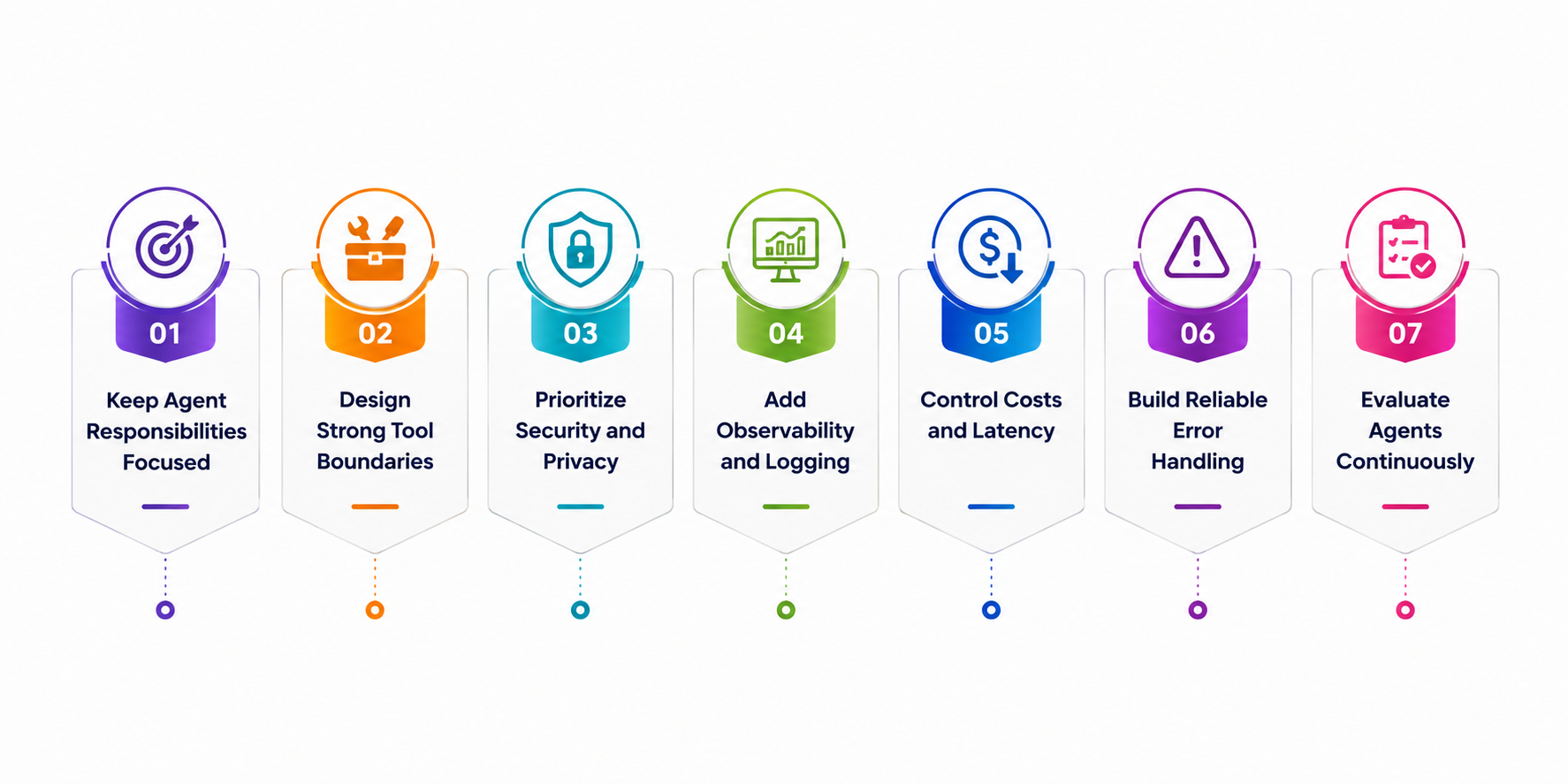
Moving an agent from a prototype to a production environment requires careful architecture and operational planning. Developers should focus on reliability, security, observability, cost management, and controlled autonomy. The following practices can help organizations create agents that remain dependable as usage and complexity increase.
1. Keep Agent Responsibilities Focused
Avoid creating one agent that attempts to perform every business function. Define focused responsibilities and provide only the tools required for those responsibilities. Specialized agents are generally easier to test, monitor, secure, and improve. For larger workflows, multiple specialized components can be coordinated through a structured architecture.
2. Design Strong Tool Boundaries
Every tool should have clearly defined inputs, outputs, permissions, and failure behavior. Avoid giving an agent unnecessary access to sensitive systems or unrestricted actions. Strong tool boundaries reduce operational risks and make it easier to understand exactly what the agent can and cannot do within a particular workflow.
3. Prioritize Security and Privacy
Agents may process confidential customer, financial, operational, or business information. Apply authentication, authorization, encryption, access controls, input validation, and appropriate data-retention policies. Sensitive actions should require additional controls where necessary. Security should be considered during architecture design rather than added only after the agent has been deployed.
4. Add Observability and Logging
Production agents require visibility into what they are doing. Track model responses, tool calls, failures, latency, costs, and task outcomes while respecting privacy requirements. Detailed observability helps development teams identify incorrect tool selection, repeated actions, unexpected workflows, and performance problems that may not appear during basic testing.
5. Control Costs and Latency
Agent workflows can involve multiple model calls and tool executions, which may increase both response time and operational costs. Use appropriate models for different tasks, limit unnecessary iterations, cache reusable information where suitable, and design efficient retrieval strategies. Cost monitoring should become part of ongoing production management.
6. Build Reliable Error Handling
External APIs can fail, databases can become unavailable, and users can provide incomplete information. Agents should have defined fallback behavior for these situations. Use retries where appropriate, validate tool responses, prevent endless loops, and escalate unresolved problems. Reliable error handling helps prevent small failures from becoming larger workflow disruptions.
7. Evaluate Agents Continuously
Agent quality should be measured using realistic business scenarios rather than occasional manual testing. Create evaluation datasets covering normal requests, edge cases, ambiguous instructions, tool failures, and unsafe actions. Regular evaluations help teams identify regressions after changing models, prompts, tools, retrieval systems, or agent workflows.
Conclusion
LangChain agents are helping developers move from basic AI chat experiences toward intelligent applications capable of reasoning through tasks, using external tools, accessing business information, and completing multi-step workflows. Their flexibility makes them valuable across customer service, sales, research, analytics, software development, document processing, and enterprise automation.
However, building a successful AI agent requires more than connecting a language model to a few tools. Businesses need clear objectives, well-designed architectures, secure integrations, effective prompts, reliable state management, monitoring, testing, and appropriate human oversight.
ToXSL Technologies, a leading AI development company, helps businesses explore and develop intelligent AI solutions designed around their unique operational requirements. From AI agents and automation workflows to custom AI applications and enterprise integrations, our team can help transform AI concepts into practical, scalable digital solutions that deliver measurable business value.
Ready to build an intelligent AI agent for your business? Connect with ToXSL Technologies and turn your AI vision into a powerful, production-ready solution.
Frequently Asked Questions
1. What are LangChain agents?
LangChain agents are AI-powered applications that use language models to make decisions and interact with external tools. They can understand objectives, select appropriate actions, retrieve information, execute tasks, and generate responses. Unlike basic chatbots, agents can dynamically determine what steps are needed to accomplish a user's request.
2. What is the difference between a LangChain chain and an agent?
A chain generally follows a predefined sequence of operations, while an agent can dynamically decide which tool or action to use based on the task. Chains are useful for predictable workflows, whereas agents are better suited to situations where the required steps may change according to user input or intermediate results.
- Chains follow fixed sequences
- Agents choose actions dynamically
- Chains suit predictable workflows
- Agents handle flexible, multi-step tasks
3. Can LangChain agents connect to business APIs?
Yes. LangChain agents can be designed to work with external APIs and business systems through tools. Depending on the implementation, an agent can interact with CRM platforms, databases, search services, analytics systems, internal applications, and other APIs while following defined permissions and validation rules.
- Connect with CRM and ERP systems
- Access databases and internal applications
- Integrate search and analytics APIs
- Execute authorized business operations
4. Do LangChain agents have memory?
LangChain-based applications can maintain state and conversation context depending on their architecture. Developers can determine what information should be retained, for how long, and where it should be stored. Memory and state are particularly useful for multi-step workflows and conversations that require relevant information from earlier interactions.
- Store relevant conversation context
- Maintain information during multi-step tasks
- Retrieve previously stored information
- Support more personalized interactions
5. Are LangChain agents suitable for enterprise applications?
Yes. LangChain agents can be used as part of enterprise AI solutions when they are designed with appropriate security, authentication, authorization, monitoring, testing, and governance. Enterprises should carefully control tool permissions, sensitive data access, model usage, and high-impact actions before deploying agents in production environments.
- Implement authentication and authorization
- Protect sensitive business information
- Monitor agent activities and performance
- Add human approval for critical actions
6. What programming languages can be used with LangChain?
LangChain provides support for popular development environments, including Python and JavaScript/TypeScript. The choice depends on the existing technology stack, development team's expertise, integration requirements, and deployment architecture. Developers can use these ecosystems to create LLM-powered applications, retrieval systems, tool integrations, and agent workflows.
7. How can businesses get started with LangChain AI agents?
Businesses should begin by identifying a specific workflow where an AI agent can provide measurable value. Next, define the required tools, data sources, integrations, security controls, and success metrics. Working with an experienced AI development team can help organizations design, develop, test, deploy, and continuously optimize production-ready LangChain agent solutions.