









































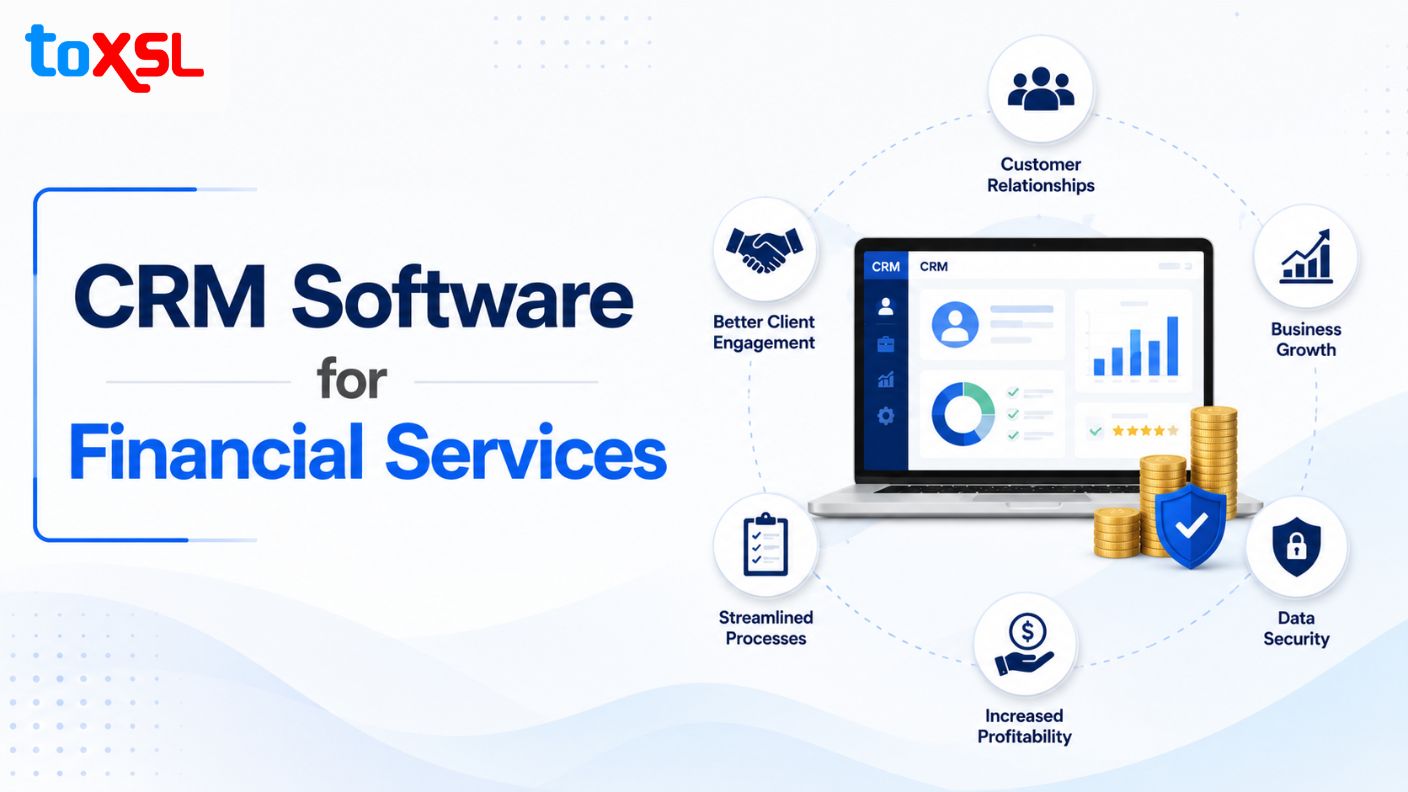
Customer expectations in the financial industry have changed dramatically over the last few years. Clients now expect personalized services, faster responses, secure communication, and seamless digital experiences across every touchpoint. Whether it is banking, insurance, wealth management, lending, or fintech, financial institutions must build stronger customer relationships while managing compliance, security, and operational efficiency.
This is where CRM (Customer Relationship Management) software for financial services plays a critical role. Modern CRM solutions go beyond storing customer information. They leverage automation, artificial intelligence, predictive analytics, and omnichannel communication to help organizations improve customer engagement, increase revenue, reduce operational costs, and maintain regulatory compliance. From tracking every customer interaction to automating workflows and providing data-driven insights, CRM software has become an essential investment for financial organizations seeking sustainable growth.
In this comprehensive guide, you'll discover how CRM software is transforming financial services, its benefits, must-have features, implementation considerations, future trends, development costs, and much more.
Key Takeaways
- CRM software centralizes customer information, making financial services more personalized and efficient.
- AI-powered CRM helps automate customer interactions, sales processes, compliance management, and reporting.
- Financial CRM improves customer retention through personalized communication and proactive engagement.
- Emerging technologies such as predictive analytics, cloud computing, and automation are redefining CRM capabilities.
- Choosing the right CRM development partner ensures scalability, security, compliance, and long-term business success.
Market Stats of CRM Software for Financial Services
- The CRM market is expected to surpass USD 249 billion by 2033, growing at a CAGR of over 12%.
- More than 90% of financial organizations now use CRM solutions to manage customer relationships.
- Financial institutions using AI-powered CRM report up to 40% improvement in customer engagement.
- Nearly 75% of banking executives consider CRM a strategic investment for digital transformation.
- Cloud-based CRM deployments account for over 70% of new CRM implementations globally.
- Financial institutions using CRM automation reduce manual administrative work by nearly 30–40%.
What is Financial CRM?
A Financial Customer Relationship Management (CRM) system is designed specifically for banks, insurance companies, wealth management firms, credit unions, mortgage providers, and fintech businesses to efficiently manage customer interactions, automate processes, and deliver personalized financial experiences.
Unlike traditional CRM software, Financial CRM integrates customer data, financial records, compliance management, communication tools, and analytics into a single platform. This allows financial institutions to improve customer satisfaction, streamline operations, enhance security, and make data-driven decisions while maintaining regulatory compliance.
Top Benefits of Financial CRM for Modern Financial Institutions
In the financial services industry, delivering exceptional customer experiences while maintaining compliance and operational efficiency is essential for long-term success. A Financial Customer Relationship Management (CRM) system empowers banks, insurance providers, investment firms, wealth managers, credit unions, and fintech companies to streamline customer interactions, automate business processes, and gain valuable insights from customer data.
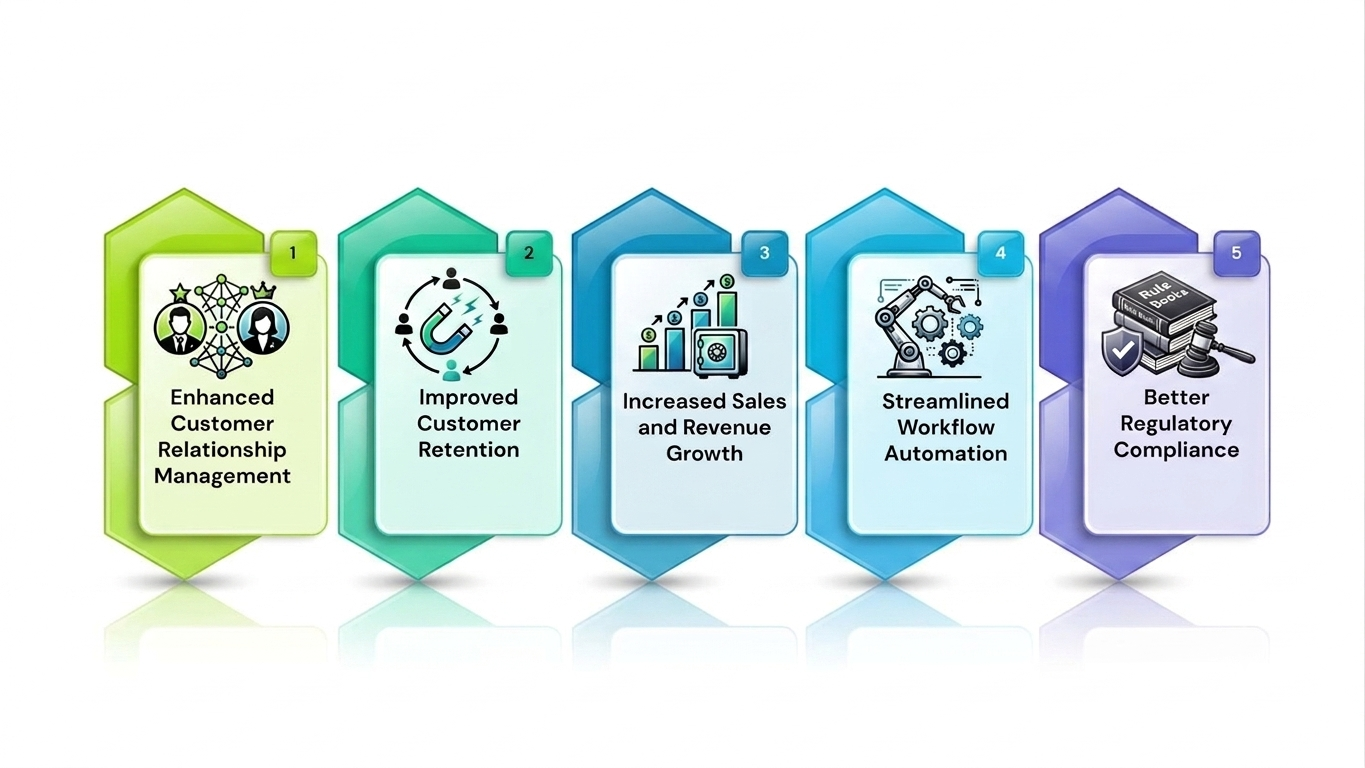
1. Enhanced Customer Relationship Management
Financial CRM enables organizations to build stronger and longer-lasting customer relationships by maintaining a complete history of interactions, financial preferences, and service requests. This allows advisors to deliver personalized experiences, strengthen trust, and improve customer satisfaction throughout the entire client lifecycle.
Key Benefits:
- 360-degree customer profiles
- Personalized financial services
- Stronger customer engagement
- Improved customer loyalty
- Better relationship management
2. Improved Customer Retention
Retaining existing customers is significantly more cost-effective than acquiring new ones. Financial CRM helps businesses proactively engage clients through personalized communication, timely follow-ups, and tailored financial recommendations, reducing customer churn and increasing long-term customer value.
Key Benefits:
- Personalized follow-ups
- Customer loyalty programs
- Reduced churn rate
- Higher client satisfaction
- Increased lifetime value
3. Increased Sales and Revenue Growth
Financial CRM streamlines lead management, sales tracking, and opportunity management, enabling sales teams and relationship managers to identify high-value prospects, automate follow-ups, and close deals more efficiently while maximizing revenue opportunities.
Key Benefits:
- Better lead management
- Improved conversion rates
- Sales pipeline visibility
- Revenue forecasting
- Faster deal closures
4. Streamlined Workflow Automation
Manual administrative tasks can slow down operations and increase the risk of human error. Financial CRM automates routine processes such as appointment scheduling, reminders, document approvals, customer onboarding, and follow-up communications, allowing teams to focus on strategic activities.
Key Benefits:
- Automated workflows
- Reduced manual tasks
- Faster approvals
- Improved operational efficiency
- Higher employee productivity
5. Better Regulatory Compliance
Financial institutions must comply with strict industry regulations and data privacy standards. Financial CRM helps maintain compliance by securely managing customer records, tracking audit trails, monitoring documentation, and automating compliance-related workflows to reduce legal and operational risks.
Essential Features of Financial CRM Software
Financial institutions require more than a standard customer management system to handle complex client relationships, regulatory requirements, and financial operations. A Financial CRM is specifically designed to streamline customer interactions, automate workflows, improve compliance, and provide valuable insights that drive business growth.
From managing customer data and monitoring sales opportunities to ensuring regulatory compliance and delivering personalized services, Financial CRM software offers a comprehensive set of features that help financial organizations improve efficiency and customer satisfaction.
1. 360-Degree Customer View
A Financial CRM provides a complete overview of every customer by consolidating personal information, transaction history, investment portfolios, communication records, service requests, and financial goals into a single dashboard. This enables advisors to make informed decisions and deliver personalized financial services.
2. Contact and Relationship Management
Managing long-term customer relationships is critical in the financial sector. Financial CRM helps institutions track customer interactions, schedule follow-ups, manage appointments, and maintain strong relationships throughout the customer lifecycle, resulting in better engagement and retention.
3. Lead and Opportunity Management
Financial CRM allows organizations to capture, qualify, and manage leads efficiently. It provides visibility into the sales pipeline, helping advisors prioritize opportunities, nurture prospects, and improve conversion rates through structured sales processes.
4. Workflow and Process Automation
Automation reduces manual workload and improves operational efficiency by handling repetitive tasks such as document approvals, email communications, appointment reminders, customer onboarding, and internal approvals without constant human intervention.
5. Compliance and Regulatory Management
Financial organizations must comply with strict regulations and reporting requirements. Financial CRM includes tools to manage compliance processes, maintain audit trails, track customer consent, and ensure proper documentation to reduce risks and simplify regulatory audits.
6. Document Management System
Financial CRM securely stores and organizes important documents such as contracts, KYC records, loan applications, investment reports, insurance policies, and customer agreements, making document retrieval faster and more efficient.
7. Customer Communication Management
Effective communication is essential for building trust with customers. Financial CRM centralizes communication channels and enables organizations to manage emails, calls, SMS messages, and customer interactions from a single platform.
How to Choose the Right CRM Software for Financial Services
Selecting the right Customer Relationship Management (CRM) software is a strategic decision that directly impacts customer satisfaction, operational efficiency, regulatory compliance, and long-term business growth. Below are the key factors to consider when choosing the ideal CRM solution for your financial services organization.
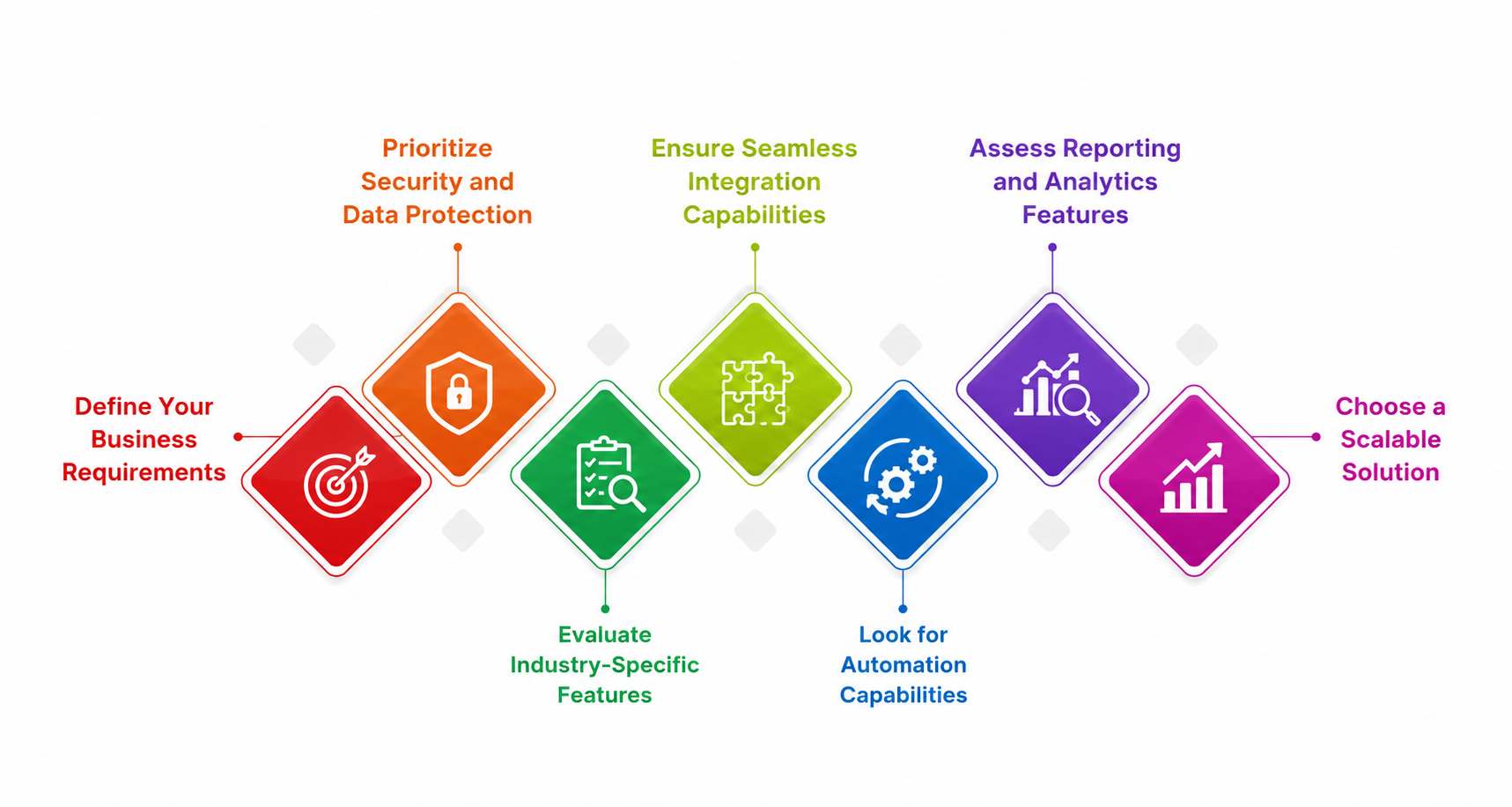
1. Define Your Business Requirements
Before evaluating CRM solutions, identify your organization's specific goals, operational challenges, customer expectations, and compliance requirements. Understanding your business needs helps you select a CRM that supports your current processes while accommodating future growth and evolving financial services.
Key Considerations:
- Business objectives
- Customer management needs
- Workflow requirements
- Compliance expectations
- Long-term growth plans
2. Prioritize Security and Data Protection
Financial institutions manage highly confidential customer and financial data, making security a top priority. Choose a CRM that offers enterprise-grade security features to protect sensitive information and comply with financial industry regulations and privacy standards.
Key Considerations:
- End-to-end data encryption
- Multi-factor authentication
- Role-based access control
- Secure cloud infrastructure
- Regulatory compliance support
3. Evaluate Industry-Specific Features
A generic CRM may not address the unique operational requirements of financial organizations. Look for a solution specifically designed for banking, insurance, lending, investment management, or fintech to improve efficiency and customer service.
Key Considerations:
- Client portfolio management
- KYC and compliance tracking
- Financial reporting
- Risk management tools
- Customer lifecycle management
4. Ensure Seamless Integration Capabilities
The CRM should integrate smoothly with your existing software ecosystem, including core banking systems, accounting platforms, payment gateways, ERP solutions, document management systems, and communication tools to eliminate data silos and improve operational efficiency.
Key Considerations:
- Core banking integration
- ERP connectivity
- Accounting software integration
- Payment gateway support
- API availability
5. Look for Automation Capabilities
Automation significantly improves productivity by reducing repetitive manual tasks. A Financial CRM should automate lead management, customer onboarding, approvals, follow-ups, reporting, and communication, allowing employees to focus on higher-value customer interactions.
Key Considerations:
- Workflow automation
- Automated reminders
- Lead nurturing
- Task scheduling
- Email automation
6. Assess Reporting and Analytics Features
Data-driven decision-making is essential in the financial sector. Choose a CRM that offers customizable dashboards, advanced reporting, predictive analytics, and performance monitoring to help managers make informed strategic decisions and identify business opportunities.
Key Considerations:
- Real-time dashboards
- Customer insights
- Sales reporting
- Revenue forecasting
- Predictive analytics
7. Choose a Scalable Solution
As your financial institution grows, your CRM should be capable of supporting additional users, increased customer data, new services, and advanced functionalities without compromising performance or security.
Key Considerations:
- Cloud scalability
- Flexible architecture
- Performance optimization
- Future feature expansion
- Multi-branch support
How Much Does It Cost to Develop CRM Software for Financial Services?
The cost of developing a CRM for financial services depends on several factors, including the project's complexity, required features, customization level, third-party integrations, security requirements, compliance standards, deployment model, and the experience of the development team. A basic CRM with essential customer management features is significantly more affordable than an enterprise-grade platform that includes AI-powered analytics, workflow automation, cloud infrastructure, and advanced security capabilities.
Financial institutions should also consider additional expenses such as UI/UX design, API integrations, data migration, testing, deployment, employee training, and ongoing maintenance. Investing in a scalable and secure CRM solution can improve operational efficiency, strengthen customer relationships, and generate a strong return on investment over time.
CRM Type | Estimated Cost (USD) | Development Timeline | Best For |
|---|---|---|---|
Basic Financial CRM | $15,000 – $30,000 | 2–4 Months | Startups and small financial firms needing core CRM functionality |
Standard CRM with Custom Features | $30,000 – $60,000 | 4–6 Months | Growing businesses requiring workflow automation and reporting |
Advanced Financial CRM | $60,000 – $100,000 | 6–8 Months | Mid-sized organizations needing integrations, analytics, and compliance tools |
Enterprise Financial CRM | $100,000 – $180,000 | 8–12 Months | Banks, insurance companies, and large financial institutions |
AI-Powered Financial CRM | $150,000 – $250,000+ | 10–14 Months | Organizations seeking predictive analytics, intelligent automation, and personalized customer experiences |
Enterprise CRM with Custom Integrations | $200,000 – $350,000+ | 12–18 Months | Large enterprises requiring complex workflows, multiple third-party integrations, and high scalability |
The Future of CRM Development in Financial Services
The future of Financial CRM is centered around delivering intelligent, personalized, and highly secure customer experiences. As digital transformation accelerates, CRM platforms will continue evolving with artificial intelligence, automation, predictive analytics, and cloud-native technologies to help financial institutions improve efficiency, strengthen customer relationships, and remain competitive in an increasingly data-driven market.
1. Hyper-Personalized Customer Experiences
Future CRM platforms will use artificial intelligence, behavioral analytics, and real-time financial insights to deliver highly personalized recommendations, communications, and financial solutions tailored to each customer's unique needs and preferences.
2. AI-Driven Decision Intelligence
Artificial Intelligence will become a strategic decision-making assistant by analyzing massive datasets, identifying trends, and providing actionable recommendations. Financial institutions will use AI-powered CRM systems to improve forecasting, reduce risks, and enhance operational performance.
3. End-to-End Workflow Automation
Automation technologies will continue eliminating repetitive manual tasks across financial operations. Future CRM solutions will automate customer onboarding, compliance management, approvals, reporting, and customer communications with minimal human intervention.
4. Predictive and Prescriptive Analytics
Future CRM platforms will not only predict customer behavior but also recommend the best actions to improve customer retention, increase revenue, and optimize financial services through intelligent, data-driven decision support.
5. Cloud-Native CRM Ecosystems
Cloud-native architecture will become the standard for Financial CRM, enabling organizations to scale quickly, integrate new technologies, and securely access customer information across multiple branches and devices without infrastructure limitations.
6. Voice-Enabled and Conversational CRM
Voice recognition and conversational AI will make CRM systems more intuitive by allowing financial professionals and customers to interact using natural language, improving accessibility, efficiency, and customer convenience.
Conclusion
As customer expectations continue to evolve, financial institutions must embrace technologies that enable personalized experiences, operational efficiency, and regulatory compliance. Financial CRM software has become an essential business tool, helping banks, insurance providers, wealth management firms, credit unions, and fintech companies centralize customer data, automate workflows, improve decision-making, and strengthen long-term customer relationships.
At ToXSL Technologies, we specialize in developing secure, scalable, and feature-rich CRM solutions tailored to the unique requirements of the financial services industry. Our experienced development team builds customized CRM platforms that streamline operations, enhance customer engagement, ensure regulatory compliance, and support business growth. Contact today to know more.
Frequently Asked Question
1. What is a Financial CRM?
A Financial CRM is a specialized Customer Relationship Management system designed for banks, insurance companies, wealth management firms, lenders, and fintech businesses. It helps organizations manage customer relationships, automate business processes, and deliver personalized financial services.
- Centralizes customer information
- Manages client interactions
- Automates financial workflows
- Supports regulatory compliance
- Improves customer engagement
2. Why do financial institutions need CRM software?
Financial institutions use CRM software to strengthen customer relationships, improve operational efficiency, automate repetitive tasks, and gain valuable insights that support business growth and informed decision-making.
- Enhances customer satisfaction
- Improves customer retention
- Streamlines daily operations
- Increases employee productivity
3. What are the essential features of Financial CRM software?
A Financial CRM includes industry-specific features that simplify customer management, improve collaboration, automate operations, and ensure data security while supporting regulatory compliance.
- 360-degree customer view
- Workflow automation
- AI-powered analytics
- Omnichannel communication
- Advanced security controls
4. How much does Financial CRM development cost?
The cost of developing Financial CRM software varies depending on business requirements, customization, integrations, and technology stack. Projects typically range from $15,000 to $350,000+.
- Feature complexity
- Custom UI/UX design
- Third-party integrations
- AI and automation capabilities
- Cloud infrastructure
5. How does AI improve Financial CRM solutions?
Artificial Intelligence enhances Financial CRM by automating business processes, analyzing customer behavior, and providing intelligent recommendations that improve efficiency and customer experiences.
- Predictive analytics
- Smart customer segmentation
- AI chatbots and virtual assistants
- Fraud detection
- Intelligent lead scoring